
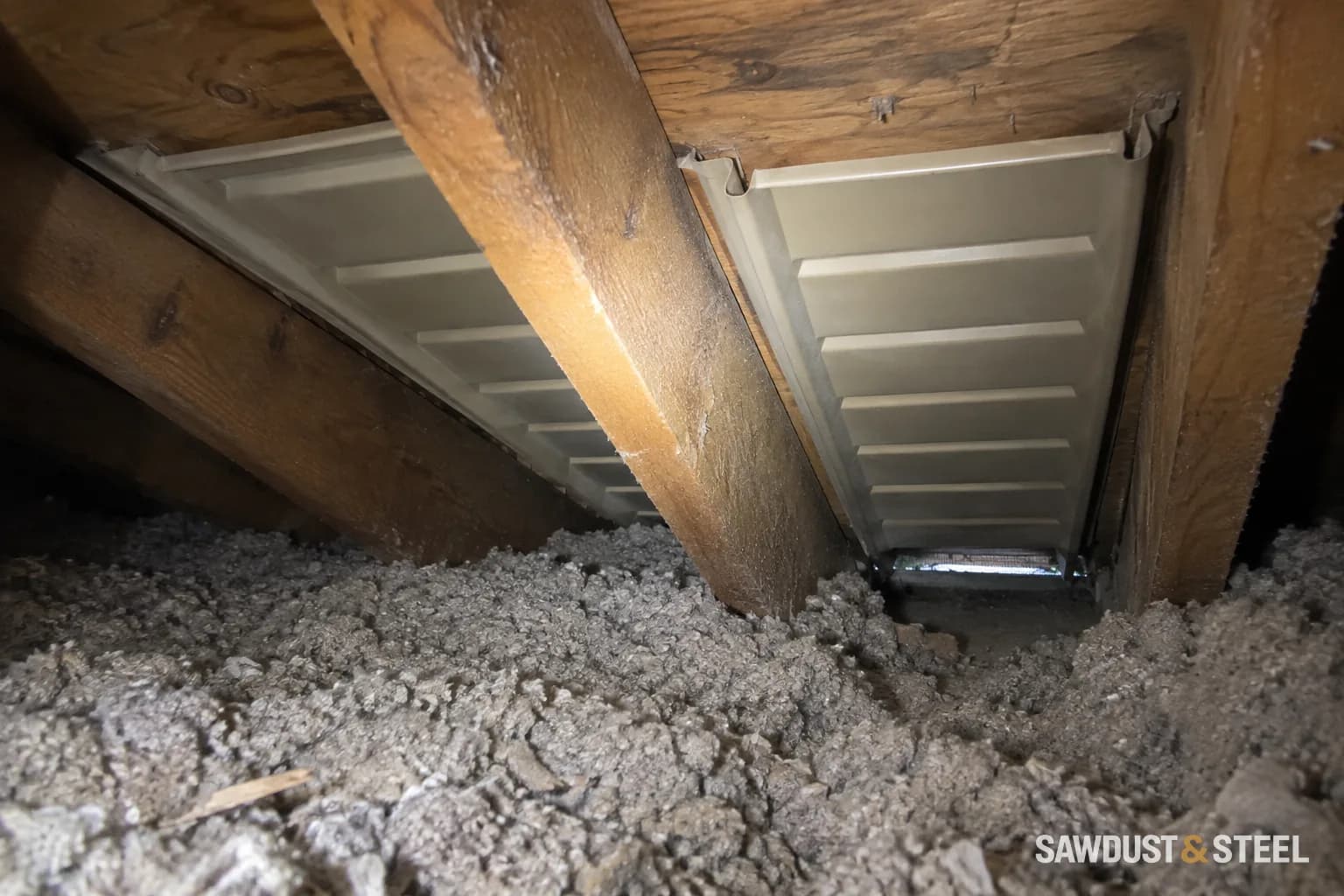
You've paid for more attic insulation, so a deeper blanket looks like good news. The awkward bit is right out at the eaves, where that same insulation can block the air route you're trying to preserve.
In a vented attic, the insulation and the incoming air need room to do different jobs. Piling one into the other's route is not an upgrade.
What a baffle actually does
A baffle maintains a passage near the eaves between the insulation and the underside of the roof. Natural Resources Canada's attic guidance describes preserving ventilation openings and keeping insulation from spreading over vented soffits.
The important word is passage. We've opened up an eave where the new baffle looked fine from the hatch, but old insulation was still packed across its lower end. The installer had added a channel without clearing its entrance. Before the top-up, we had the intake checked and the obstruction resolved. Ask for a photo of that junction, not just a row of tidy channels farther up the roof.
Separate the roof-side and room-side work
| Part of the path | What needs to be visible |
|---|---|
| Outdoor intake | The soffit opening actually admits air; a perforated new cover over a solid old soffit does not establish that. |
| Lower end of the baffle | Insulation or debris is not packed across the entrance. |
| Channel above the insulation | The baffle remains open rather than flattened or buried at its upper end. |
| Insulation at the wall edge | The insulation covers the top of the exterior wall without filling the intended ventilation passage. |
NRCan's vented-attic detail, Figure 5-11, shows the route from soffit to attic above the insulation. Its batt-insulation guidance describes a 38 to 50 mm space below the roof sheathing. Have the installer show the detail required for your roof and baffle system; that example does not establish the entire vent-area design or apply to an unvented roof.
Ventilation concerns the intended outdoor air route through a vented attic. Air sealing concerns leaks from the house into that attic. NRCan's air-leakage guide addresses those ceiling penetrations and connections.
A new baffle does not seal a leaky hatch or a plumbing penetration. More insulation does not establish that the air barrier beneath it is continuous. We separate that preparation from the blowing work in the scope: what gets sealed, what stays clear, and what gets photographed. Otherwise the quickest part of the job can bury the unfinished part.
Read the eave section from outdoors inward
Outside: soffit intake
Clear intake: an opening connects outdoors to the channel.
Wall top: insulation edge
Insulation covers the wall top without blocking the intake.
Under roof: baffle
The channel stays open above the insulation.
Below insulation: ceiling air barrier
Seal house-air leaks separately from the ventilation route.
Conceptual vented-eave section, read outside to inside. Not an unvented-roof detail or a universal ventilation-area calculation.
Ask for a wide photograph that locates the eave and a closer view of the lower channel entrance. A photo of the upper end alone cannot tell you whether outside air can reach it. If several roof shapes meet, ask which representative areas were checked rather than accepting one convenient bay as proof of the whole perimeter.
The installer should explain how the channel remains open during the top-up. Loose insulation moved by the hose can undo earlier preparation unless the retaining detail is complete. Record what was corrected before the new material arrives, then obtain a completion photo from the same location.
If the attic still develops frost after a channel repair, do not assume the next step is more vents. Review moisture sources and ceiling leakage with the assessor. The hatch seal is one accessible part of that separate air-barrier check.
Ask for evidence before the top-up
- Photos showing representative eave conditions and the actual intake route.
- Identification of blocked, missing, or damaged channels where relevant.
- The proposed baffle and insulation detail at the roof edge.
- Air-sealing work needed before the new insulation hides access.
- Confirmation that exhaust ducts terminate outdoors rather than in the attic.
Request photographs from the installer instead of entering a cramped attic yourself. Ceiling finishes are not a safe walking surface, and access can expose wiring or other hazards.
Do not redesign the attic from one photograph
Some roofs use an unvented assembly or have construction details that need a different approach. Establish the intended roof design before adding vents or cutting openings.
Before the installer packs up, ask to see the eave photos and the completed preparation list. You should be able to point to the clear air route and understand what was sealed below the insulation. From the hatch, a finished top-up can look much the same whether those details were handled or buried.
Before the insulation delivery, also resolve recessed-light contact ratings and air sealing; those details are separate from the eave air route.