
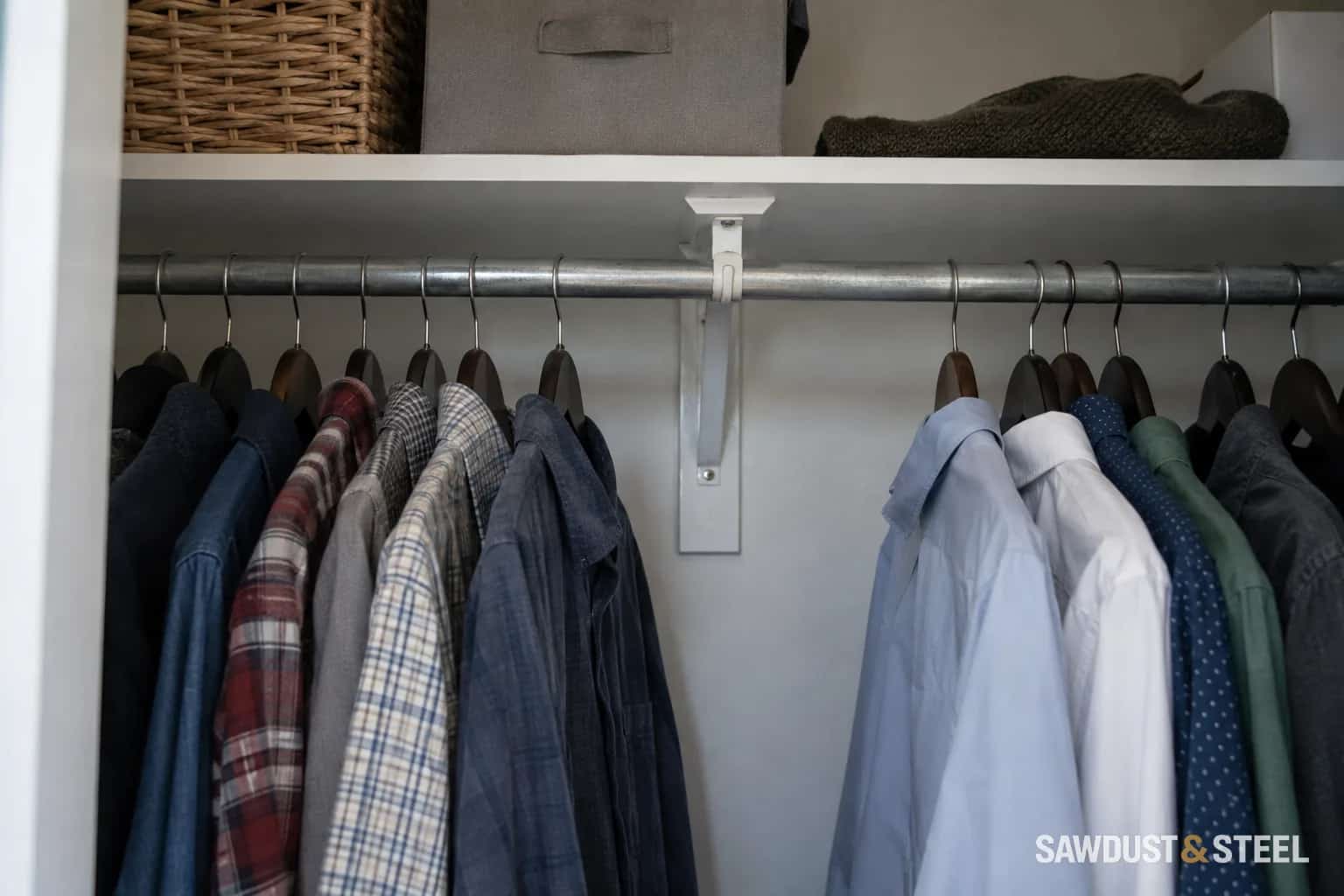
A closet rod usually fills up a hanger at a time, so the extra weight is easy to miss. Then the centre drops, the hangers slide inward and the entire winter wardrobe gathers in one place. Take the load off before deciding whether you need a stronger rod or a better attachment.
Watch what returns to position when it is empty
If the rod straightens but the brackets remain firm, the span and loading deserve attention. If a socket has tilted, its screws have loosened or the wall finish has cracked, repair that connection too. A rod that stays bowed when unloaded should not simply be forced straight and put back with the same contents.
Load ratings belong to an exact system. IKEA's 50 cm KOMPLEMENT rail identifies the compatible wardrobe frame and states that its rating assumes evenly distributed loading. That is not a rating for a longer generic tube held in different sockets. ClosetMaid's installation guidance likewise distinguishes its matching shelves, rod supports and brackets.
Observe the empty assembly
Span or rod
Rod bends; sockets stay firm
Review the rod model, span, loading and need for its compatible intermediate support.
Connection
Sockets or brackets move
Restore the attachment to suitable backing before reloading.
Shared support
Shelf above bends too
Assess the complete shelf-and-rod assembly instead of adding a bracket to a weak shelf.
Put the support where it can work
A centre support has to suit the rod shape and attach as the manufacturer intends. Some connect to a wall cleat, others to shelving or a proprietary track system. Make sure that supporting component is designed for the transferred load. A thin shelf held by a few pins is not automatically a useful anchor for a heavily loaded rod.
Consider how hangers will move past the support. A divided hanging run can be perfectly practical if each side has a purpose: coats on one side, short jackets on the other. Place the division deliberately rather than hiding it behind the most-used garments. Measure the hanger drop and preserve room for shelves or drawers below.
Sometimes two shorter runs work better
If the closet was intended for shirts and now stores heavy coats, splitting the run may be more sensible than chasing an ever-larger tube. A vertical divider can create a useful shelf bay, but its connections and support still need to be designed. See closet shelf depth before giving every remaining centimetre to shelves.
After repairing, reload within the system's limits and spread the weight. Leave space to lift hangers off without levering the rod upward. If the wall attachment is uncertain, have it checked before returning the load. A rod that looks straight for five minutes is not evidence that a damaged fixing has recovered.