
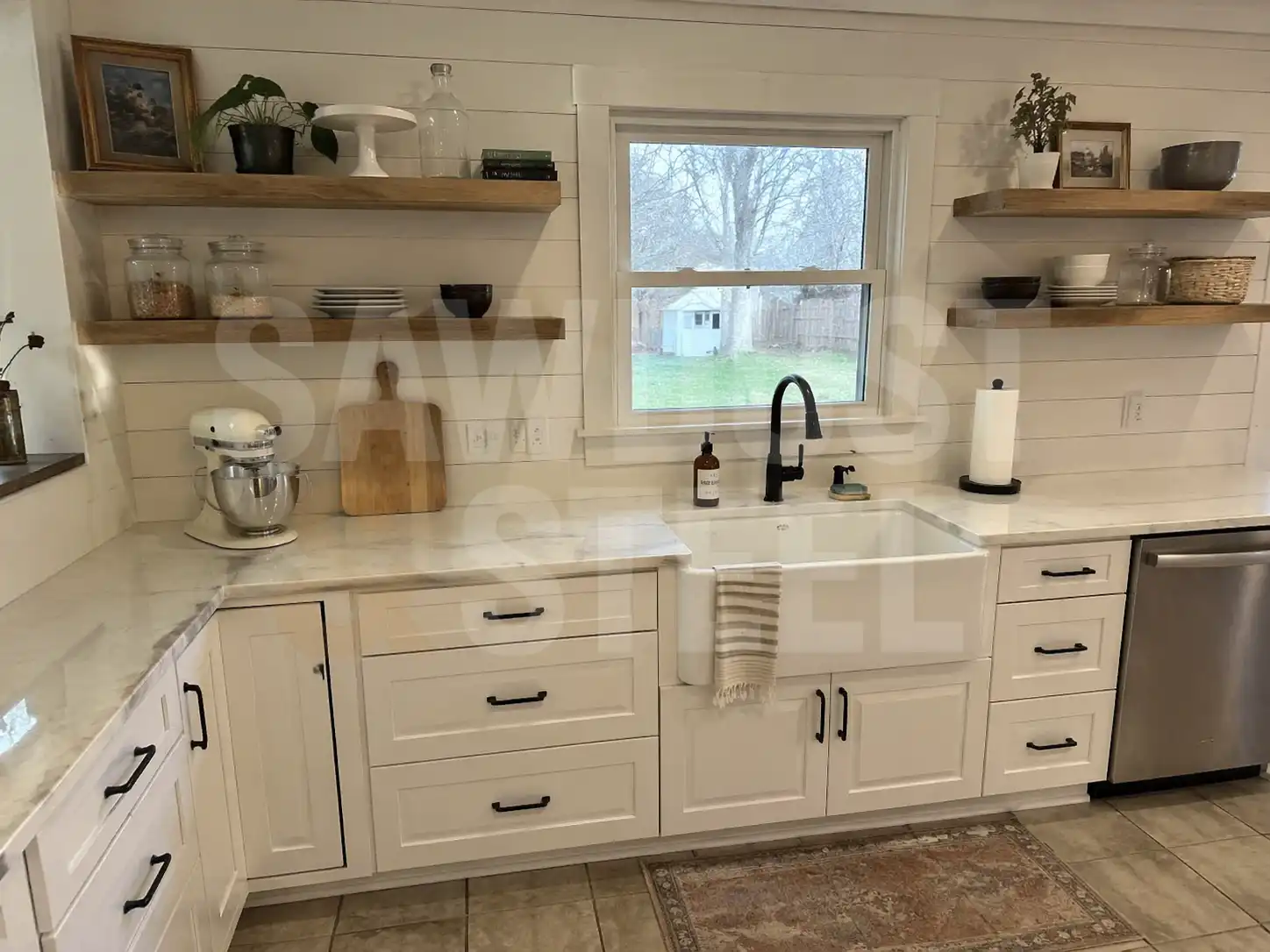
A deep sink can hide a baking tray beautifully. It can also make washing a teaspoon feel like reaching into a well. Before choosing the deepest bowl that fits the cabinet, test where your hands will spend their time.
Sink depth is only one measurement. Finished counter height, mounting style, the position of the drain and your usual washing task all affect comfort. A person rinsing vegetables at the front of the bowl has a different reach from someone scrubbing a heavy pot against its bottom.
Start at the finished counter
Finished surface
Use the final countertop level as your standing reference.
Working bottom
Compare where your hands and heavy pans will sit.
Faucet and rear edge
Check forward reach as well as downward reach.
Drain below
Leave a feasible connection and access for service items.
Write down the height of the finished countertop, not the unfinished cabinet. Then read the sink drawing carefully: the published bowl depth may use a different reference point from the finished surface you will stand beside. An undermount installation puts its rim below the counter; a top-mounted sink has its own rim above it. Compare the resulting bottom position, not just two catalogue depth numbers.
BLANCO's sink buying guide treats sink selection as part of cabinet and countertop planning. Use that sequence here: choose a promising sink, check the drawing with the installer and confirm the complete installation before committing to the cutout.
For a simple reach test, use your current counter as the standing reference and mark the proposed bowl-bottom level beside it. A sturdy box or board positioned safely at that level can represent the work surface. Do not balance heavy cookware on a makeshift support. The point is to compare your posture, not build a temporary sink.
Try the job you do most often
Stand where you would normally wash up, in ordinary indoor footwear. Reach forward and down with relaxed shoulders. Pretend to hold the largest pan by both handles. If you have to lean your abdomen hard against the counter or keep your back bent to reach the bottom, a deeper bowl may be a poor everyday choice.
Repeat the test for everyone who regularly uses the sink. There may not be a perfect height for the entire household. In that case, prioritise the longest and heaviest task, then consider an approved raised accessory for lighter preparation. A bottom grid slightly changes the working surface but should not be expected to correct a fundamentally awkward reach.
Check front-to-back reach as well. A deep bowl pushed far back behind a wide counter edge can feel much harder to use than the same bowl near the front. The faucet controls should remain accessible without stretching over dishes. Ask to see the sink and tap together rather than approving them from separate pictures.
Test the awkward cookware
Measure a stockpot with its handles and a baking tray across its widest point. Depth alone does not guarantee either will fit. Bowl width, corner shape, divider position and faucet clearance are separate constraints. Our single-versus-double sink guide handles that configuration decision.
If your main reason for a deeper sink is hiding dishes, be honest about the trade. Concealing a pile is convenient, but you still have to retrieve the glass underneath it. A shallower bowl with enough width for a pan may serve you better than a narrow deep bowl that requires everything to stand upright.
Splashing also depends on faucet stream, pressure, bowl geometry and where water strikes. Do not assume an extra-deep bowl guarantees a dry counter. At a working showroom display, watch water hit both the empty bowl and a plate. That reveals more than tapping the sink with your knuckles.
Leave room for what happens underneath
Lowering the sink bottom lowers the drain connection. Ask the plumber to compare the proposed outlet and trap arrangement with the existing wall connection. The new bowl may conflict with a disposal unit where permitted, filter cartridge, pull-out bin or drawer. A deeper sink is not a reason to invent a cramped drain arrangement on installation day.
Put the actual filter replacement movement and shutoff access on the cabinet sketch. Being able to store a bottle beside a pipe is different from being able to remove a cartridge or turn a valve. Photograph the current cabinet before ordering and label anything you want to keep.
Choose the depth after this combined check: comfortable hands, usable cookware space, workable plumbing and accessible service items. If a shallower model passes all four and the deeper one only looks better in the catalogue, the decision is already doing itself.