
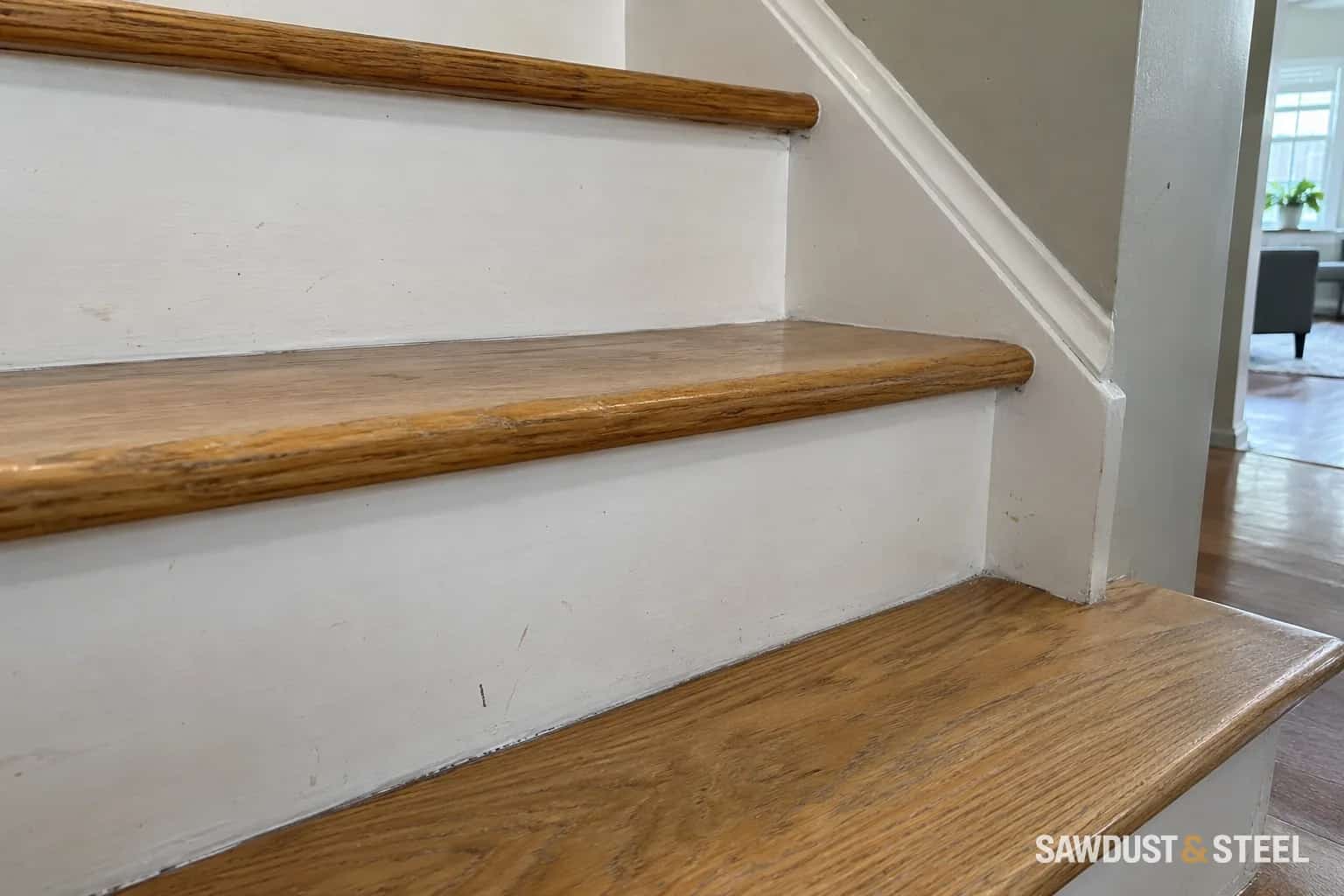
The staircase looks wide enough until the chair reaches the newel post, the knees pass the handrail and the front door opens across the proposed rail. A stairlift survey needs to follow the whole journey, not stop at one width measurement.
Measure from the obstructions
Stannah's dimensions guide distinguishes folded, unfolded and rail dimensions and explains that trim and handrails reduce usable width. Its measurements are examples for particular models and configurations. They are not a universal minimum for every lift, staircase or Ontario installation.
Record the narrowest passage, turns, intermediate landings, radiator projections and doors at the bottom and top. Photograph the stair from both ends. If the installer proposes removing a handrail, ask how safe everyday stair use and applicable requirements will be maintained. Other people still need to walk there.
The occupied chair is the important outline
A folded chair in a brochure looks compact. Ask the surveyor to demonstrate the occupied envelope, including the user's knees, feet and any relevant movement. Where practical, try the proposed seat and controls with suitable assistance. A person who can sit comfortably may still find a transfer difficult.
Confirm the intended user fits the model's capacity and seating arrangement. Ask how the seat belt, swivel and footrest are operated and whether those operations suit their strength, reach and dexterity. A perch-style or seated model is a functional choice that should be assessed for the person, not simply a way to squeeze equipment into narrow stairs.
Give the landings as much attention as the stairs
| Location | Check during the survey |
|---|---|
| Bottom | Rail projection, nearby door swing and a clear approach to the seat. |
| Top | Swivel position, transfer space and a route away from the stair edge. |
| Along the flight | Occupied clearance, remaining walking space and obstructions. |
| Parking and charging | Where the chair rests, how charging works and who can call it. |
Ask whether a retractable or curved rail is proposed to clear a doorway and how it operates. Make sure the solution works for the household when the lift is parked as well as moving. Avoid a plan that requires a loose mat, shopping bags and another person to move every time the lift is used.
Discuss interruptions before installation
Have the supplier explain charging points, battery maintenance, operation during a power interruption and what happens if the lift stops between floors. Get the model's actual instructions and service arrangements. Do not infer unlimited outage operation from the words battery powered, and do not improvise a rescue or carry a person on a moving chair.
Keep the stair support and fixing assessment in the installation scope. A loose handrail or unstable tread needs attention in its own right. If the layout cannot provide workable transfers or a usable stair route, compare main-floor living rather than forcing the equipment to fit.
An occupational therapist's assessment can help separate "the machine fits" from "this person can use it." Ask for the final drawing, dimensions, power arrangement and handover demonstration before accepting the order. The most valuable measurement may be the one that stops the wrong purchase.