
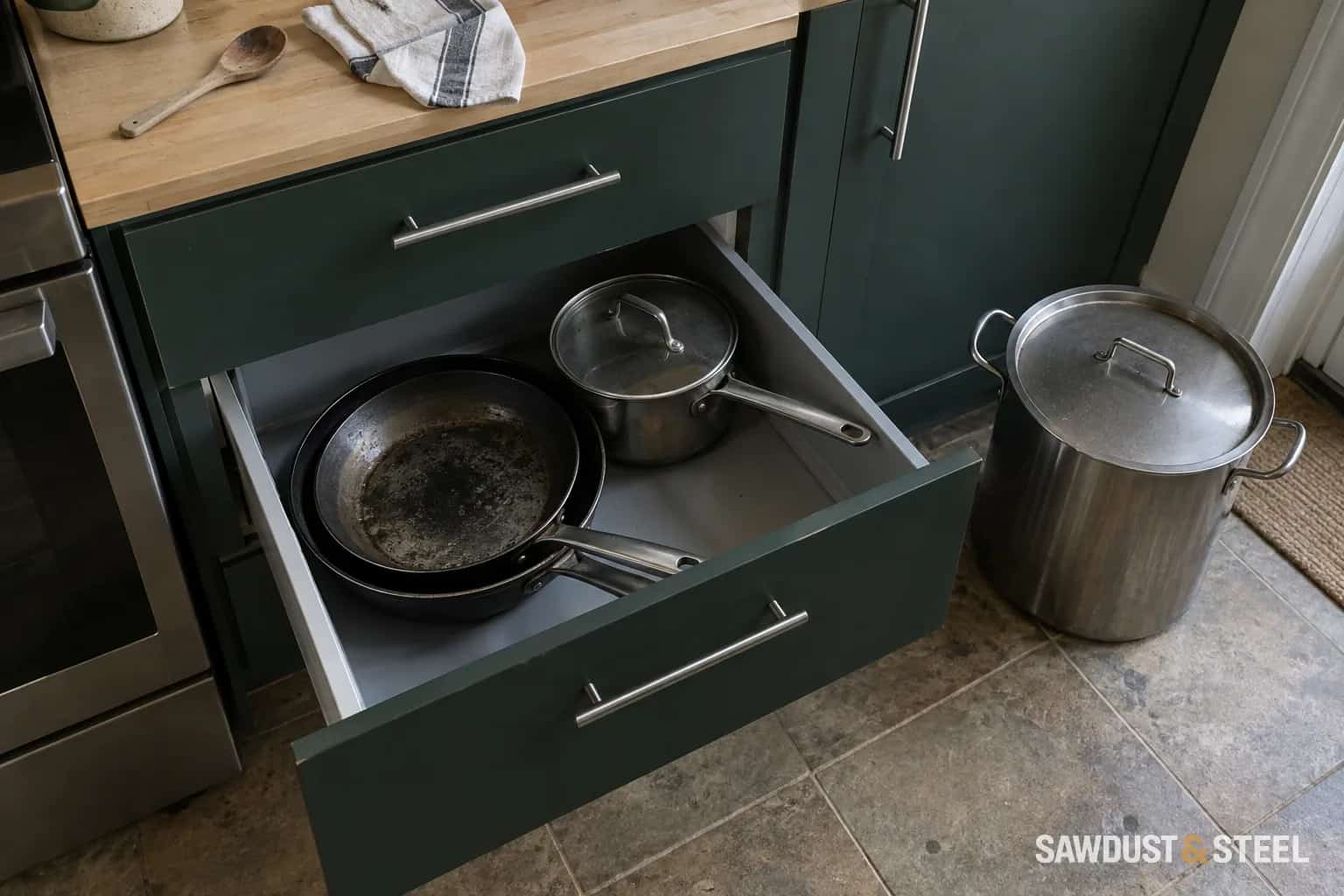
The useful question is not simply whether the bottom bends. It is what used to hold it up. Some bottoms sit in grooves around the drawer, some slide into three sides and fasten at the back, and some attach underneath. The correct repair preserves that construction instead of covering it with a random block of wood.
Look at the edges as well as the middle
Empty the drawer and remove it using the slide manufacturer's release instructions. Set it on a stable surface. Inspect all four edges of the bottom and check whether the drawer's corner joints have opened. A groove can appear too shallow because the side has pulled away; forcing the panel back without repairing that joint leaves the cause in place.
- One edge is loose but the panel is flat: inspect the retaining groove, back fixing and corner joints.
- The edges remain captured but the centre bows: the panel or its support arrangement is inadequate for the load or has deteriorated.
- The panel feels furry, swollen or soft: investigate moisture and replacement rather than disguising the damage.
- The whole box twists: repair the drawer structure before adjusting its front.
The space below the bottom already has a job
A reinforcing batten can foul concealed runners, release levers or the drawer below. Blum's runner installation resources show model-specific drawer construction and hardware clearances. Record the existing underside arrangement before buying a thicker panel or adding supports; a stronger bottom is little use if the drawer no longer fits.
Identify the original support
Trace the grooves, back fixing and joints that retain the bottom.
Restore or replace the failed part
Keep the box square and preserve the hardware's required clearances.
Test empty, then with normal contents
Watch for rubbing and renewed bowing before returning the drawer to daily use.
When a new bottom is enough
A sound drawer box with a damaged removable panel is a good candidate for a new bottom. Match its fit to the grooves and specify the material for the actual span and contents. There is no universal panel thickness for every drawer. Do not route deeper grooves into already thin sides simply to make an arbitrary sheet fit.
If the corners are loose, the grooves are broken or several past repairs have split the sides, compare the effort with a replacement box that retains the existing decorative front. Photograph and measure the front attachment before disassembly. A cabinetmaker can often preserve the visible kitchen while replacing the part doing the work.
Put back what the drawer can carry
Divide dense contents between suitable drawers rather than returning the entire cast-iron collection to the repaired panel. Confirm the runner capacity for the installed model and the drawer manufacturer's limits; use the lower applicable limit. If it now closes badly, use the soft-close fault checks before adjusting the runners. A rubbing repair can mimic a failed closer.