
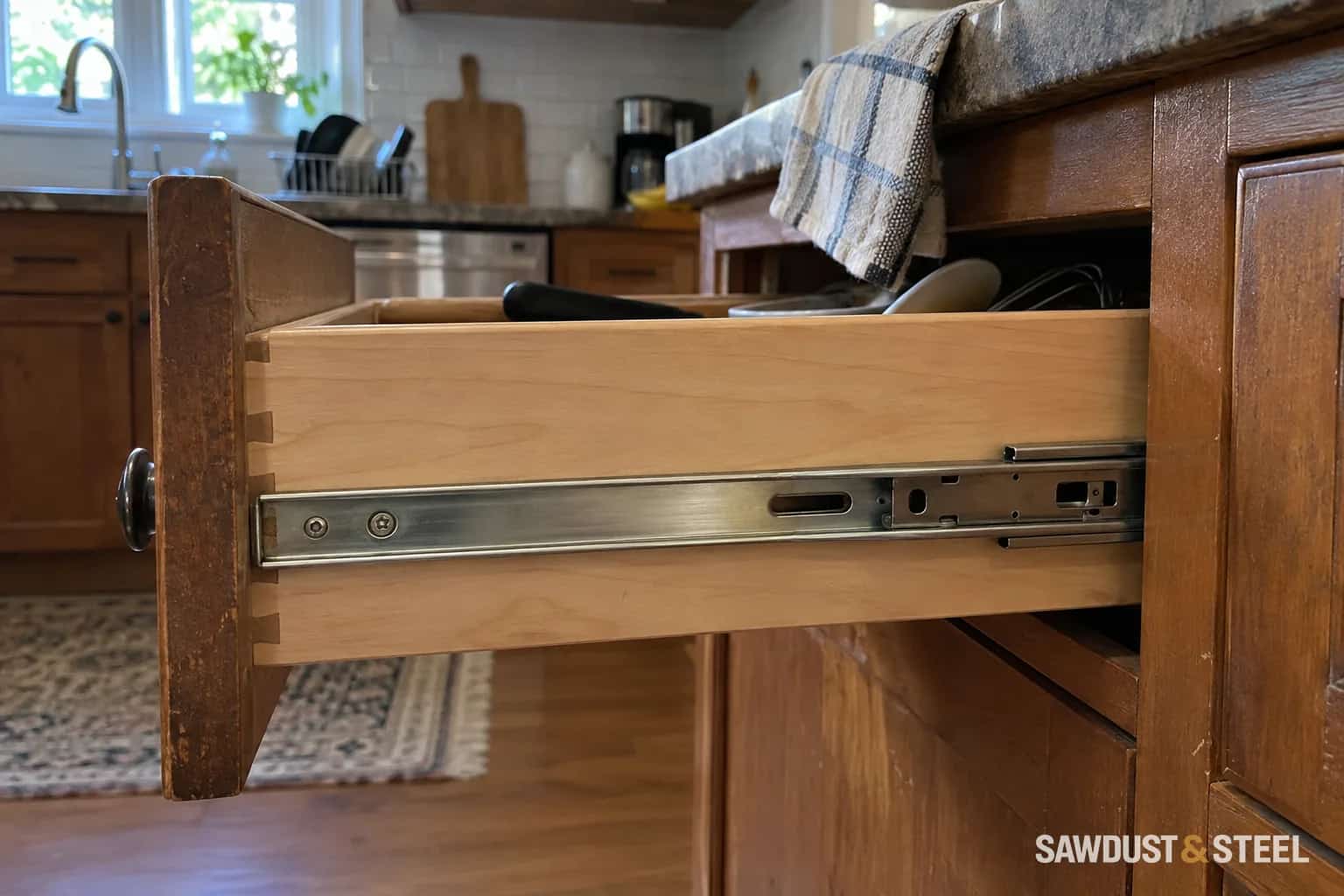
The last few centimetres tell you a lot. A drawer that glides normally and then stops dead has a different problem from one that scrapes throughout its travel. Note where it stops, whether both sides arrive together and whether it behaves differently empty. Stop slamming it: the catch is small, and extra force does not make the problem easier to diagnose.
Empty it before touching the adjusters
Remove the contents, including the liner if it has folded behind the box. Use a light to look above and behind the drawer without putting fingers into the moving hardware. Check for a utensil catching the cabinet rail, a loose screw, or a cable from an appliance. Close adjacent doors and drawers separately to see whether their fronts collide.
If empty operation is smooth but loaded operation is not, look for a bowed bottom, loose box joints or contents that rise above the drawer sides. A failing drawer bottom can rub the hardware even when the runners themselves remain sound. A hardware load rating is not permission to ignore the strength of the drawer box.
What happens with the drawer empty?
Hard stop
Stops sharply at one point
Look for a trapped object, screw or front touching the cabinet.
Uneven front
One side stays forward
Check that both sides are seated and retained on the identified runners.
Closer does not engage
Runs freely but no longer catches
Inspect the closing unit using its own service instructions.
Find the model before following a reset video
Side-mounted ball-bearing slides, concealed runners and push-to-open systems do not release or reset the same way. Photograph markings on both sides and the underside. Blum's MOVENTO resources provide separate installation and adjustment documents for the runner and its accessories. Use the sheet matching your hardware; an orange lever in a video does not identify every concealed runner.
Support the drawer before releasing it, and get help for a wide or heavy box. Follow the removal and reinstallation sequence rather than pulling harder when it resists. Once refitted, confirm the retention devices engage on both sides before loading it. Do not spray an unidentified damper with lubricant or try to dismantle a sealed closer.
Adjust alignment only after the box is seated
Take a photograph of the starting gaps. Change one permitted adjustment at a time and test the full travel. If the front has to be pushed sideways to shut, the issue may be runner alignment or a cabinet that has moved out of square. Turning every adjuster can hide that fault while creating another.
Broken plastic, a bent rail or a closer that no longer engages despite free movement usually calls for matched replacement parts. Send the supplier the model, runner length and photographs. Keep left and right parts identified. If several drawers changed together after a leak or renovation, check the cabinet before ordering a pile of closers.