
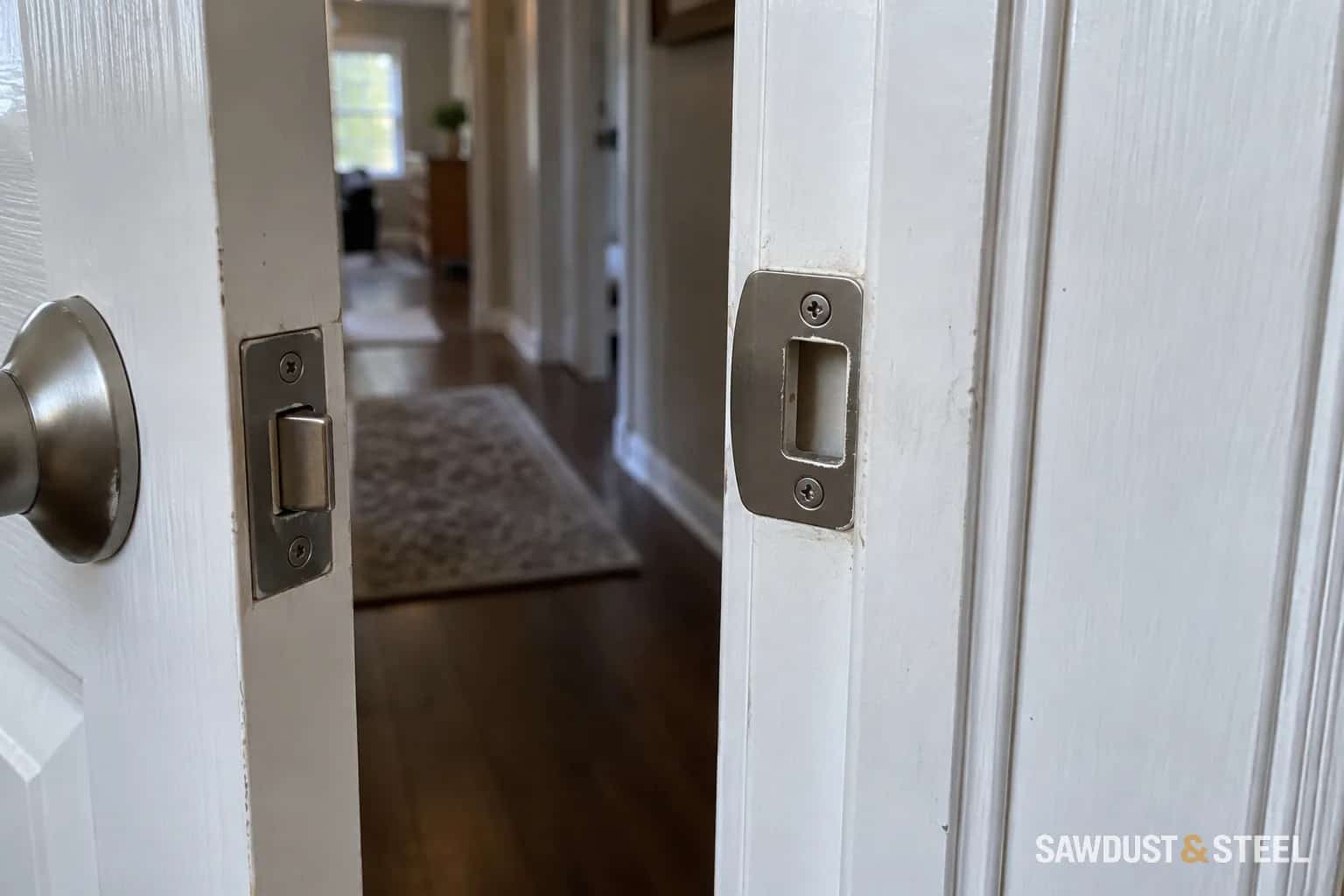
A bathroom lock should give someone privacy without turning a dropped toddler toy or a stuck button into a locked-room problem. Look at the function before the finish. Two handles that look identical can be passage, privacy or keyed-entry sets, and that difference matters more than whether the metal matches the towel rail.
Choose the function deliberately
A passage set latches but does not lock. A privacy set is intended for rooms such as bedrooms and bathrooms and commonly includes an outside emergency release. A keyed-entry set uses a different access arrangement. Read the exact specification; the handle's appearance is not enough to identify the function.
For a specific example, Schlage's Broadway F40 privacy lever locks with an inside push button, unlocks when the inside handle rotates, and can be released from outside with the included pin key. Those details describe that product. Other privacy locks may use a turn button, slot or different release action.
Try the release before installation
Find the outside release opening and use the supplied tool exactly as instructed while the hardware is accessible. Keep track of whether the action is a push, turn or other movement. Do not assume any thin object is an appropriate substitute; the mechanism can be damaged by forcing the wrong tool.
Choose a storage spot outside the bathroom that the adults in the household can readily reach and identify. The tool is no help in the vanity drawer behind the locked door. Keep the instructions or model information with household maintenance records so a replacement tool can be identified later.
| Function | What to check |
|---|---|
| Passage | Latches without locking |
| Privacy | Inside lock and documented outside emergency release |
| Keyed entry | Key access arrangement, not assumed privacy behaviour |
| Installed set | Free latch movement and reliable release with door open |
Measure the door preparation
Check door thickness, the main bore, the latch-edge preparation and backset, which is the distance from the door edge to the centre of the handle hole. Also compare the strike plate and latch shape. Reusing existing holes is convenient only when they suit the new hardware.
The cited Schlage model lists particular backset and door-thickness ranges. Use those model specifications rather than treating them as dimensions for every lock. If the door or frame is also changing, settle door handing and swing before ordering the whole set.
Test with the door open first
Install and tighten according to the instructions, then operate the latch, inside lock and outside release with the door open. Check that the inside handle releases as intended and that the latch moves freely. Over-tightened or misaligned parts can bind even when the finish looks perfect.
Only after the open-door checks should you test the closed door with another person available and the release tool outside. The latch should meet the strike without lifting, pushing or pulling the door unusually. If the handle is loose or the rose moves, see the loose-lever repair guide rather than tightening random screws until the mechanism jams.
Do not confuse unlocking with opening
An emergency release unlocks the mechanism; it does not move a fallen person, a jammed door or an object blocking the swing. Consider the room layout and household needs as well as the lock. For someone who may need assistance, discuss access arrangements and the door layout before treating hardware as the entire solution.
If the release stops working, stop using the lock until it is repaired or replaced. In an actual emergency, get appropriate emergency assistance rather than spending time dismantling hardware. For ordinary maintenance, periodically demonstrate the release to the adults who need it and return the tool to its agreed place. It is a small habit that makes the hardware's useful feature usable.