
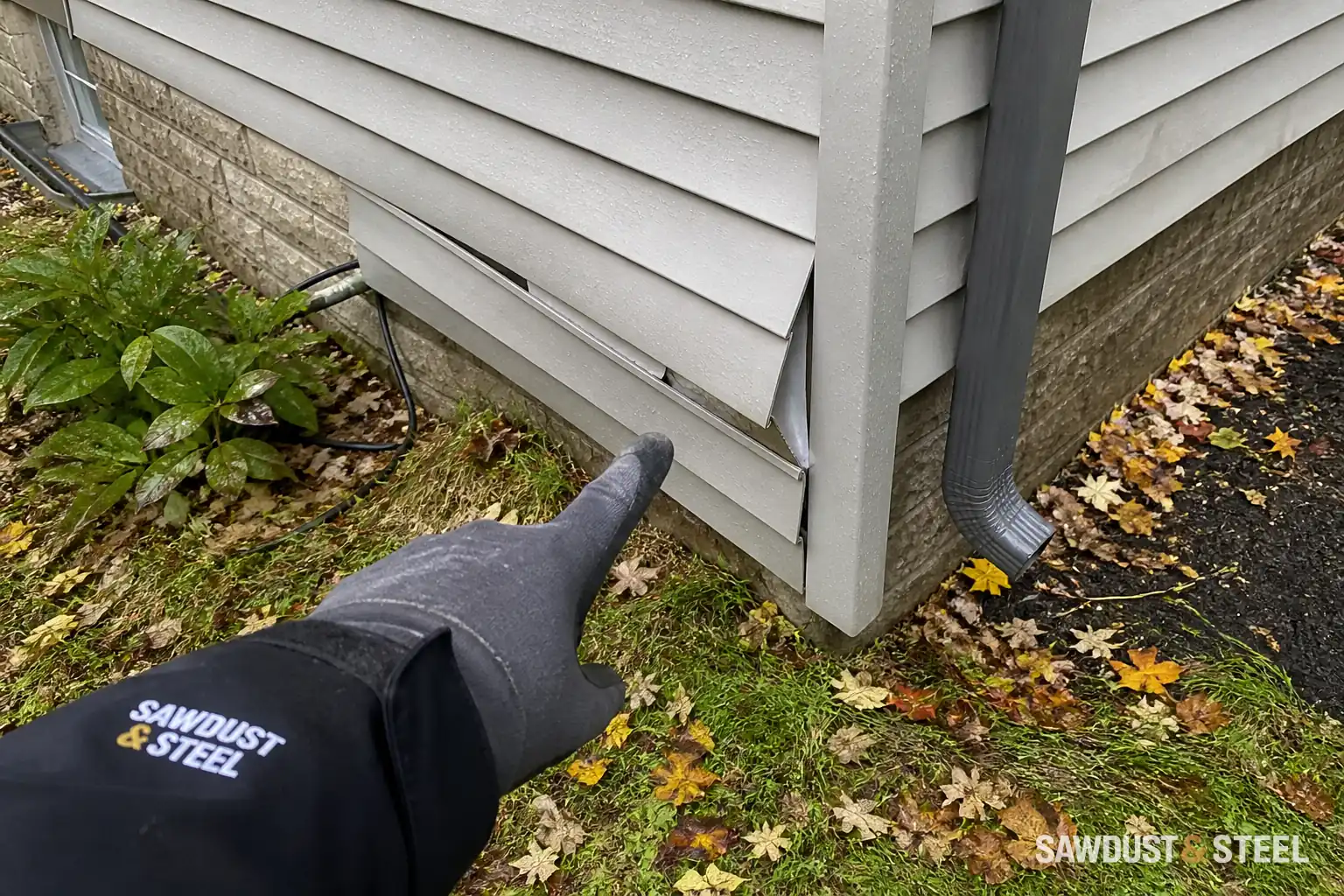
A caulking gun is wonderfully persuasive. Every small opening begins to look like an unfinished job. On siding, a tidy bead can occasionally turn a useful exit into a water trap. Before applying caulk, identify whether you are looking at an intended drainage or movement opening, a damaged panel or a separate window joint.
Ask what the opening is supposed to do
The Vinyl Siding Institute installation manual describes drainage and movement provisions and cautions against caulking specified siding joints. The manufacturer's instructions for your product control the detail. An opening is not automatically a leak, and an unintended gap still deserves assessment.
| Location | What to do before reaching for caulk |
|---|---|
| Small drainage openings formed in the siding | Keep the intended drainage exit open; do not fill it to tidy the edge. |
| Panel ends in corner receivers or J-trim, and overlapping panel joints | The VSI manual says not to caulk these joints. Check the exact siding instructions. |
| A window-frame joint or penetration through the wall | Identify its own flashing, sealant and drainage detail; the siding rule does not settle the window detail. |
| A broken, displaced or missing piece | Have the component assessed and repaired instead of assuming the opening is intentional. |
The VSI basic installation rules, page 5, distinguish panel movement joints from the weather detailing around openings. If the concern is a stain below a roof edge, also trace the kickout flashing and roof-to-wall route.
Mark four openings before applying sealant
Panel bottom
Identify factory drainage openings; keep their water exit clear.
Course overlap
Panel-to-panel overlap is not a joint to caulk under VSI basic rules.
End inside J-trim
The panel needs its prescribed movement space; do not glue the panel to its receiver.
Window assembly
Follow the window manufacturer’s perimeter-seal and drainage details; siding trim is a separate component.
Conceptual detail; product instructions and the actual assembly determine dimensions and attachment.
The VSI manual, printed page 5 specifically separates panel ends at receivers and overlaps from other weather detailing. Its window and door section shows flashing integrated with the water-resistive layer. These examples explain why the correct answer can differ a few centimetres across the same opening.
On a photograph, number the proposed sealant locations and ask the installer to identify each one. "Window needs caulking" is too broad: do they mean a frame perimeter joint, a trim joint, or the end of a movable siding panel? Save the marked photograph with the applicable instructions so future maintenance does not undo the detail.
If an existing bead has already sealed a drainage or movement opening, ask how it should be removed without cutting or damaging the panel. Do not drill additional holes to compensate for an unknown blocked route. Where water has reached indoors, the investigation may need a planned opening behind the finish; a tidy exterior seam is not evidence the concealed flashing works.
For the whole-wall route, read how the space behind cladding drains. The surface opening and the drainage plane have to connect, not merely look finished from the driveway.
Trace the water management behind the appearance
Around windows and doors, distinguish siding trim from the window's own sealant and drainage details. If water is entering the house, investigate the route and flashing rather than sealing every visible seam. Ask the installer to show which joints require sealant and which must remain open.
Before the next step
- Identify the siding and window products.
- Match each proposed sealant location to the applicable detail.
- Investigate active leakage before attempting a cosmetic seal.
Before you seal a gap, ask the installer to identify its job in the wall detail. Leave intended drainage exits clear and get active leakage investigated; the neatest bead isn't always the useful repair.