
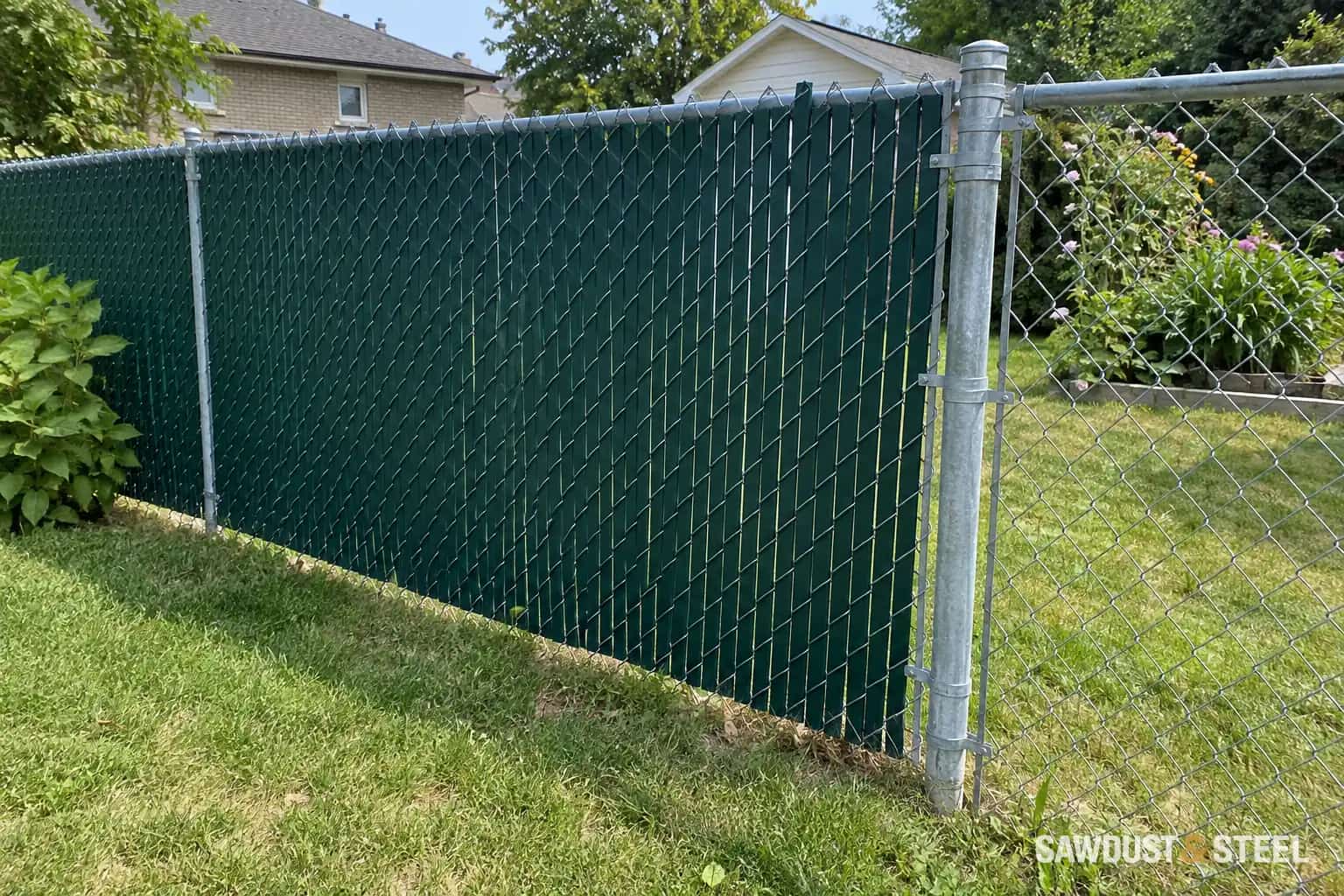
An open chain-link fence is useful until the neighbour's patio lines up perfectly with yours. Slats promise a quick privacy upgrade, and the installation can look simple enough to finish between lunch and dinner. The fence's ability to carry the new wind load is a separate question.
Privacy percentage is not a strength rating
Pexco's privacy-product range includes different levels of visual screening and different slat arrangements. Those percentages describe how much can be seen through the fence; they do not certify the posts or foundations holding it up.
An open mesh lets much of the air through. Adding material changes the area the wind acts on and the forces transferred into the supporting system. A fabric sold as breathable still needs an appropriate installation assessment. Its appearance is not a wind calculation.
The Chain Link Fence Manufacturers Institute Wind Load Guide identifies factors including exposed area, fence height, post strength and spacing, soil and wind exposure. Its design tables use United States standards. They are not Ontario post-size or footing prescriptions, but they explain why one universal slat recommendation cannot suit every backyard.
Inspect the fence you actually have
- Establish ownership and obtain any required agreement before changing a shared fence.
- Record fence height, post spacing and available product or installation records.
- Look for leaning posts, corrosion, loose mesh, damaged rails and movement at the ground.
- Measure mesh openings and identify the wire and fence configuration for product compatibility.
- Note exposed corners, open fields, hilltops and other local conditions for the installer's assessment.
Do not push or pull an unstable fence as a strength test. Existing damage needs attention before adding screening. A line of thin posts that has survived for years with open mesh has demonstrated performance in that configuration, not in the proposed one.
Include the gate in the assessment
Gate leaves, hinges, latches and posts also receive the changed forces. Adding slats can alter a gate's weight and the way it behaves in wind. Check that the chosen slat system is intended for the gate arrangement and that required closing and latching functions remain reliable.
A gate that already catches the ground needs a separate geometry check. The guide to gates that hit rising ground helps distinguish a clearance problem from a support or hinge problem. Screening should not be used to hide a gate that has stopped working properly.
Compare more than one route to privacy
| Choice | Useful question |
|---|---|
| Slats in the existing fence | Can this complete fence support the proposed product at this site? |
| A separate screen near the seating area | Can a smaller independently supported screen provide the needed sightline privacy? |
| Replacement fence | Would a system designed for the required screening avoid uncertain retrofit capacity? |
| Planting | Is there enough space and time for growth without damaging access or the fence? |
A short screen beside a seating area may provide privacy without filling an entire property boundary. It still needs suitable support and any applicable approvals. Keep road sightlines, access and local fence-height rules in view. Where the fence forms a pool enclosure, confirm that the change preserves the required barrier and gate performance.
Buy after the support question is answered
Bring the installer the exact slat product, not just a colour sample. Ask whether any posts, rails, connections or foundations need upgrading and how the selected product is retained. Follow the maker's mesh and installation requirements after the fence has been accepted for the change.
Avoid a "try one whole side and see" approach in an exposed location. A privacy retrofit should have a support decision before installation, then a check after completion and after unusual weather. The useful result is a quieter view of the yard with a fence that still stands straight.