
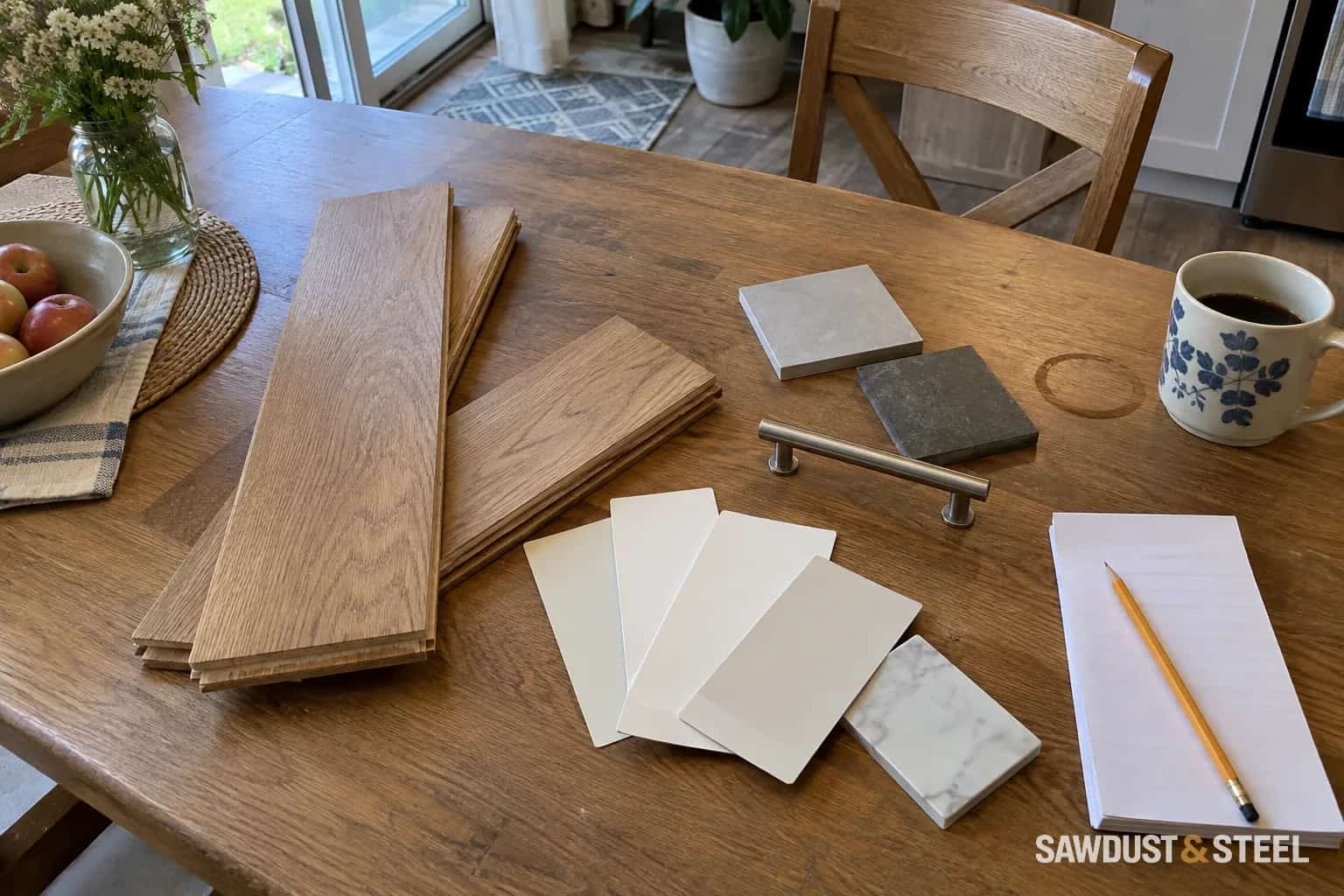
The unfinished shelf is exactly the pale colour you wanted. Then the first clear coat goes on and the wood looks warmer. Nothing has necessarily gone wrong. Clear finishes can be transparent and still change the colour you see. Choose the coating with a sample before treating the entire room as the test board.
Separate three changes that look similar
There is the colour of the liquid and cured coating, the richer appearance produced when a finish wets the grain, and the later changes in the wood or finish during use. These can happen together. A photograph of a newly coated board cannot tell you how it will look after years beside a sunny window.
Minwax's finishing FAQ describes its oil-based topcoats as adding warmth and its water-based Polycrylic example as usually drying clear. That is a useful starting comparison within those products. It is not a guarantee that every water-based finish is invisible, suitable for every surface or immune to ageing. Read the intended use and compatibility of the exact product.
| What you notice | How to investigate it |
|---|---|
| Warmth immediately after coating | Compare cured samples of alternative clear products. |
| A darker, richer grain pattern | Compare bare wood with the complete coating rather than judging the liquid in the can. |
| Different colour beneath an object | Consider uneven exposure and the age of both wood and coating. |
| A patch that stays pale beside old trim | Check species, preparation and existing finish before adding more colour. |
| Cloudiness or an uneven film | Investigate application and compatibility, not just the tint. |
Build the sample from the same material
Use an offcut of the actual species and, ideally, the same batch. Include enough grain variation to represent the project. Veneer, solid wood and an edge strip can respond differently even when sold under the same species name. On a shelf with exposed end grain, coat the end of the sample too.
Prepare every candidate consistently. Label the underside with product, sheen, preparation and coat sequence. Apply the number of coats and drying intervals required for the intended use; one thin wipe is not a fair representation of a finished tabletop. Keep a bare reference offcut nearby, but do not let it become the only standard. The question is whether you like the finished wood in the room.
A useful trial has three pieces: your existing finish proposal, a compatible lower-colour alternative and an untreated reference. If a stain or conditioner is also planned, each coated piece needs that layer. Comparing clear finishes over different stain preparations answers several questions badly instead of one question well.
Choose protection as well as colour
A cabinet side, stair tread, bathroom shelf and dining table have different exposure and wear. A pale sample is not enough if the coating is not intended for that use. Ask about cleaning, water exposure, repair, recoat preparation and the manufacturer's restrictions. Use an appropriate exterior system outdoors rather than accepting a lovely indoor sample for a garden project.
Compatibility matters when coating an existing surface. Identify what is already there and follow the new product's preparation requirements. Do not assume a water-based topcoat will cancel the amber tone of an old coating underneath. Removing the old finish may change the appearance, but that is a separate refinishing job with its own risks and labour.
For new pine that is already uneven, resolve blotchy stain preparation before evaluating topcoat colour. A clear film makes the existing pattern visible; it does not selectively erase dark patches.
Bring the sample into the finished room
Hold it vertically or horizontally as the finished piece will sit. Check it beside the floor, painted trim and nearby fabrics, both during the day and after dark. In a hallway, we found the warmer sample sat comfortably beside an older oak floor while the paler one looked disconnected. In another room the pale finish was exactly the point. Neither can label could make that decision for the household.
The paint-and-light guide explains why the evening view deserves a vote. Avoid deciding solely from a phone photograph: automatic colour correction can make two samples seem more alike or more different than they are.
Before ordering, keep the chosen sample and written schedule together. Ask the finisher what future repair should look like and whether a spare coated piece can be retained. Do not promise that exposed wood will remain identical to a sample kept in a drawer. The sample records what you approved at installation; it is a useful reference for later conversations, not a way of stopping time.