
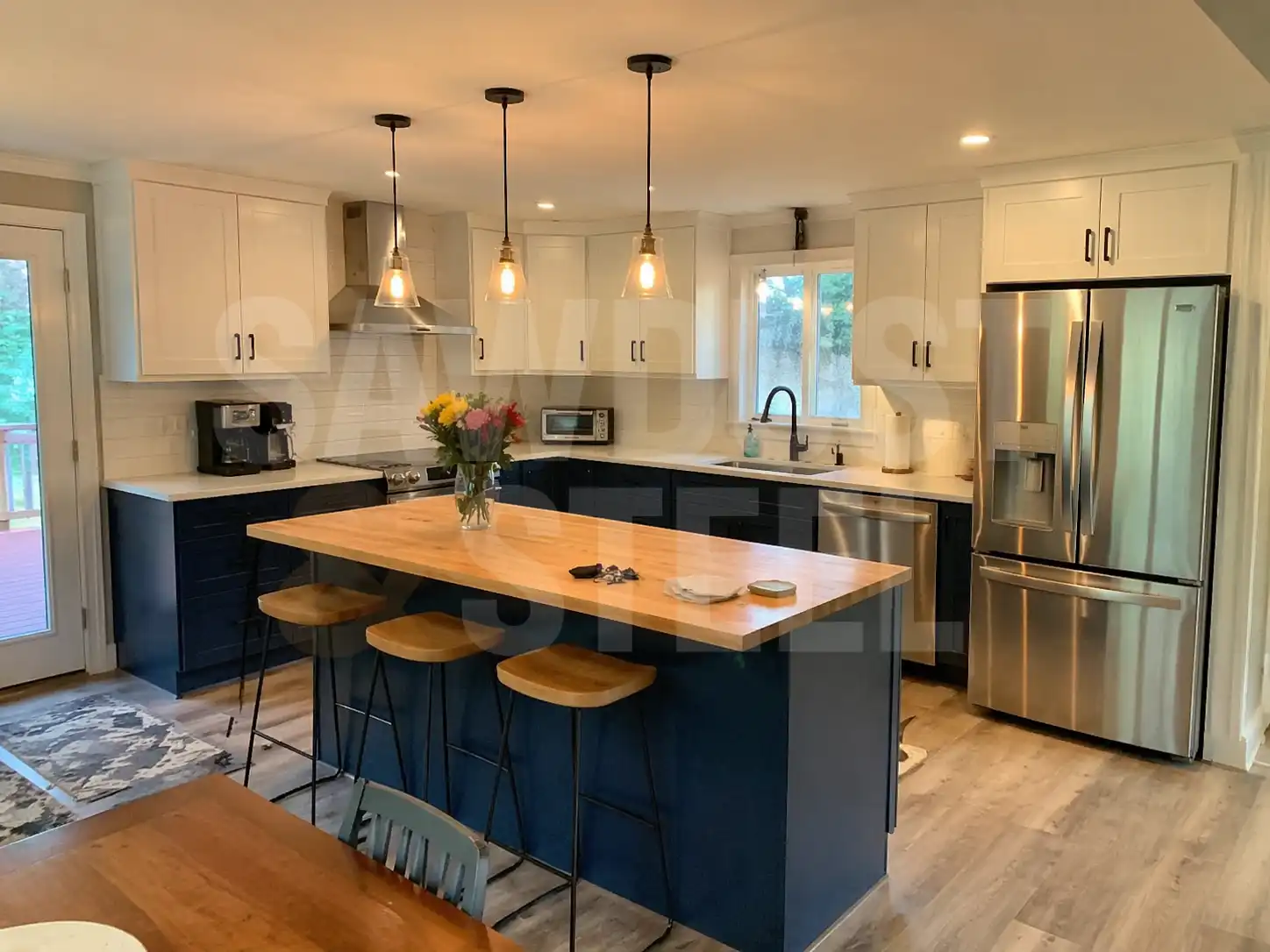
A stool can look perfectly proportioned beside an island and leave the person on it eating at shoulder height. Another can tuck in beautifully until knees meet the apron. Start with the seat, the underside and a person.
Ignore the back height until the seat height is right
Record finished floor to countertop top, finished floor to the lowest obstruction beneath it, and floor to seat on the candidate stool. A thick cushion may compress under the user, while a shaped seat may be lower at its centre than its edge. Read the dimension diagram rather than the single height in a shopping filter.
IKEA: Counter and bar stool sizing lists counter-stool seats around 22 to 26 inches high and bar-stool seats around 28 to 30 inches. Its shopping rule of thumb leaves 10 to 12 inches between the seat and countertop. Use those ranges to shortlist products, then check the actual kitchen: a tall bar stool can leave very little room below a standard-height island.
For example, a 36-inch countertop and a 25-inch seat leave an 11-inch seat-to-top gap. If an apron hangs down to 32 inches above the floor, the usable gap above that seat is only 7 inches. Those are different measurements. Measure to the lowest obstruction, sit on the stool and check your thighs before accepting the fit. Aprons, support brackets, compressed cushions and footrest position can change comfort substantially.
Seat to underside
Include aprons and brackets, not only the top surface.
Feet to footrest
Check comfortable support when seated normally.
Occupied width
Allow elbows and movement, not just the seat shell.
Space behind
Test someone walking past while the stool is in use.
Stay seated long enough to notice the footrest
Try getting on and off without pulling on the countertop. Sit facing forward and turn as you would to speak to someone. Check whether the footrest supports your feet and whether a hard edge presses behind your knees. If the island is used for working or homework, a ten-second showroom perch is not a useful comfort test.
Swivel and adjustable stools solve some problems and create others. Confirm stability, the adjustment range and manufacturer use limits. For children or someone with limited balance, choose seating suited to their needs rather than relying on the counter to steady an unsuitable stool.
Plan the number of people, not the number of empty seats
Mark the stool legs and the position when a person sits down. Open the dishwasher or a nearby drawer and walk the route around them. A row of narrow seats can still become crowded at elbow height, especially if one end is enclosed by a wall or waterfall panel.
Check overhang support and knee space before ordering a full set. If the fit is marginal, buy or borrow one representative stool first and test it at home within the retailer's conditions. Reducing the count often makes the remaining seats more useful than squeezing another one into the picture.