
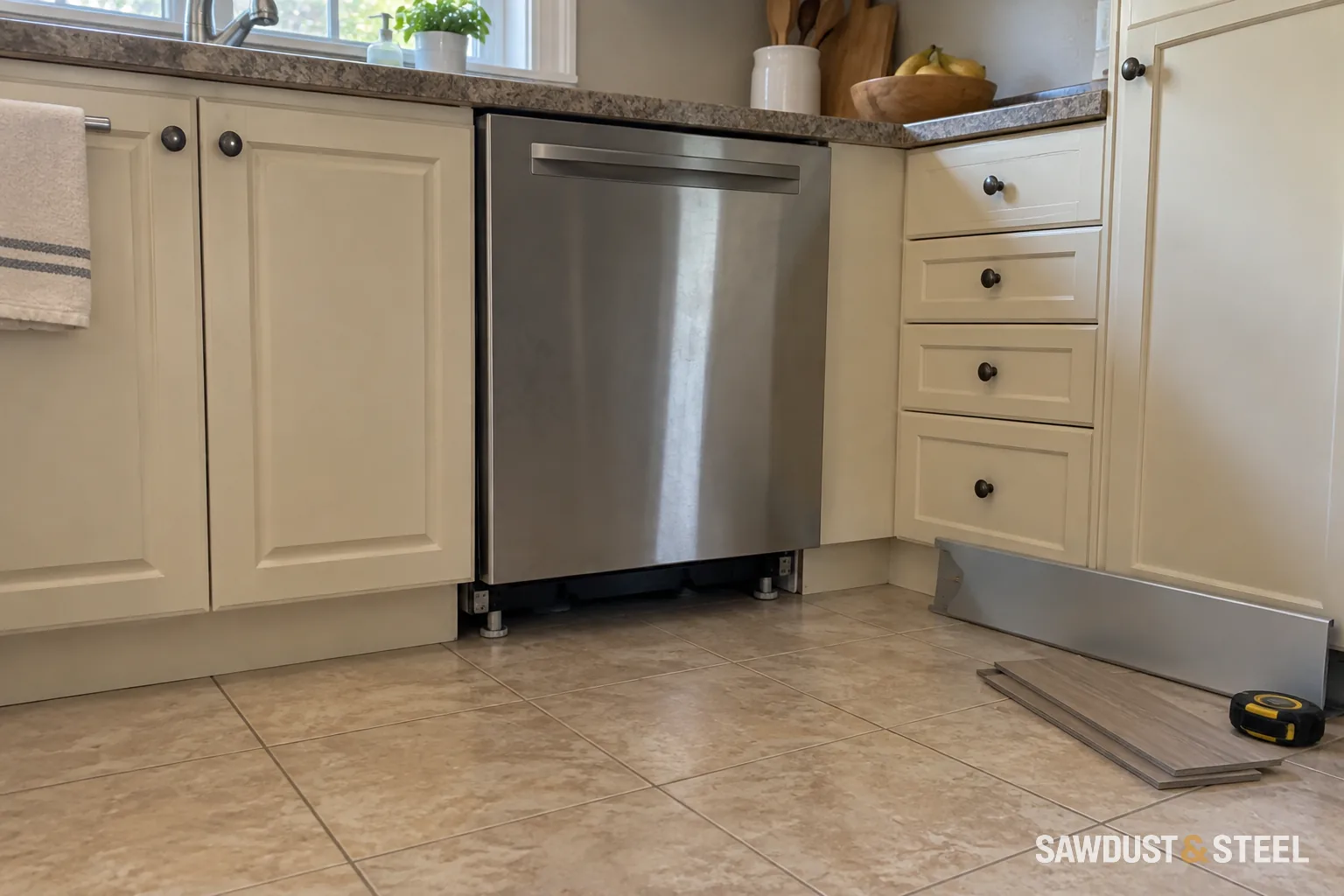
A kitchen plan with every door closed is a very polite fiction. The dishwasher spends its most useful moments doing the opposite. Draw the dishwasher with its door open and racks pulled out before approving a corner layout.
Draw the unloading position
Show the open dishwasher door and extended racks using the chosen model's dimensions. Then open the nearby cutlery drawer and cupboard. Mark the place where someone will stand. Include handles and any corner filler in the drawing.
Try the sequence with the actual dishes you use most: plates, glasses, pans, and cutlery. The best storage location is not always the nearest cabinet when that cabinet cannot open during unloading.
Decide what is allowed to conflict
A little occasional sequencing can be acceptable in a compact kitchen. Blocking the only walking route or the cupboard used for every load is a more persistent compromise. Make it conscious.
Coordinate the final measurements
- Verify the dishwasher's installation and service requirements.
- Check adjacent drawers, handles, and corner accessories at full extension.
- Keep a practical standing position for loading and unloading.
- Decide where the daily dishes live before ordering internal organizers.
Rehearse one ordinary dishwasher load, including where you stand with the rack pulled out. Move the dishes on the plan if that makes the sequence easier. Once those cabinet positions are settled, use the countertop template checklist to catch the decisions that still affect the stone.
Use the actual appliance drawing for the corner test
For a concrete model example, Bosch's SHPM65Z55N specification drawing gives a required cutout 23 5/8 inches wide, 24 inches deep and at least 33 7/8 inches high. These dimensions belong to that model; they are not a universal kitchen rule. Use the exact supplied model and revision when you draw your opening.
The opening is only the parked appliance. Add the fully open door, the rack at full extension and any projecting handle to the floor mock-up, measured on the actual model or its installation drawing. Then add the adjacent drawer travel and corner-door arc. Label each dimension on the plan; do not assume a 24-inch opening gives a 24-inch unloading zone.
Try one clean load without stepping over an open door. Put plates, mugs and cutlery in their proposed homes while another person uses the route to the fridge. If one infrequent cupboard must remain closed during unloading, record that accepted sequence. If every plate requires closing the dishwasher, move the plate storage or revise the corner. Review deep drawers and corner storage before buying the internal fittings.
Appliance opening
Use the exact model's opening dimensions.
Door and rack
Show the open door, extended rack and handle.
Adjacent storage
Show drawer travel, door swing and fillers.
Standing route
Leave room to unload and for others to pass.
Transfer verified measurements to a scaled plan and full-size floor tape; this is not a minimum-clearance diagram.