
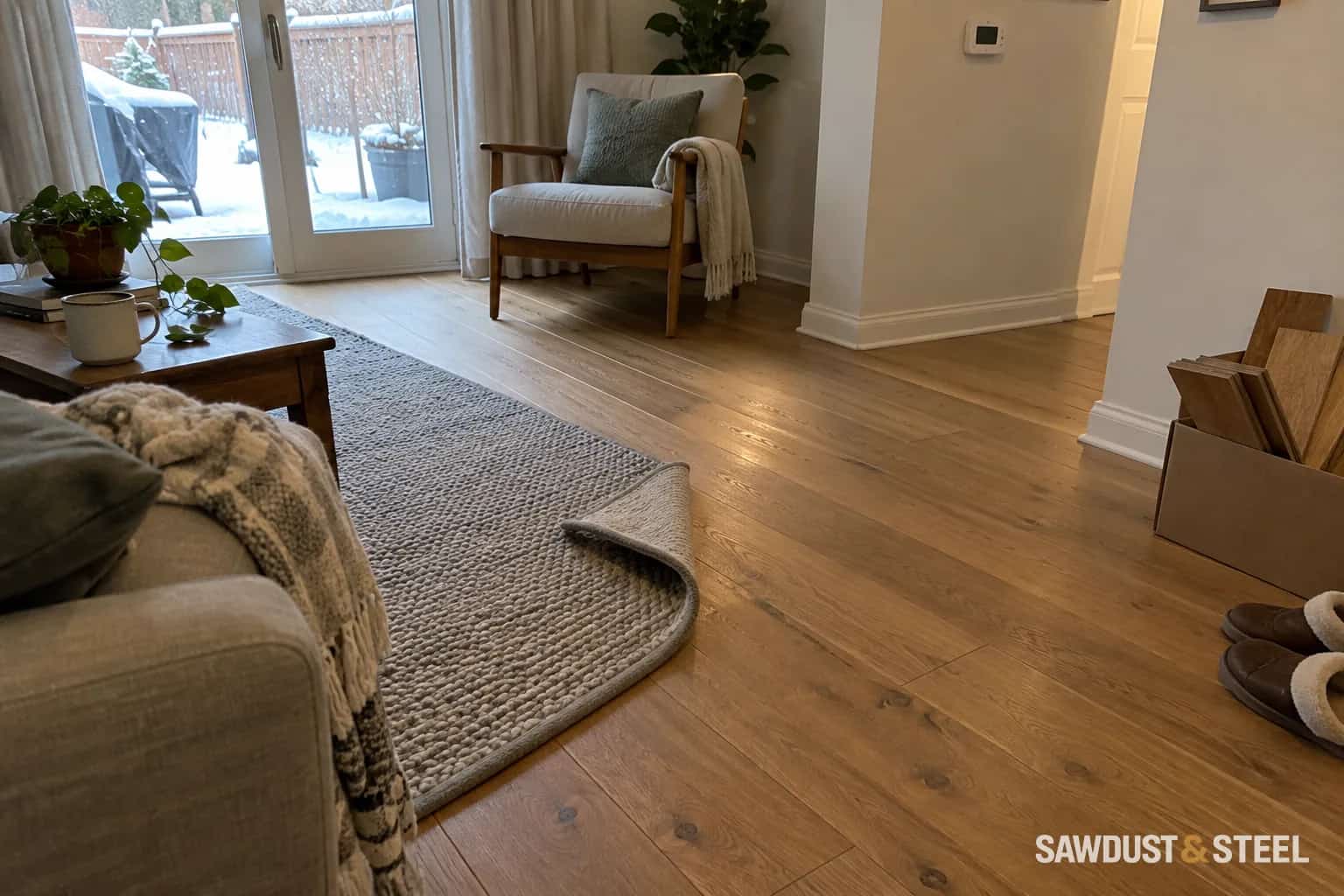
The sample in the drawer looks substantial, and the floor has only been refinished once. Neither fact tells you how much usable wood remains on the most heavily sanded part of the room. The area beside the doorway may have a very different history from the spare plank.
Find the exact product before choosing a machine
Start with invoices, carton labels, spare boards and the original retailer. Confirm that the floor is engineered wood rather than wood-look laminate or vinyl; photographs can be misleading. Request the manufacturer's refinishing guidance for that collection and construction. A statement that the brand makes sandable floors does not establish that this particular one is sandable.
Inspect what remains, not what was sold
An exposed edge at an existing register or transition may help a professional identify the layers without cutting a new hole. It is only one observation, not a guarantee for the room. NWFA: refinishing wood floors says sanding potential depends on wear-layer thickness, flatness, condition and the work itself. Previous repairs and low spots can make a uniform sanding allowance unrealistic.
Finish wear only
Ask about a compatible maintenance coat and adhesion testing.
Sandable wood remains
Obtain a written sanding and finishing scope for this product.
Insufficient or damaged face
Compare local board replacement with replacement of a larger area.
Decide which factory details you want to keep
A full sand can change bevels, texture, wire-brushing and colour variation. Ask to see a sample of the proposed result, including edges, rather than approving from a stain swatch alone. If the existing face has a special treatment, the room may become smoother or more uniform than you expected. That can be attractive, but it should be an intentional choice.
Make the stop point part of the quote
Ask how the contractor will inspect the floor before work, where any test will happen, and what would cause them to stop. Include replacement-board availability and the transition to adjoining rooms. A price for sanding without an assessment of whether sanding is possible leaves the most expensive decision until the room is already empty.
If the wood is sound but the surface is tired, compare recoating with full refinishing. For one damaged area, a single-plank replacement may preserve more of the original floor.