
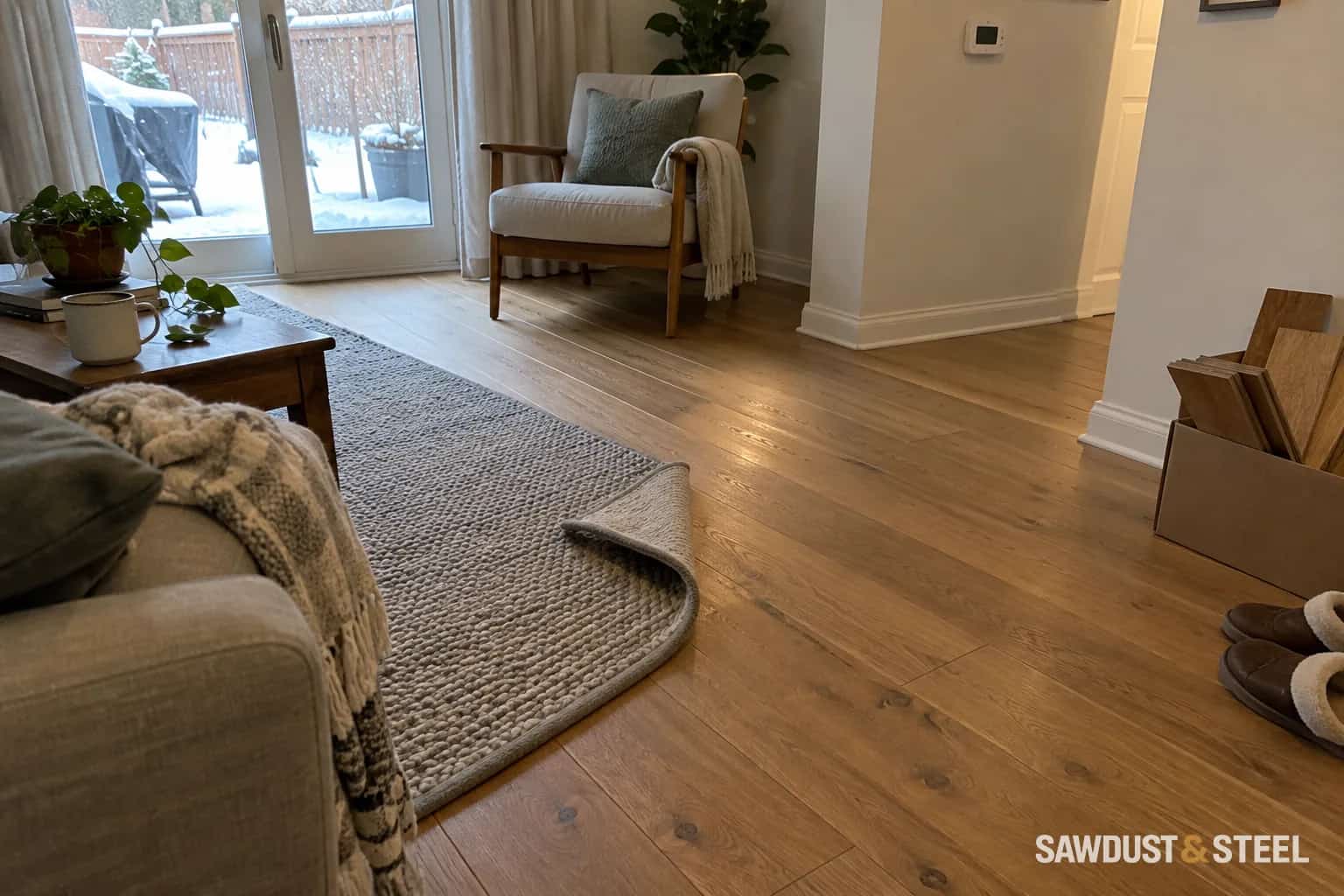
The dropped pan found the one board in the middle of the room. Before anyone reaches for a saw, check the cupboard for spare planks and the invoice for a product code. 'Same oak colour' is not enough when the replacement has to match dimensions, edge shape and sheen.
Work out what holds the plank in place
Look at existing records or an accessible edge. Do not cut an exploratory square into the damage. A nailed wood board, a glued vinyl tile and a clicked plank need different removal and reinstatement plans. If there is underfloor heating, a moisture membrane or sound-control layer, include it in the assessment before tools touch the surface.
Disassemble from an edge
May preserve the original locking method but requires access across several rows.
Approved in-place repair
Can limit the opened area but needs the product's specific joint and adhesive procedure.
No matching stock
Compare a planned larger section or a cosmetic repair before destructive removal.
Check the replacement beside the existing floor
Lay a spare board beside the damaged area in daylight and evening light. Expect the installed floor to have aged differently from stock kept in a cupboard. Check width, thickness and profile as well as colour. If the product has been revised, ask the supplier to confirm compatibility in writing rather than relying on the collection name alone.
Price the access, not just one board
A floating-floor repair near a clear wall may differ greatly from one beneath a fitted bookcase. COREtec: six installation questions shows that locking mechanisms vary; do not assume every joint can be lifted or tapped the same way. Ask which trim must come off, whether neighbouring locks may be damaged and how the floor will be reconnected. Include spare material for that possibility.
Make sure it is a local accident
A single impact mark is different from several boards swelling, separating or changing colour. Repair the underlying condition first if the damage is spreading. Keep a photo of the removed board and any observations beneath it. For water-related marks, a surface assessment may identify a smaller repair; for repeating open joints, replacing the visible plank alone may miss the cause.