
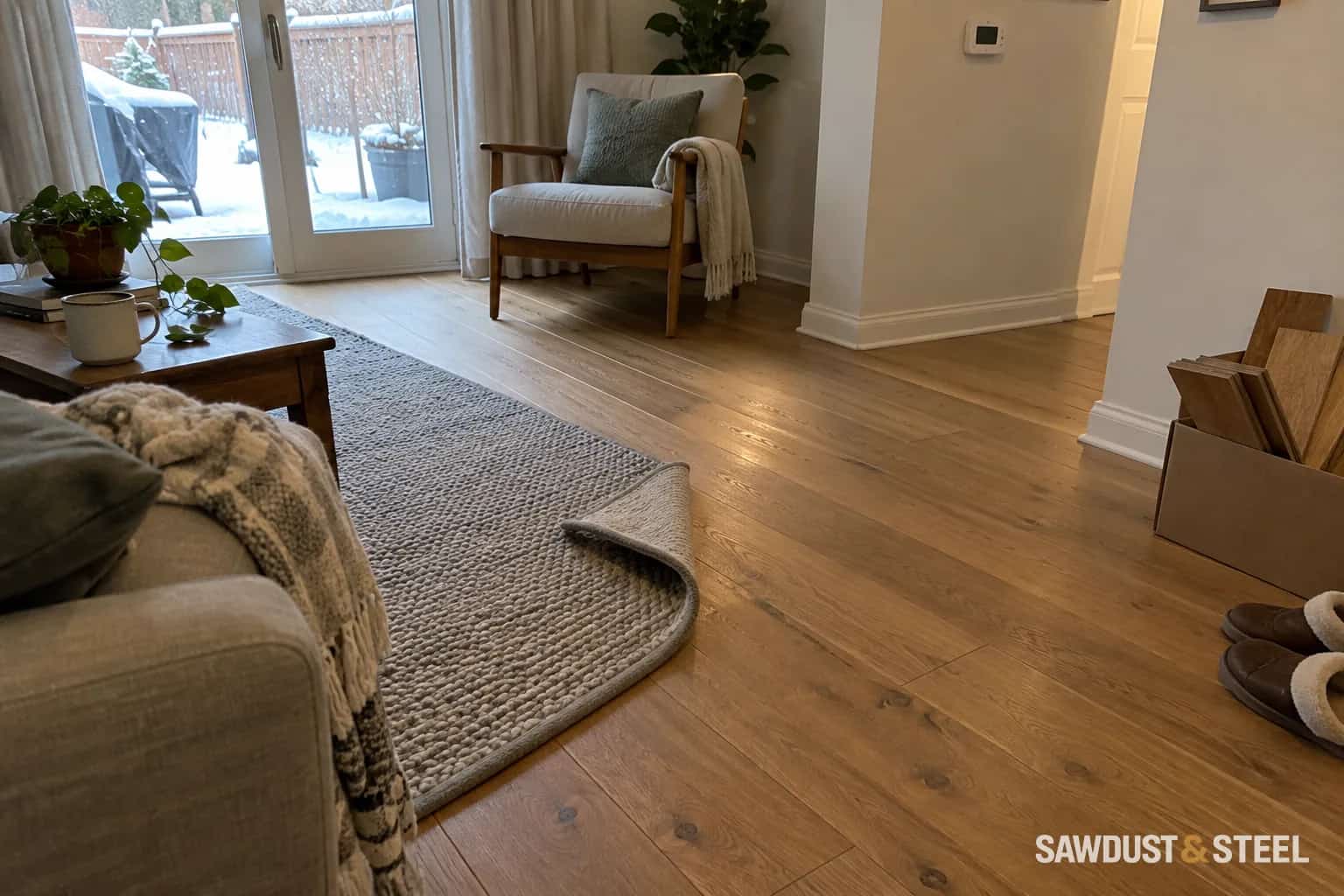
The afternoon light suddenly makes every board look like a shallow gutter. Before booking refinishing, photograph the floor from that angle and write down when the change appeared. The useful question is what changed in the room or below it, not which sanding grit removes the ridges fastest.
Check the shape across individual boards
Cupping is a board-width problem: raised edges and a lower middle. A high middle is crowning; a broad hump across several boards is a different observation again. NWFA: wood floor problem prevention connects moisture gain with cupping. A floor that has lifted away from its support, feels unstable or is still wet needs prompt assessment rather than an observation period under a rug.
Record a moisture pattern, not one reassuring reading
Note whether the worst boards sit beside a dishwasher, patio door, plant pot, exterior wall or room over a damp basement. Check accessible areas below for staining without opening ceilings or disturbing wiring. Give the installer the leak history, room humidity records and cleaning routine. Surface dryness does not establish that the underside or subfloor is dry.
Find the change
Map affected boards and investigate the water or humidity source.
Confirm stability
Have appropriate moisture readings compared over time and with unaffected areas.
Choose the repair
Assess remaining distortion, wear layer and finish after conditions are stable.
Ask for a repair decision after the readings
Wagner Meters: wood flooring installation and moisture describes the risk of sanding a cupped floor before it has dried: removing the raised edges can leave them lower than the centre after the boards settle. This is why the moisture assessment belongs ahead of the refinishing decision.
Some boards relax as the moisture imbalance resolves; others remain distorted or damaged. The assessment should separate what can be retained from what needs replacement. Ask how the contractor will decide the floor is ready, and what happens if the shape continues to change. A fixed waiting period without measurements is not much of a decision rule.
The remaining wood also matters. NWFA: refinishing wood floors identifies wear-layer thickness, condition and flatness among the factors governing resanding. Before agreeing to aggressive levelling, check whether your engineered floor can be sanded.
Keep the floor accessible while you investigate
Do not add more wet cleaning, hide the area beneath an impermeable covering or start filling the joints. Keep useful photos and moisture reports with the invoice for any leak repair. If the surface is stable and only the finish is dull, that is a different job from removing distorted wood; ask the contractor to explain which problem the quote actually solves.