
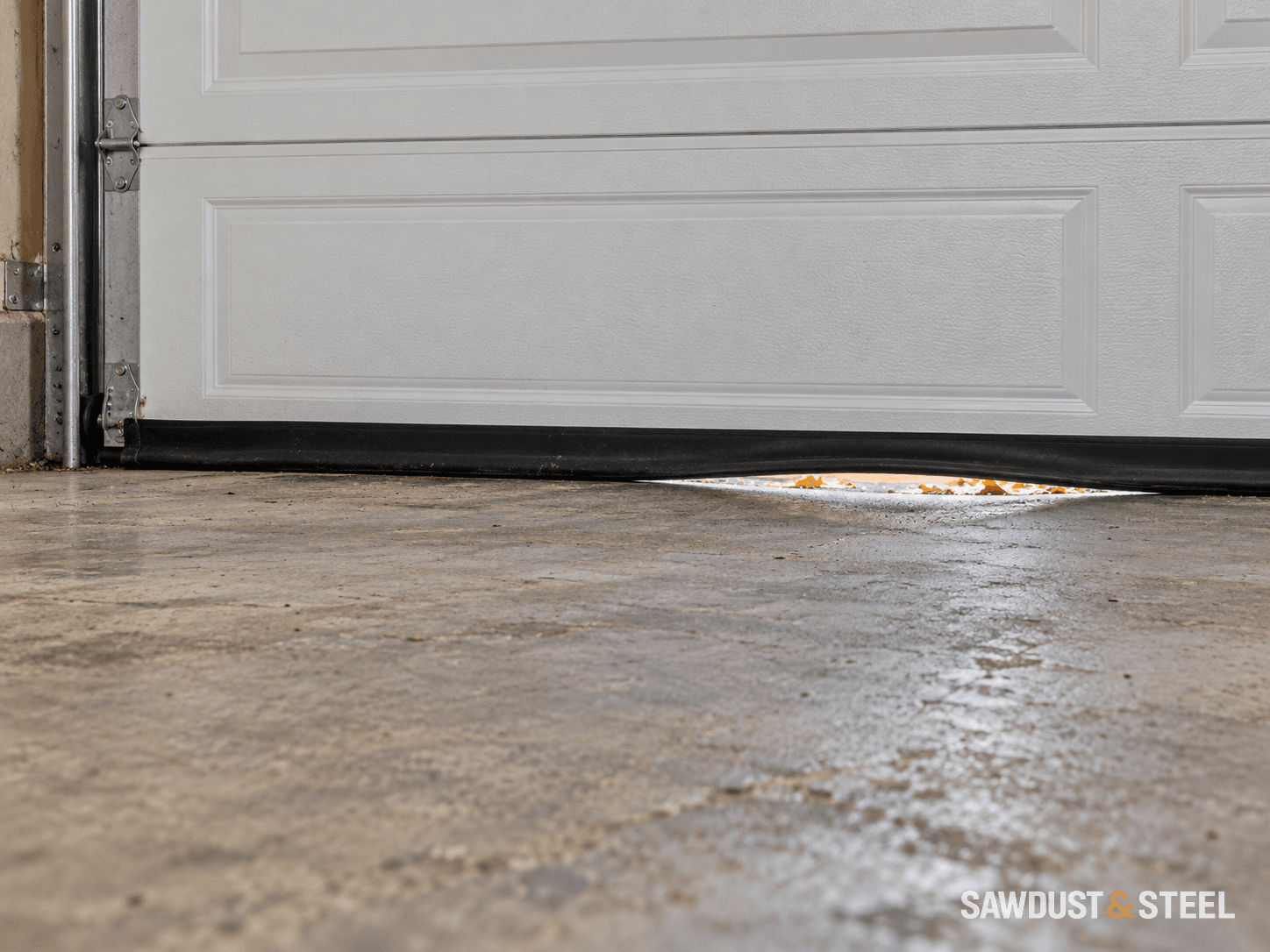
Daylight appears under one section of the garage door. The first shopping result offers a reassuringly enormous bottom seal. Before ordering it, compare the bottom of the door with the concrete beneath it. Rubber can accommodate a suitable amount of variation; it cannot explain why the gap appeared.
Record the gap with the door stationary
Keep people, pets and objects clear of the door's path. From inside, photograph the fully closed door across its width and then the affected area. Look without putting fingers under the door or reaching into its hardware. If the door closes crooked, moves unpredictably, binds or has a loose cable, stop operating it and arrange service.
Record whether the gap is local or continuous, whether the floor looks sunken or cracked there, and whether the bottom section is visibly damaged. Note when the problem started: after a seal replacement, a vehicle impact, a cold spell or gradual floor movement. Those observations are more useful to the technician than 'it needs to close harder.'
| Observation | What it suggests checking |
|---|---|
| Torn, flattened or brittle rubber | Seal condition and the correct replacement profile |
| A local dip below an otherwise straight bottom | Floor profile and a compatible sealing detail |
| One end closes well before the other | Door alignment, hardware and operation by a technician |
| A bent channel or damaged bottom section | Retainer or door-section repair before new rubber |
| A new thick seal stops normal closure | Product fit and operation, rather than more closing force |
Match the retainer, not just the width
Find the door maker, model and any seal or retainer identification. Ask the supplier which profile belongs in that channel. Clopay's seal guide describes several arrangements, including T-shaped and bead-style connections. Similar-looking black rubber strips are not necessarily interchangeable.
Follow the exact door and seal instructions for replacement, including how the door must be secured. If that procedure is unavailable or the retainer needs hardware removal near a cable attachment, use a technician. Do not dismantle a bottom bracket to make room to slide in a seal.
A thicker seal has limits
Clopay notes that an oversized seal can interfere with closing. More material has to compress somewhere. A replacement that fills the low spot may bunch heavily at the high spots or change how the door reaches its closed position. Give the supplier the floor-gap pattern and the model rather than guessing from the largest dimension.
A floor-mounted threshold is a separate option, not another name for the seal on the door. Before choosing one, consider the vehicle path, drainage, snowmelt and how water already leaves the garage. A raised strip across the opening can change that route. Have a slab that is settling, lifting or breaking assessed; selecting rubber around continuing movement is a short-lived plan.
Check whether water is actually coming through the bottom gap. Rain can also enter at side seals, damaged cladding or a poor exterior slope. Photograph the water path after weather if it is safe to do so. A dry-weather daylight check cannot establish the source of every puddle.
Keep tensioned hardware out of the seal experiment
Clopay's service guidance specifically warns against removing bottom brackets because of spring tension. Springs, cables, their attachments and a door that runs incorrectly belong with a qualified garage-door technician. Do not adjust the opener's force to press the door into uneven concrete.
After the appropriate repair, have normal operation and the opener's safety functions checked according to the exact manuals. A door that seals but no longer reverses or closes reliably has not passed. Keep the replacement part details so the next seal can be ordered from a specification rather than a photograph of a flattened remnant.
Separate weather sealing from the house boundary
The overhead door is only one edge of an attached garage. If garage odours are reaching the house, investigate the shared wall, ceiling and connecting-door boundary as a separate issue. A better bottom seal is useful weather protection; it does not establish that the house is isolated from garage air.