
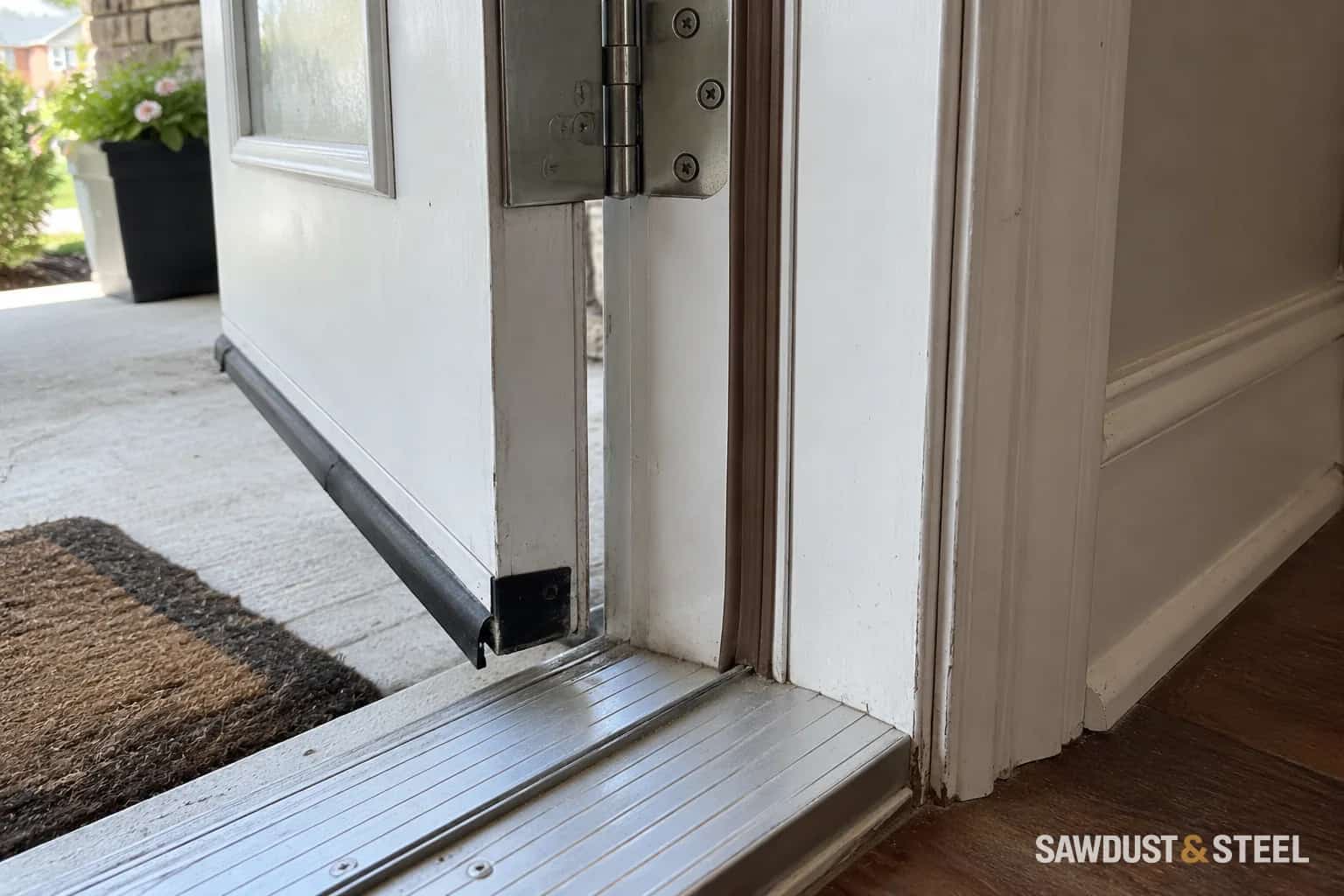
Look at the closed, latched door
Check with daylight outside and the indoor area relatively dim. Close and latch the door normally. Note whether the light appears as a narrow line along the bottom, a vertical line up the side, or a small triangle at one corner. Take a photograph without pushing or lifting the door so the starting condition is clear.
Now press gently near the corner without operating the handle. If the light disappears only under pressure, the door may not be meeting the seal consistently. Inspect the gaps around the slab and the hinge attachment. Do not immediately move the strike so far inward that everyone has to lean against the door to lock it.
Four parts meet in a small space
Line under most of the slab
Check the door bottom and its contact with the threshold.
Line up the jamb
Check weatherstrip seating and the slab's alignment.
Triangle at the junction
Inspect the correct corner pad and adjoining seals.
Gap changes when lifted
Inspect hinges and support before fitting thicker seals.
Therma-Tru sells handed corner seal pads for specific door systems; the small corner component is distinct from the long jamb weatherstrip Therma-Tru: Corner seal pad.
Find the door's product information before buying a generic pad. Compare thickness, shape, side and mounting position. A pad placed on top of old hardened adhesive may sit proud and prevent closing. Photograph the existing arrangement before removal, including anything that looks missing on the opposite corner.
A worn sweep and a missing corner pad are different repairs
Therma-Tru's dual-bulb door-bottom replacement procedure includes removing the slab and fitting the specified replacement, so even a small seal repair can require planned door handling Therma-Tru: Replace a dual-bulb door bottom.
Do not assume every sweep slides out while the door stays hung. Match the attachment profile and length, and confirm whether the threshold is adjustable. Raising a threshold indiscriminately can create drag, reduce seal life or make the lock difficult to operate. Follow the assembly's adjustment instructions rather than using resistance as the only test of a tight fit.
No visible light is a useful check, not the whole test
After repair, close and lock the door several times without a shove. Look for consistent contact and make sure the weatherstrip is not folded or pulled out. Check during windy weather for a persistent draft. If rain has also entered, inspect that separately: a corner seal does not establish that the sill installation and surrounding flashing are sound.
Use the front-door water-leak guide when the floor gets wet. If the whole entry is being replaced, keeping existing sidelights depends on how the components were assembled, not just whether the new slab has the same nominal size.