
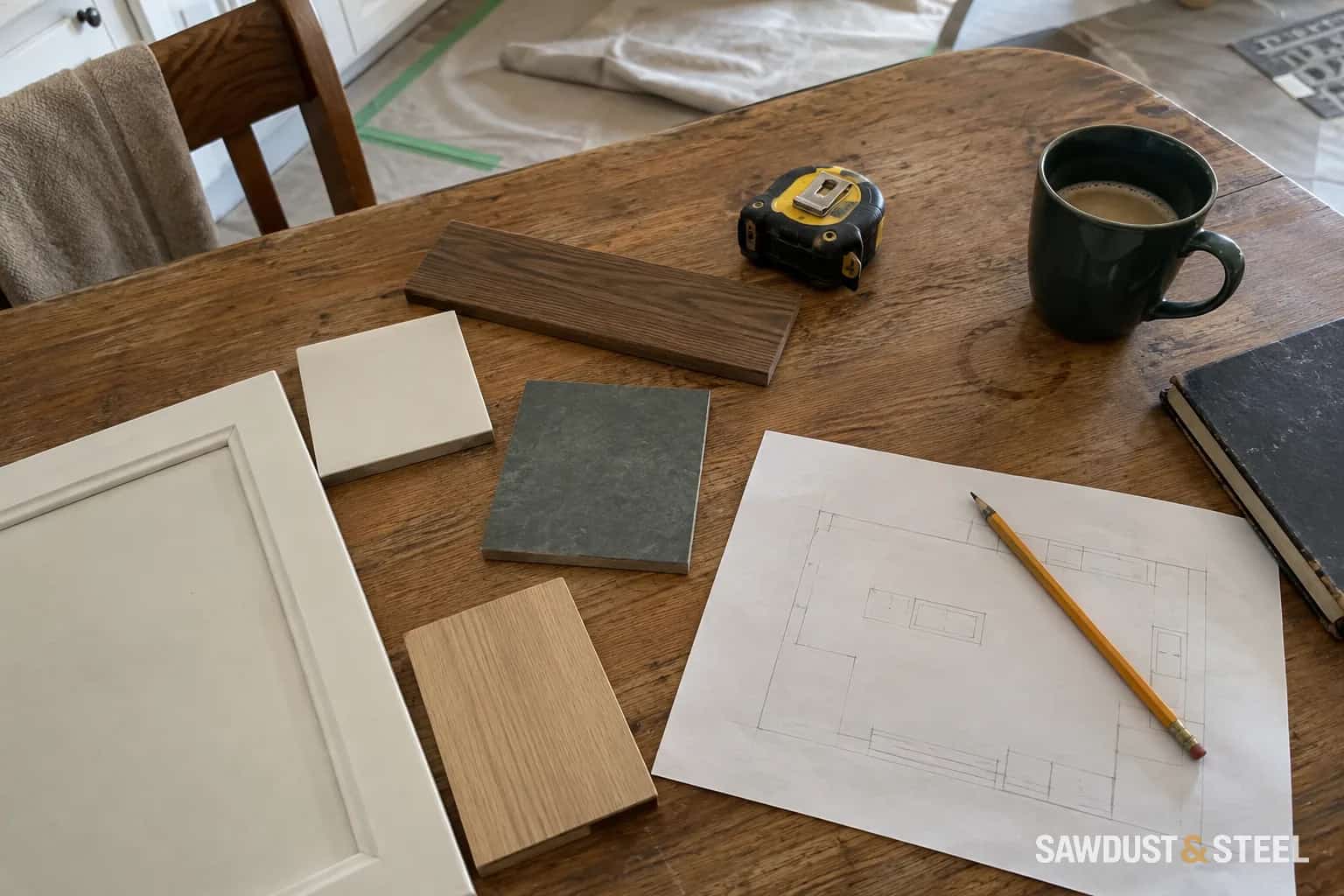
A countertop sample is small enough to hold in one hand and expensive enough to influence the whole kitchen. The trouble is that it cannot show you the sink cutout, the long seam or the edge that your stockpot will eventually knock.
Compare laminate, quartz and sintered surfaces by the kitchen you actually use. Write down your hot-pan habits, messy ingredients, preferred sink mounting and tolerance for visible repairs. Then ask suppliers to price the same finished layout so you can compare more than three square-foot rates.
Separate the material families
| Material | Daily advantage | Tradeoff to accept |
|---|---|---|
| Laminate | Decorative sheet over a core; compare a straightforward replacement with your existing layout. | Protect from hot cookware. Deep surface damage cannot be sanded away like solid timber. |
| Quartz / mineral-resin surface | Fabricated slab appearance with straightforward routine cleaning; Silestone is a product example. | Use trivets; exposed edges can chip, and a repair may remain visible. |
| Sintered / ultracompact surface | Dekton offers greater tolerance of hot cookware than the Silestone care guidance allows. | It can still chip or crack. Prolonged heat needs protection, especially on thinner products. |
Laminate is a decorative surface bonded to a supporting core. Quartz products are manufactured mineral-and-binder surfaces; the exact formulation depends on the product. Sintered or ultracompact surfaces form another manufactured family. Similar colours do not mean identical cutting, support, cleaning or repair requirements.
The differences become useful at the stove. Cosentino's current Silestone care page recommends trivets against sudden temperature changes and describes professional repair of some edge chips. Its Dekton guidance allows hot cookware but still recommends protection for prolonged heat, especially on thinner surfaces, and excludes direct flame. Both pages distinguish a repairable chip from a crack that usually cannot be durably repaired. These are named-product comparisons, not promises for every slab sold as quartz or sintered stone.
For laminate, Formica's care guidance calls for surface protection and appropriate cleaning. Its burn-prevention guidance recommends a protective barrier beneath hot cookware. The decorative face is not a thick layer of timber you can sand back after damage. At a sink edge, keep the proposed core, edge treatment and approved mounting system in the comparison; a familiar material name does not establish an undermount detail.
Start with three ordinary kitchen tasks
First, picture unloading a hot roasting pan. Plan a trivet and a convenient landing area regardless of which shortlist you prefer. Read the exact product's heat advice instead of testing a sample with a hot pot at home. If damage has already appeared, use the quartz damage assessment before attempting a repair.
Second, picture cutting a loaf, opening a parcel and sliding a heavy mixer. Use a cutting board and lift equipment where appropriate; do not select a counter on the assumption that every object can be dragged over it. Ask which marks are removable residue and which represent permanent damage to the actual surface.
Third, picture water around the sink overnight. Look at the proposed cutout edge, joints and core protection rather than only the flat field of the sample. Sink installation and countertop fabrication need to be compatible. Ask the fabricator to show the detail they intend to build, particularly if you want an undermount sink with a material or construction that needs a special system.
Inspect edges and repairs
Touch the proposed edge profile on a finished display. Sharp-looking corners can be more exposed to knocks; elaborate built-up edges introduce other fabrication considerations. Ask to see a real sample of the edge rather than choosing from a line drawing alone.
Request a plain answer about damage: if this edge chips, this seam opens or this surface burns, what can be repaired and how visible might the repair remain? Repairability depends on damage, colour, pattern and local expertise. A supplier saying that something is repairable should not be heard as a promise that it will become invisible.
Look at pattern continuity on a larger sample or slab image, then discuss seam placement. A heavily veined surface can make a seam more noticeable even when it is properly fabricated. Put seams on the layout and approve how the pattern will meet. The smallest sample is often the least useful place to judge that decision.
Which material fits your priority?
If keeping replacement work and spending contained matters most, get a laminate proposal using the existing cabinet layout and a simple compatible sink detail. Let the complete quote establish the saving rather than assuming every laminate design is cheaper. If you want a fabricated slab and are happy to use trivets, quartz or a current mineral-resin product is a sensible shortlist. If hot cookware tolerance is the deciding benefit, compare a named sintered product with published heat guidance, such as Dekton, and accept that careful edge handling still matters.
For example, a household that always parks pans on a trivet may gain little from paying specifically for greater heat tolerance. The same household might value a preferred colour, a simpler edge or a more accessible repair service. A frequent cook who wants more forgiving hot-pan handling has a reason to compare the sintered option closely. Neither choice removes the need for sound supports, correct cutouts and a fabricator who knows the selected material.
Compare complete installed proposals
Give each supplier the same plan, sink information, edge choice and backsplash requirements. Ask whether the quote includes templating, cutouts, supports, removal, disposal, delivery and installation. Clarify who reconnects plumbing and who handles any cabinet levelling needed before the counter is fitted.
Do not compare one price that includes an upgraded edge and sink cutout with another that lists only the basic material. Keep alternates separate so you can see what each design choice costs. If replacing the sink too, use our sink-material comparison to coordinate the two purchases.
Before signing, take samples home and view them horizontally in daytime and evening light. Put your cabinet sample and a white plate beside them. Choose the combination whose daily care, finished details and complete cost suit you. A counter earns its place through years of meals, not through winning a showroom thumbnail comparison.