
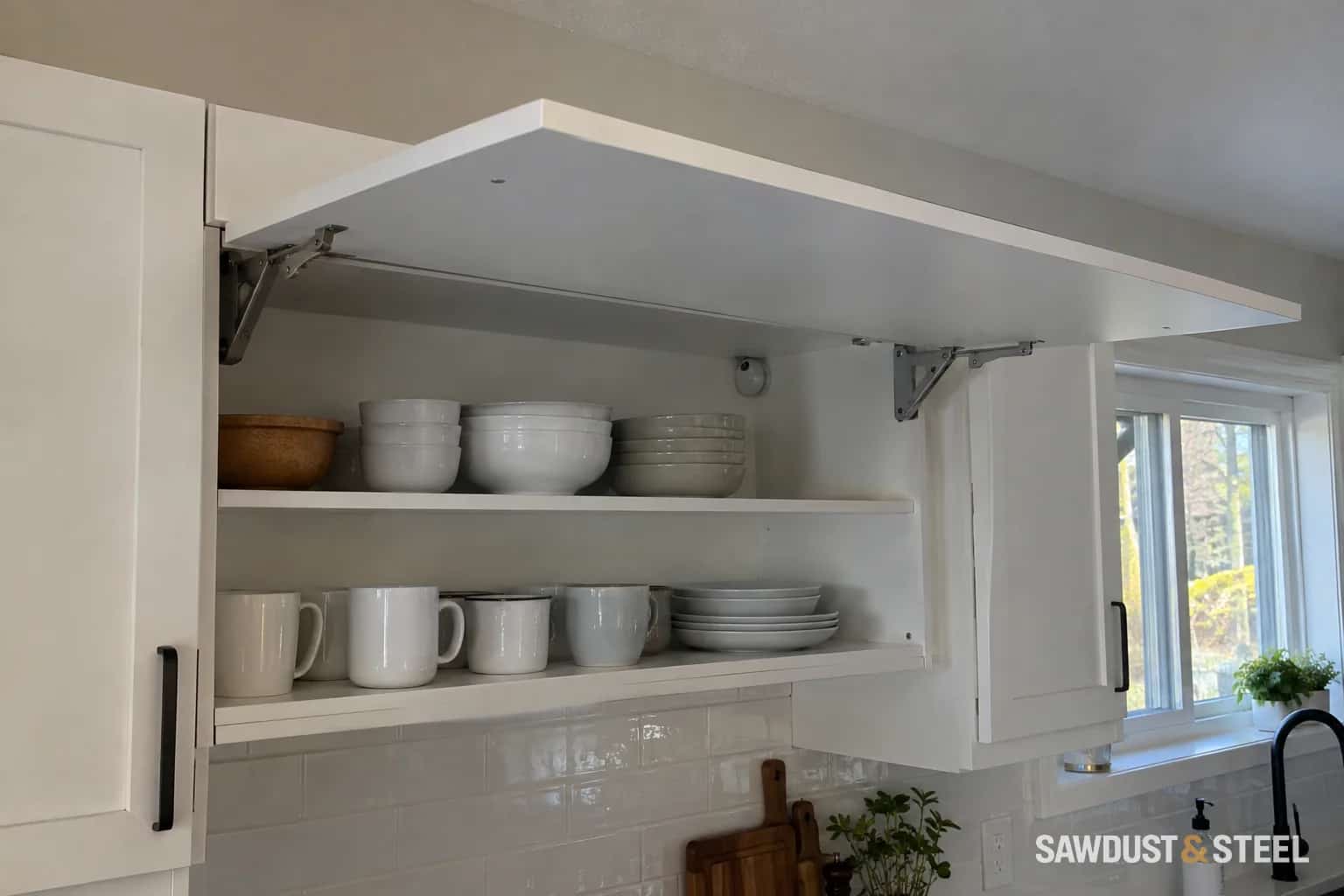
Lift-up doors can leave the space in front of a wall cabinet pleasantly clear. They also turn the gap above it into working space. That gap may already belong to a cornice, a sloping ceiling or the slightly lower end of an old bulkhead.
Find out how the front moves
A one-piece front that rotates upward does not use the same space as a bi-fold front or a door that lifts roughly parallel to the cabinet. Some travel above the box; others project farther into the room. Start with the exact hardware family and front dimensions, then look at its planning drawing.
| Opening movement | What to check |
|---|---|
| Stay-lift or flap-up front | Arc above and in front of the cabinet, including the handle. |
| Bi-fold front | Both panels and the folding joint throughout movement. |
| Up-and-over front | Space above and behind its highest position. |
| Parallel-lift front | Door travel in front of the upper cabinet area and access beneath it. |
These descriptions help you ask the right questions; they are not interchangeable hardware specifications. Even within one brand, a newer mechanism may use a different stop or setting from the previous generation.
Measure the obstruction that is actually there
Measure from the finished cabinet position to the lowest nearby surface, across the full width of the front. Include crown moulding, projecting trim, a ceiling beam and any neighbouring open door. A measurement to the bare ceiling before trim is installed can make a perfectly accurate drawing incomplete.
Give the supplier the front height, thickness and weight, including the handle, plus the finished cabinet depth and obstruction dimensions. Ask for the movement envelope at the proposed opening limit. The most useful answer is a drawing of your front passing your obstruction, not a general claim that the lift works near ceilings.
If the kitchen already exists, photograph the start of contact without forcing the front farther. Note whether only one corner touches. That may point to an uneven ceiling or cabinet alignment, whereas contact across the entire width suggests the planned movement simply does not fit.
Use the correct stop for the correct mechanism
Blum's guidance for AVENTOS HK and HK-S describes separate opening-angle stops and explains that front size affects the space required. Its examples are specific to those systems. The current AVENTOS HK top has an integrated adjustable stop instead.
That difference matters when ordering parts or following a video. Identify the marking on the lift mechanism, then use its own adjustment instructions or ask the installer to set it. A stop intended for another family, a cord tied to the front or a block screwed into the travel path is not a substitute.
If no permitted setting gives a useful opening, change the arrangement: a different lift motion, a lower cabinet position or a conventional hinged front may suit the room better. Avoid altering crown or cabinet height until you know which change actually resolves the conflict.
Check what happens after the collision is solved
Reducing the opening angle can keep the door below the ceiling but also leave it in the user's face or restrict access to the top shelf. Try taking out the largest regularly stored item. Then check that every regular user can reach the handle to close the door without stretching across a hot appliance.
Our upper-cabinet reach guide covers that human side of the measurement. For a coffee or mixer station, check the appliance in use as well: a lifted door that stays directly above a steam plume has solved the ceiling problem while creating another one.
Have the installer confirm that the front holds and closes as the mechanism is designed to do after any permitted adjustment. Do not detach the front or release spring-loaded arms to investigate a collision without the specific service instructions. If the door suddenly drops, stop using the cabinet until it is repaired.
For a counter-level appliance cupboard, weigh this front against the space a mixer lift needs below the counter. They solve different access problems; neither earns its place simply by making the appliance disappear.