
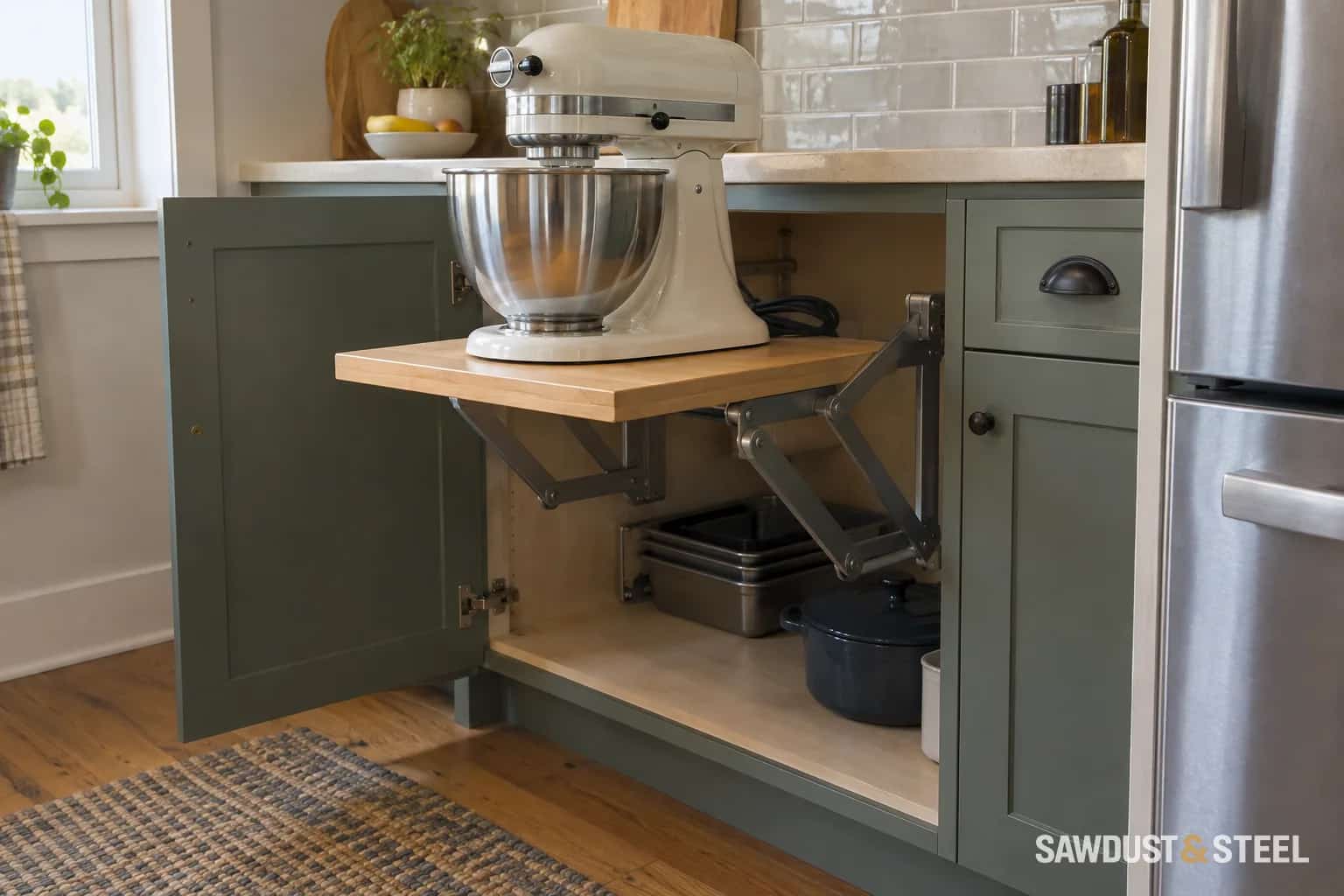
A stand mixer is easy to admire on the counter and less enjoyable to lift from knee height. A cabinet lift can help, but it spends a substantial part of a base cabinet to do one job. Before buying the mechanism, establish that it can bring your particular machine into a useful position.
Measure the mixer in more than one position
Record the machine's weight and footprint with the bowl and parts that will stay on the platform. Measure its stored height, then its working height: a tilt-head mixer needs space to raise the head, while a bowl-lift model needs room to remove the bowl and attachments. Include the handle or projection that is easiest to overlook.
Set the mixer on a counter and go through making something without switching it on. Can you add ingredients, release the bowl and remove the beater? Now compare that activity with the lift's proposed height and distance from the counter. A mechanism that reaches counter level may still leave you working farther forward than expected.
Follow the complete arc through the opening
The stored platform, moving platform and raised platform occupy different places. Match all three to the kit's drawings. The appliance can strike a drawer rail on the way up even when it fits beneath that rail at rest. A countertop overhang or open cabinet door can also occupy the route.
| Check | Include in the measurement |
|---|---|
| Cabinet opening | Frame, hinges, centre stile and actual door swing. |
| Inside the box | Clear depth and height after rails, shelves and services. |
| Moving load | Mixer, bowl and platform travelling together. |
| Raised position | Head or bowl movement, nearby handles and room to stand. |
| Return to storage | Cord route and clearance throughout lowering, not only at the endpoints. |
A drawer above the cupboard often complicates the arrangement. Do not cut its support rail to make a purchased lift fit. Ask the cabinetmaker whether the unit can be adapted, whether the drawer must be removed, and what usable storage remains. Sometimes a different cupboard is the cheaper answer.
Compare exact kits, not the words heavy duty
Rev-A-Shelf's ML series lists appliances up to 60 lb and adjustable spring tension. By contrast, the Knape & Vogt HAL20 instructions give a 30 lb maximum load. Those numbers belong to different products. They are not a range from which to choose an average.
Check what the selected rating includes, whether the required shelf is supplied, and how the platform is attached. Obtain confirmation when a heavy custom platform or accessory changes the load. The mechanism's capacity does not establish the strength of an old cabinet side or its existing fixings.
The HAL20 instructions specifically discuss support blocks behind a face frame and require its two mechanisms to be level and parallel. That illustrates why cabinet construction matters. Its screw locations and platform settings should not be transferred to a Rev-A-Shelf unit or another lift with similar-looking arms.
Try the lock and the working position
See a comparable installed lift if possible. Raise and lower it with the intended user, using a demonstration load allowed by the supplier. Can the person reach both release controls comfortably? Does the raised position lock as intended? Is the shelf stable enough for the appliance and its approved use? Ask explicitly whether the kit and installation are suitable for running your mixer on the platform, rather than using the lift only to transfer it to the counter.
Plan the cable so it cannot be pinched by the mechanism or stretched during travel. Keep hands away from the moving arms and follow the manufacturer's operating and tension-adjustment instructions. If movement becomes uneven or the platform will not latch, stop using it until the installation is checked; added force is not a repair.
Compare the space it saves with the space it uses
For a mixer used several times a week, avoiding repeated lifting may be worth a full cabinet. For occasional use, a reachable fixed shelf or properly fitted rollout may be enough. A rollout improves access but does not raise the appliance, so compare the actual lifting task.
If you prefer keeping the mixer at counter height behind a door, check the appliance-garage arrangement. For an upward-opening front, also check ceiling clearance and the handle's open position. The best hiding place is one you will still bother opening on a busy evening.