Sawdust & Steel
kitchen renovations

What it's actually like to live in your house during a kitchen renovation

An honest, week-by-week look at living through a GTA kitchen renovation — dust containment, temporary kitchenette, when to book the hotel, what to plan for.

February 26, 20269 min readby Marcus Cole
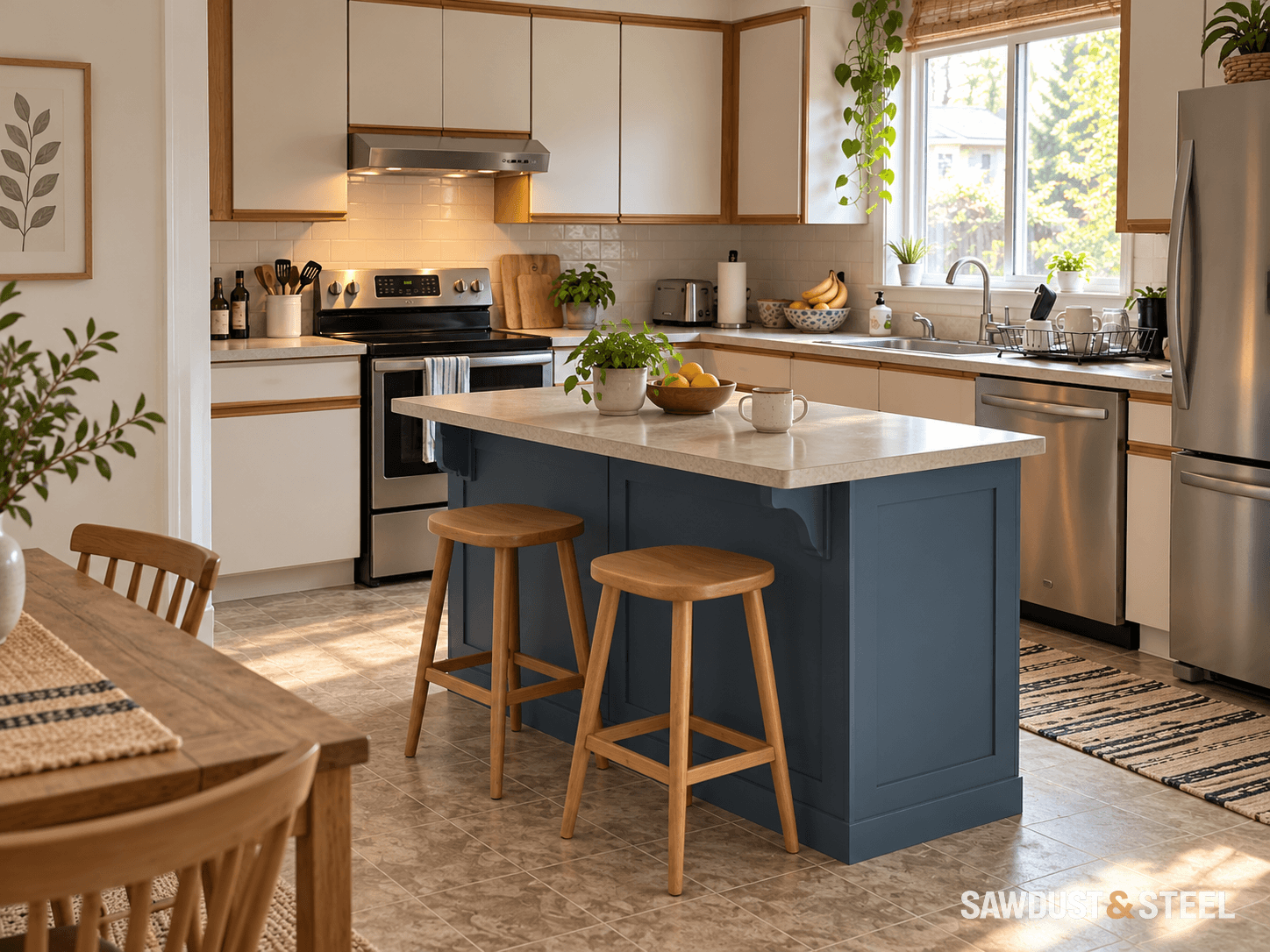
Modern kitchen with a blue island, butcher block top, and pendant lighting

Every kitchen consultation in the GTA eventually gets to the same question, usually about forty-five minutes in, usually from whichever parent is holding a coffee: "So, can we actually live here while you do this?" The short answer is yes, most of our clients do.

The long answer is that the six weeks you're about to sign up for is less about drywall dust and more about logistics — where dinner happens, which door the kids use, where the coffee machine lives, and whether you can tolerate a zipper wall at the entrance to what used to be your kitchen. This is a week-by-week, honest read on what that actually looks like on a typical Burlington or Mississauga reno. For the money side of the same job, see what a full GTA kitchen renovation costs in 2026 line by line.

We've done around two hundred of these. The pattern is consistent enough that we can tell you in advance which weeks feel rough, which weeks are quiet, and which small things every homeowner forgets to plan for until day three. None of this is meant to scare you off — the finished kitchen is worth the takeout. It's meant to make the six weeks tolerable instead of a surprise.

How long does a kitchen renovation take in the GTA?

A full gut kitchen renovation in the GTA takes four to eight weeks from demo to final walkthrough, with most of our jobs landing at five to six. The variance is almost never our crew — it's cabinet lead times, counter template-to-install windows, and whether the electrical rough-in triggers an ESA permit inspection that has to clear before drywall goes up.

Here's roughly how the weeks fall on a typical six-week job. It's not universal — every house has its own surprises hiding behind the drywall — but it's close enough that you can plan your life around it and only be wrong by a couple of days in either direction. Which, as renovations go, is basically on time.

  • Week 1 — Demo and prep. Two days of controlled teardown, one day of hauling, the rest of the week on rough framing fixes and opening up plumbing and electrical runs. Loud. Dusty. The temporary kitchenette gets set up on day one.
  • Week 2 — Rough-in. Plumber moves the sink line, electrician pulls new 20-amp circuits and whatever the ESA permit requires, HVAC tweaks the supply register if the layout moved. Quieter than week one but lots of trades walking through.
  • Week 3 — Inspection, drywall, prime. Rough-in inspection early in the week, then drywall goes up, taped, mudded, sanded, primed. Sanding day is the worst dust day of the whole job — plan to be out of the house from 8 to 4 if you can.
  • Week 4 — Cabinets. Delivery day is the big one. Boxes staged in the dining room, then installed over three to four days. This is the week the kitchen starts looking like a kitchen again and the family mood turns around.
  • Week 5 — Counter template, tile, paint. Counter template is an hour, then a ten-to-fourteen-day wait for fabrication. Tile backsplash goes in while we wait. Final paint and trim happen at the end of the week.
  • Week 6 — Counters in, plumbing final, appliances, punch list, walkthrough. Counters install in a single morning, plumber hooks up the sink and dishwasher the same afternoon, appliances roll in, we chase the punch list for a day, and then you get your kitchen back.
White shaker kitchen with stainless steel appliances and light wood floors
Week six, morning of the walkthrough. Counters are twelve hours old and the punch list is one page.

How do you keep dust out of the rest of the house?

Dust containment on a GTA kitchen job is a zipper wall at every opening, a HEPA air scrubber running continuously for the duration of demo and drywall, taped-off supply and return registers so the furnace doesn't suck drywall sand through the whole house, and poly on the floors between the kitchen and the front door. That's the baseline, and it works.

The specific gear matters more than people expect. We use ZipWall poles with 4-mil poly and a real YKK zipper door on the seam, not a tarp taped to the frame with painter's tape. The air scrubber is a Bauta-style HEPA unit rated around 500 CFM, which turns the kitchen air over roughly once every two minutes and pulls negative pressure so whatever escapes through the zipper gets sucked back, not pushed out.

On drywall sanding day we add a second scrubber and a Festool sander on a CT vac so most of the sanding dust gets caught at the source instead of floating.

  • ZipWall barrier with 4-mil poly at the kitchen entry, zippered door for trades to walk through
  • HEPA air scrubber (500+ CFM) running continuously, second unit added during drywall sanding
  • Supply and return HVAC registers in the work area taped over with 6-mil poly and Gaffer tape — not masking tape
  • Ram Board or builder paper over finished floors from the kitchen to whichever door the crew uses
  • Furniture in adjacent rooms covered in plastic on dust-heavy days even though the containment should handle it
  • Shoes-off rule for the crew past the zipper wall — we're obsessive about this and homeowners still notice it week two

The containment doesn't make the job dust-free. It makes it so the dust that does get through is the kind you find on top of a picture frame in February, not the kind you taste. Carmen in Burlington kept a white throw blanket on her living room couch the entire six weeks of her reno and texted us a photo of it on day forty-two — still white. That's the bar.

I kept waiting for the dust apocalypse everyone warned me about. It just never showed up. The zipper wall is louder than the actual kitchen work some days.

Carmen, Burlington

What does a temporary kitchenette actually look like?

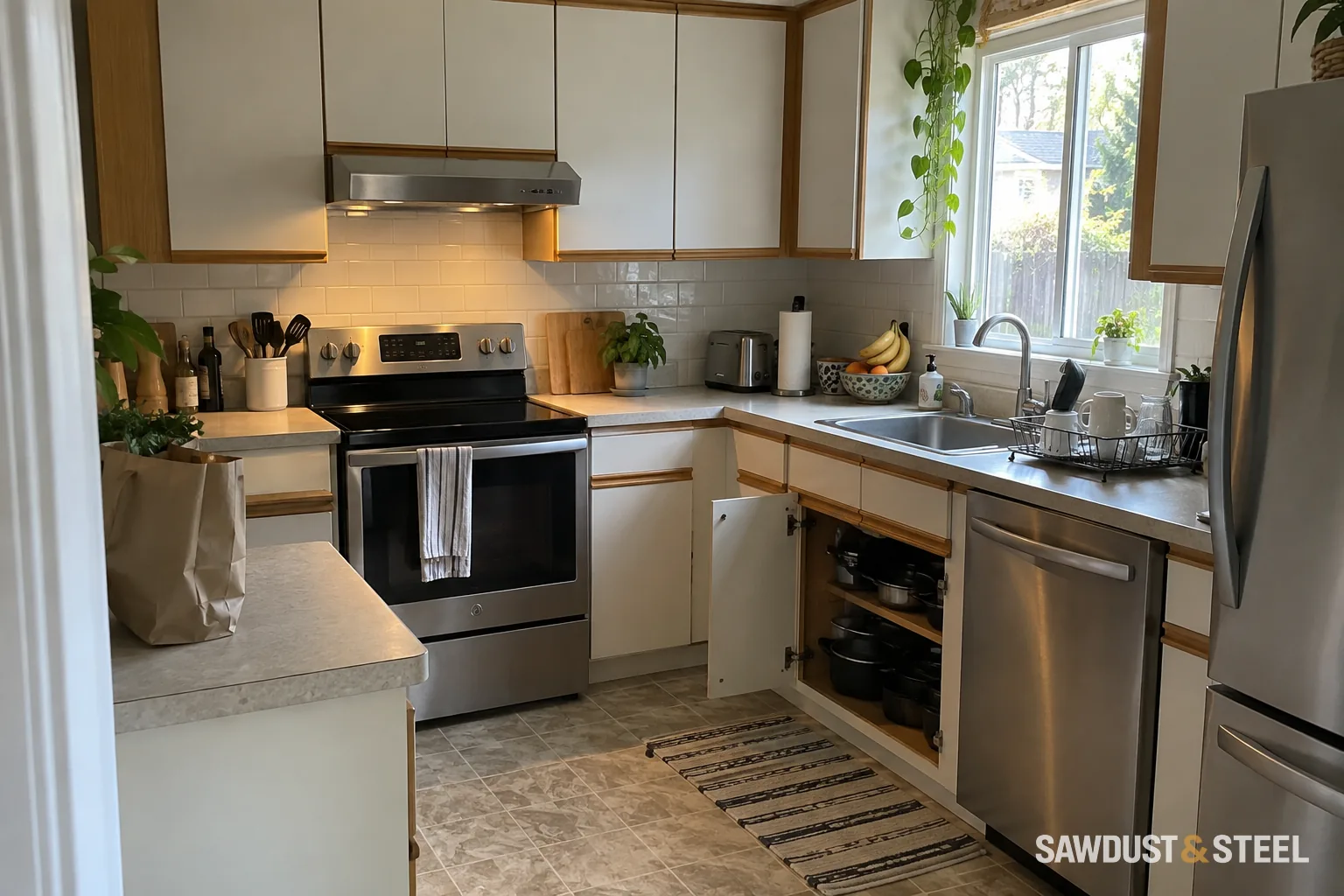
A working temporary kitchenette for a six-week GTA kitchen reno is a folding table in the dining room or basement with an induction burner, a microwave, an electric kettle, a mini-fridge, a 5-gallon water jug on a pump, a plastic tub for "dishes" (you'll be rinsing in the bathroom sink), and a garbage can with a real lid. Total cost to set up: about $350 to $500 CAD if you don't already own the burner.

The induction burner is the non-obvious hero. It's around $120 at Canadian Tire, draws on a normal 15-amp outlet, doesn't need venting, boils water faster than your old stove did, and turns off the second you move the pot so nothing scorches. One burner plus a microwave covers about 80% of a normal week of cooking — pasta, rice, eggs, stir fry, soups, frozen stuff. The 20% it doesn't cover is the stuff that forces the takeout rotation, which is fine because you were going to do that anyway.

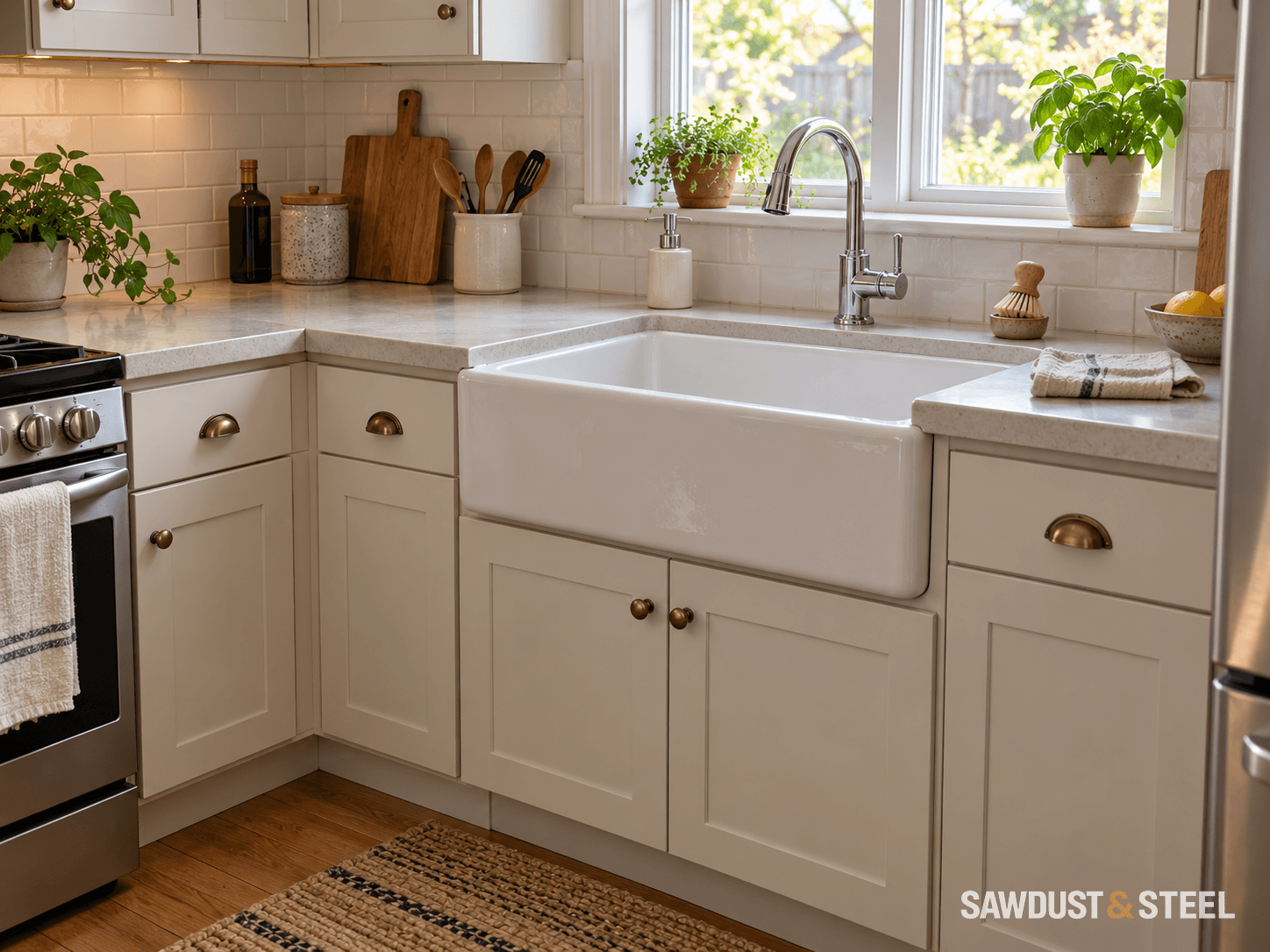
Farmhouse sink with open wood shelves and warm pendant lighting
The finished version. Four weeks of counter-height folding table turns into this.

Should we move out during a kitchen reno?

Most families don't need to move out for a GTA kitchen renovation, but there are three specific situations where we tell homeowners to book a hotel or stay with family anyway: drywall sanding day (24 hours), hardwood refinish day if you're redoing adjacent floors (48 hours), and any day the main water has to be shut off for more than a couple of hours. Everything else is tolerable with containment in place.

The bigger question isn't "can we physically survive this," it's "do we want to." Tom and Jess in Mississauga had a four-year-old and a seven-month-old during their reno last fall and decided to stay with Tom's parents for the first week of demo and the drywall sanding day in week three, then came back home for the rest.

That's a reasonable middle ground — about five nights of hotel or family-couch equivalent, spread across six weeks, instead of the full run. Total cost of that kind of partial move-out in the GTA is usually $400 to $800 if you're hoteling, zero if your in-laws still like you.

  • Book a hotel or stay elsewhere for drywall sanding day — one night, non-negotiable if anyone in the house has asthma
  • Plan around the water shut-off — we give 48 hours notice, it's usually under four hours, but having no toilet during toddler bedtime is the kind of thing that tests a marriage
  • Consider a night out on delivery day if you have toddlers — cabinet boxes staging in the dining room means the house is a maze of cardboard
  • Skip the hotel entirely if your house has a finished basement with a bathroom — you basically already have a second dwelling
  • If you work from home, plan two or three coffee-shop or co-working days per week during weeks one, two, and three — the noise during rough-in is not Zoom-compatible
Navy and white kitchen with herringbone backsplash and brass fixtures
Six weeks of folding-table dinners gets you here. Most families say it's worth it the first morning they make coffee in the new space.

The small things homeowners forget to plan for are almost always the same list, and they're not the dramatic ones. People expect the dust and the takeout. What catches them off guard is the coffee machine not having a home for six weeks, the recycling piling up because the recycling bin used to live under the sink that's now in the middle of the dining room, the cat finding a way past the zipper wall within ten minutes of the first time it's opened, and the fact that the garbage truck comes on Tuesday and you no longer remember which day Tuesday is because every day feels the same when your kitchen is a construction site. Small stuff. But it's the small stuff that grinds on people, not the big stuff.

A kitchen reno is a six-week inconvenience that ends with a kitchen. Viewed from the other side, the temporary kitchenette and the zipper wall and the drywall sanding day all get compressed in memory into a single vague "that part was rough" and the thing you remember clearly is the first dinner you made on the new island. Plan for the rough part, and it stays compressed. If you're pricing the job, our kitchen renovations service page is where most homeowners start.

questions & answers

Things homeowners ask.

  • A full gut kitchen renovation in the GTA currently runs $35,000 to $90,000+ CAD depending on cabinet tier, counter material, and whether any walls come out. Our jobs start at $15,000 for partial-scope refreshes and most full renos land in the $45,000 to $65,000 range for Kraftmaid or similar mid-tier semi-custom cabinets with quartz counters. Load-bearing wall removals add $6,000 to $12,000 once you include the engineer, permit, and beam.