Sawdust & Steel
custom decks & patios

Ontario Deck Permit Rules 2026: What Actually Fails Inspection

Ontario deck permit rules in 2026 — OBC 9.x triggers, guard and footing requirements, municipal quirks in Oakville and Toronto, and the top 10 things that fail inspection.

April 13, 202613 min readby Marcus Cole
Raised residential deck in the GTA showing code-compliant lattice skirt and framing

Every spring the same conversation happens at consultations across the GTA. Homeowner says I heard you don't need a permit for a deck if it's under a certain size. Sometimes they're half right. Usually they're quoting something a neighbor told them in 2014 before the Ontario Building Code amendments that tightened the rules. And almost always they're about to build something that absolutely needs a permit.

Here's the actual 2026 rulebook, written by people who pull deck permits in Oakville, Burlington, Mississauga, Toronto, Vaughan, and Hamilton every week. What the Ontario Building Code Part 9 says. What the specific municipal bylaws add on top. What drawings the examiner actually wants. What the inspector checks on each of the three site visits. And the ten things we see fail inspection most often — almost all of them preventable. If you want the cost side of deck building first, our custom deck cost breakdown for 2026 is the companion piece.

When does a deck need a permit in Ontario?

The headline rule in 2026 is unchanged from the last few code cycles: any deck where the walking surface is more than 60 centimetres (about 24 inches) above grade requires a building permit. That's the trigger under OBC 1.3.1.1 and the Building Code Act. The 60 cm number comes from the same place the guardrail requirement comes from — it's the height at which a fall starts to matter to the code. Below 60 cm you're in ground-level patio territory, and most municipalities don't require a permit for a structure that technically isn't considered a storey.

But height is not the only trigger. Four other situations also put you into permit territory regardless of how low the deck is:

  • The deck is attached to the house with a ledger board — the load path into the rim joist is a structural connection and almost every GTA municipality wants it reviewed.
  • The deck has a roof, pergola with more than 60% coverage, or any enclosed space underneath — now it's a "covered" structure and falls under different rules.
  • The deck has stairs with more than three risers — the stair itself requires a guard and handrail under OBC 9.8, and the permit scope covers the whole structure.
  • The deck is within a setback zone defined by your municipality's zoning bylaw — this is the one homeowners almost never think about, and it's how we've seen finished decks get ordered torn down.

Setbacks are municipality-specific and they vary more than you'd expect. Oakville requires a rear yard setback of 1.2 metres for a deck over 60 cm. Burlington allows a deck to come within 0.6 metres of the rear lot line in most R1 and R2 zones. Mississauga has a 0.6 metre side yard and a 1.2 metre rear. Toronto gets more complicated — different residential zones have different rules, and the downtown R zones are tighter than Etobicoke or Scarborough. The rule we tell every client: check your zoning before we draw the deck, not after. A 10 minute phone call to your municipality's building department saves a six-week redesign.

Freestanding decks under 60 cm, not attached to the house, not within a setback, with no stairs over three risers, do not require a permit in most GTA municipalities. This is the "ground-level flagstone alternative" case — a floating cedar platform you could theoretically pick up and move. We still build these to code because code is where the safety is, but you don't pay a permit fee on them.

Cedar deck with built-in bench showing framing and railing detail
This Oakville deck sat 34 inches off grade — well above the 60 cm trigger — so it needed a full permit, stamped footing detail, and three inspections. All three passed first time.

What drawings does the city actually want?

For a straightforward residential deck permit, most GTA municipalities want the same package of drawings. You don't need a PEng stamp for a basic deck under OBC 9 unless the span or load is out of the prescriptive tables in OBC 9.23 — which on a residential deck means anything over roughly 16-foot joist spans, cantilevers over 2 feet, or beams over 12 feet unsupported. Most decks we build are in the prescriptive range and don't need an engineer. When they aren't, we bring our engineer in early on the structural scope, because her stamp is what turns a "probably fine" design into a permit the examiner will actually accept.

  • Site plan showing the house, the deck location, distances to property lines, and the setback dimensions.
  • Plan view of the deck showing joist layout, joist spacing, beam locations, post/footing locations, and stair position.
  • Framing plan with member sizes, grade (usually SPF No. 1/2 or PT SPF), and on-centre spacing.
  • Elevation showing the height above grade, stair detail with riser and run dimensions, guard height (minimum 1070 mm / 42 inches when walking surface is over 1.8 m above grade, 900 mm / 36 inches between 600 mm and 1800 mm).
  • Footing detail — helical pile spec sheet or concrete sonotube depth and diameter. For helicals, the manufacturer's load rating usually substitutes for a site-specific calculation.
  • Ledger connection detail showing bolt spacing, flashing, and the Simpson or equivalent hardware being used.

Turnaround times in 2026: Oakville and Mississauga both run 10 to 15 business days on small residential deck permits. Burlington runs 12 to 20. Toronto is the slowest — 15 to 25 business days is normal and April through June can stretch to five weeks when the volume spikes. Richmond Hill and Vaughan sit in the Oakville range. Hamilton is faster than Toronto in our experience but has stricter setback enforcement.

Permit fees run $180 to $620 CAD depending on municipality and deck size. Toronto charges by square metre and is usually the most expensive. Oakville has a flat residential deck fee around $320 as of 2026. Never build without the permit in hand. We've inherited jobs where a previous contractor "saved" the homeowner the permit fee and the homeowner later had to pay the permit fee plus a "building without a permit" penalty that ran almost three times the original fee, plus the cost of opening up drywall to show an inspector the ledger connection.

The three inspections — footings, framing, final

Deck permits in Ontario come with three required site inspections under OBC 9. Each one has to be called in, each one has to pass before the next phase, and each one is where we see the most common failures. The inspectors are doing their job, and — being honest — most of what gets flagged is stuff that shouldn't have been built that way in the first place.

Inspection 1: Footing inspection

The footing inspection happens after the footings are placed but before the frame goes on top of them. For concrete sonotubes, that means after the tubes are poured and before backfill. For helical piles, that means after the piles are driven and the contractor has the drive torque certificate in hand. The inspector verifies the footings are at or below the frost line (1.2 metres / 4 feet in most of southern Ontario under OBC 9.12.2.2), the footings are the diameter the drawings show, and — for helicals — the drive depth matches the spec. Our helical piles vs concrete footings writeup covers which one we use and why.

Top footing failures: sonotube poured too shallow (under 1.2 metres frost depth), footing diameter smaller than the drawing, helical pile drive torque below the spec, helical pile head not bolted to the post bracket, and footing not plumb. Shallow frost-depth failures on sonotubes are the most common deck failure in the entire code inspection process, and they're almost always the sign of a contractor trying to save labor by half-digging.

Inspection 2: Framing inspection

The framing inspection happens after the frame is complete — joists, beams, ledger, posts, stairs — but before the decking goes down. The decking boards hide the frame, so the inspector has to see it naked. Inspectors check member sizes against the drawings, hanger nailing (every hole in a Simpson hanger has to be filled with a Simpson-approved nail or screw — this is the single most common framing failure), ledger bolting, flashing above the ledger, beam bearing, stair stringer sizing, and guard blocking.

Framing inspection on a typical 14x20 deck takes the inspector about 15 to 30 minutes. A first-time pass is normal if we've built to spec and have the permit drawings on site. A fail is usually one of three things: a missing hanger nail, a ledger bolt that's too close to the edge of the rim joist (must be at least 2" from the edge under OBC hardware rules), or flashing that wraps the wrong direction over the ledger.

Inspection 3: Final inspection

Final inspection happens when the deck is done — decking, railings, stairs, stain or finish if it's going on. The inspector verifies guard height, guard opening (no gap over 100 mm / 4 inches between balusters — the "4 inch ball rule" in OBC 9.8.8.3), baluster spacing, handrail height on stairs (800 to 965 mm / 31.5 to 38 inches above the stair nosing), guard deflection when pushed, and stair riser consistency. He'll stand on the deck, grab the railing, push outward — if it flexes more than a couple of centimetres, it fails.

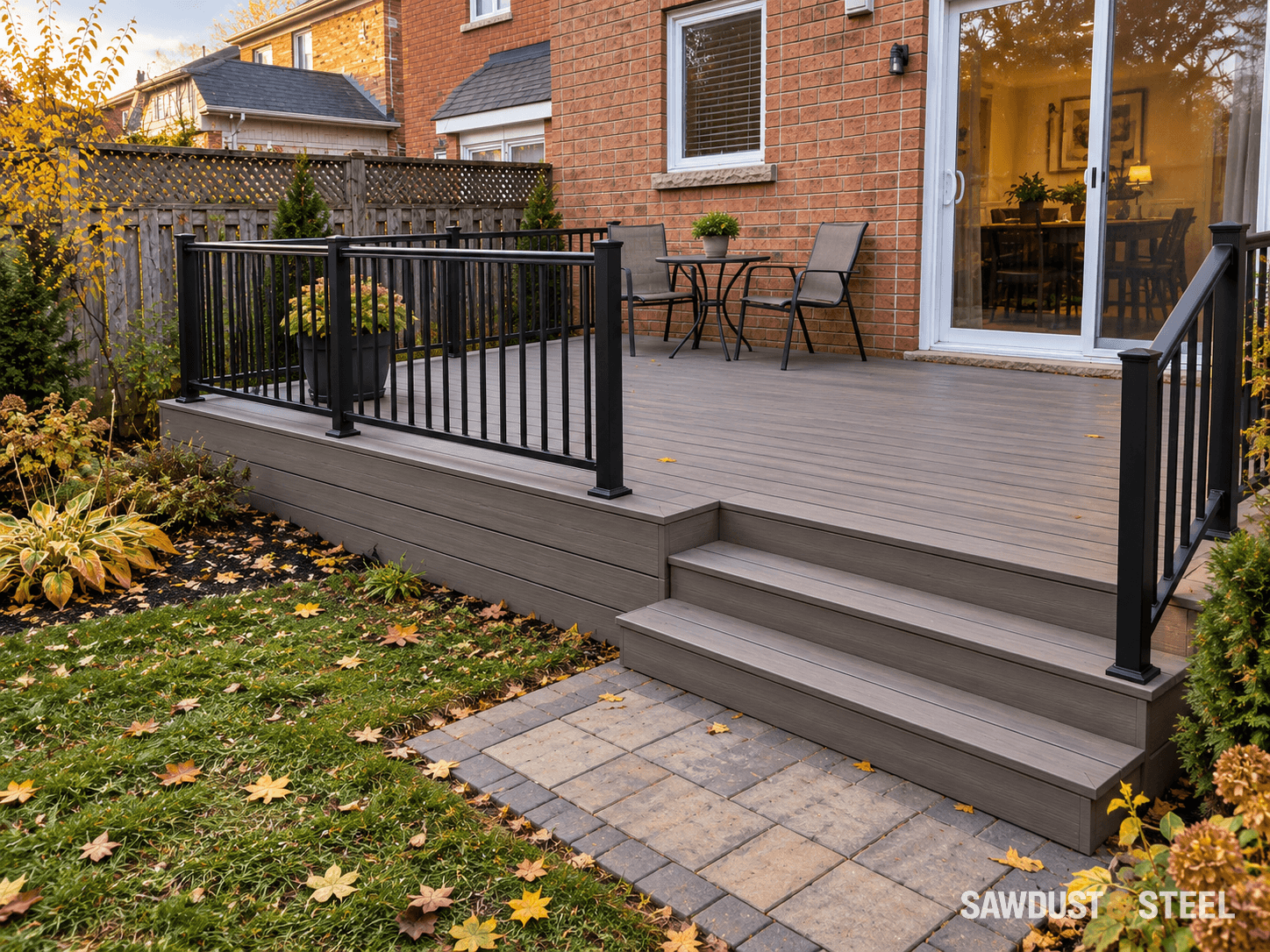
Composite deck with dark aluminum railing and stairs leading to a stone patio
Stair guards and deck guards meet at the landing. The guard has to be continuous around the top of the stair, and the handrail has to return to the guard at the top — one of the details inspectors check most often.

The top 10 reasons decks fail inspection in the GTA

These are the ten issues that show up most often on deck inspection failure notices across our service area. They're not the only ways a deck can fail, but they're the ones that come up again and again — and every one of them is preventable if the person building the deck has read the code and cares about passing the first time.

  1. Footings above frost line. OBC 9.12.2.2 requires 1.2 metres minimum in most of southern Ontario. A sonotube at 3 feet is a guaranteed fail and a guaranteed heave in two winters.
  2. Missing or wrong hanger nails. Simpson LUS hangers require every hole to be filled with a Simpson structural nail or screw (typically a 1.5" 10d). Using drywall screws or skipping holes fails every time.
  3. Ledger not flashed. Water has to be kept out of the ledger-to-rim connection. OBC 9.27 requires flashing that wraps up the sheathing and over the top of the ledger. We use copper or self-adhered membrane.
  4. Ledger bolts too close to edge. Minimum 2" from the top and bottom edges of the rim joist, minimum 2.5" from the end of the ledger. A bolt that splits the rim joist fails instantly.
  5. Guard height wrong. 900 mm (36") for decks between 600 mm and 1800 mm above grade, 1070 mm (42") for anything above 1800 mm. Inspectors measure with a tape, not by eye.
  6. Baluster spacing over 100 mm. The 4-inch ball rule. Space pickets at 3.75" on centre to be safe.
  7. Handrail missing or wrong height on stairs. OBC 9.8.7 requires a graspable handrail on any stair with more than 2 risers. 800 to 965 mm above the stair nosing, continuous, returns to the guard at top and bottom.
  8. Joist hangers undersized. A 2x10 PT joist needs a hanger rated for a 2x10 PT joist. Using a hanger one size down or a hanger not rated for pressure-treated lumber fails.
  9. Stair stringers notched too deep. OBC 9.8.4 limits how much meat you can cut out of a stringer. More than 5" of stringer left below the cut after the notch is the usual minimum — under that, the stringer is effectively a 2x6 and fails for a deck stair.
  10. No permit at all. The easiest fail to avoid and the most expensive to fix. A deck built without a permit triggers a stop-work order, a penalty, and usually a partial teardown to show the inspector the hidden connections — frame, ledger, footings.

The pattern in all ten is that they're the things a hurried or unlicensed builder cuts corners on. Every one of them is visible on the drawings before the deck is built. Every one of them is checked by the inspector on a scheduled visit. There's no mystery to passing inspection — there's just doing the work the way the code says.

Municipal quirks: Oakville, Burlington, Mississauga, Toronto

OBC 9 is the same across the province, but every municipality layers its own zoning bylaw on top, and a few add their own interpretation of the grey areas. Here's what we see differently between the four biggest service areas we work in.

Oakville is the most consistent and the fastest-moving of the four. The building department publishes a deck-specific guideline PDF that's actually useful, inspections are scheduled within two business days of calling, and the examiners are usually friendly on email revisions. The one Oakville quirk: they will not accept a deck ledger bolted into a brick veneer wall without a specific detail showing how the load transfers past the brick to the structural wall behind. We usually specify SDWS Timber Screws through the brick into the rim joist or a freestanding deck with a doubled beam where the ledger would go.

Burlington is similar on code but slower on inspection scheduling — expect 3 to 5 business days after the call, sometimes longer in peak season. Burlington is also stricter on rear yard coverage limits; the zoning bylaw caps how much of the rear yard can be "hardscaped," and a big deck plus a patio plus a pool can push you over the limit. Check the coverage math before you draw.

Mississauga examiners tend to ask for more detail on the stair guard and handrail return than the other three cities. We draw it explicitly on every Mississauga permit now to pre-empt the comment.

Toronto is the most paperwork-heavy. The review takes longer, the examiner is more likely to come back with comments, and the setback rules change by zone — RD, RS, RT, and RM zones all have slightly different deck rules. Toronto also enforces the Tree Protection Bylaw on private trees over 30 cm diameter at breast height; if your deck construction is within 6 metres of a protected tree, you may need a separate tree protection plan before the permit is released. We've seen this delay a Toronto deck by four weeks.

The one thing all four cities agree on: a deck built without a permit is a deck the city will ask you to take apart if a neighbor complains or a real estate agent flags it on a title search. Permits are cheap compared to unbuilding a deck. We price them into every quote and we pull them in the homeowner's name with power of attorney on the application.

The previous owner built the deck without a permit in 2018 and I found out the hard way at closing. Sawdust had to open up the lattice skirt so the inspector could photograph the helical piles and the ledger flashing before the city would sign off. It cost me four thousand dollars and three weeks. Next deck I build in this house is going to start with a permit application.

Permit costs and how to think about them

Permit fees and drawings together run $400 to $1,200 CAD on a typical residential deck in the GTA in 2026. That breaks down to about $180 to $620 for the municipal fee itself, $150 to $400 for the drawings if your contractor prepares them (we include this in our quotes), and $0 to $350 for engineering if the deck is outside the prescriptive tables.

On a $22,000 cedar deck, that's roughly 3 to 5 percent of the total job — not a number that changes your mind about building the deck. The contractors who make a big deal about "saving" the permit fee are almost always the ones who are going to cut other corners you won't see. We'd rather lose a job on price than build a deck without a permit. Our custom decks and patios service page is the place to start if you want to talk through the specifics for your house, and our cedar vs composite vs pressure-treated writeup covers the material decision that usually comes up in the same conversation.

The permit isn't a bureaucratic obstacle — it's the paper trail that proves the deck is safe, built to code, and legally part of the house. Ten years from now when you sell, the permit is the document the buyer's inspector wants to see, and it's the reason the deck doesn't become a negotiation item at closing. Build it right the first time. Pull the permit. Pass the three inspections. Enjoy the deck for the next twenty-five years.

questions & answers

Things homeowners ask.

  • A deck permit is required in Ontario whenever the walking surface is more than 60 cm (about 24 inches) above grade, the deck is attached to the house with a ledger, the deck has stairs with more than three risers, or the deck falls within a municipal setback zone. Ground-level freestanding decks under 60 cm in most GTA municipalities do not require a permit, but zoning setbacks still apply. When in doubt, call your municipality's building department before you build.