
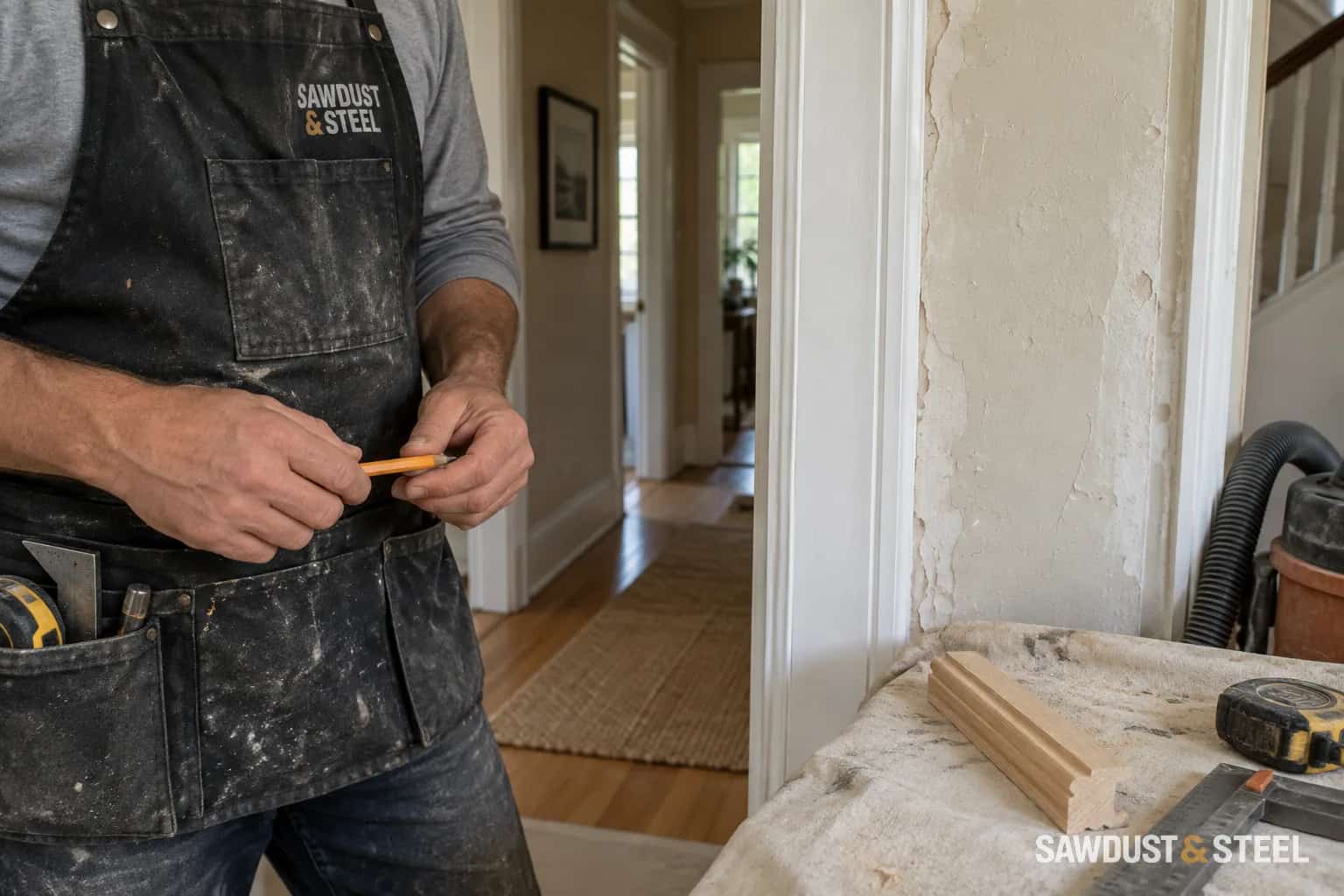
The replacement casing looked right in the store. At the doorway, its rounded edge sat proud of the old piece and the small groove landed just low enough to be annoying. Matching trim is a job for a sample and a ruler, not a good memory of the lumber aisle.
You do not always need to replace every piece in the room. The right answer depends on where the new and old work meet, whether the finish is paint or stain, and how much matching material you need.
Bring the shape, not just the name
Look for a loose offcut or an end exposed by the current renovation. Preserve useful existing material with the methods in saving old trim during a renovation. Do not pry a sound piece off simply to obtain a sample if an accurate tracing and measurements will let a supplier start the search.
Measure the overall width and maximum thickness. Record the thickness at both edges and the locations of the broad flats, curves and steps. Photograph the end square-on with a ruler in the same plane. A photograph taken at an angle makes a small profile surprisingly difficult to compare. For painted older material, avoid sanding or scraping unknown coatings just to make the sample prettier; a clean existing end is enough for the first conversation.
| Record | What it resolves |
|---|---|
| Full-size end outline | Shows the actual geometry without relying on a catalogue name. |
| Width and maximum thickness | Eliminates close-looking stock that will not meet the existing pieces. |
| Species and finish | Distinguishes a painted match from a stained match that also needs grain compatibility. |
| Required lengths and quantity | Lets the supplier check stock lengths, waste and a possible custom run. |
| Photograph of the junction | Shows whether a tiny difference will be directly visible. |
Compare the shadow lines
Woodgrain's lineal moulding catalogue provides standard profile information and custom options. A supplier can use that sort of drawing to compare a section properly. Names such as colonial or ogee describe a family of shapes; they do not promise identical geometry across suppliers or decades.
Hold samples together with their back faces on a flat surface. First compare the outer edges, then the main ridges and hollows. Finally, put them beside the actual wall. A difference that vanishes on separate doorways can be very obvious halfway along one uninterrupted baseboard run.
Consider a 90 mm-wide old casing and a 92 mm candidate. Those example measurements alone do not settle the decision. The extra width might be manageable around an entire new doorway, while a different edge thickness prevents a neat splice into an existing leg. Write down where the joint will be before spending time on an almost-match.
When custom milling makes sense
Custom work becomes more attractive when the profile repeats through several connected rooms, when a long visible run must be repaired, or when the original shape contributes strongly to the house. Ask about tooling or setup charges, minimum order, available species, lead time and whether the delivered surface needs finish sanding.
Request a short approval sample before the complete run. Compare it at the intended junction and under the room's light. For stained work, make a finish sample too: identical curves do not make different grain and colour disappear. The stained-trim colour matching guide covers that second problem.
I like to keep one accepted sample marked on the back until the job is finished. It is a small bit of wood that saves a much larger discussion when an extra length arrives from a different batch.
Choose a clean stopping point
If exact matching is impractical, replace a complete doorway surround or a complete wall run rather than inserting a conspicuous odd piece in the middle. Corners, plinth blocks and designed transitions can separate profiles, but they should suit the room. Adding a chunky block everywhere to hide one mismatch usually creates a new design problem.
Check how the proposed piece meets the baseboard, floor and adjacent doors. A thicker casing may project beyond a baseboard that previously returned neatly. A wider baseboard may expose old paint lines elsewhere when removed. Make a short dry-fit at the most complicated corner before committing.
Order enough matching stock for realistic cutting waste and one future repair if the profile is difficult to obtain. Label the spare with the supplier, profile and finish. Next time, the person trying to match this room may be you, and you will appreciate the note.