Sawdust & Steel
finish carpentry & trim

MDF vs Poplar vs Pine Trim: The Honest Tradeoffs for Ontario Houses

An honest comparison of MDF, poplar, and pine trim for baseboards, casing, and crown moulding in Ontario renovations — durability, cost, finish quality, and where each belongs.

March 17, 20269 min readby Marcus Cole
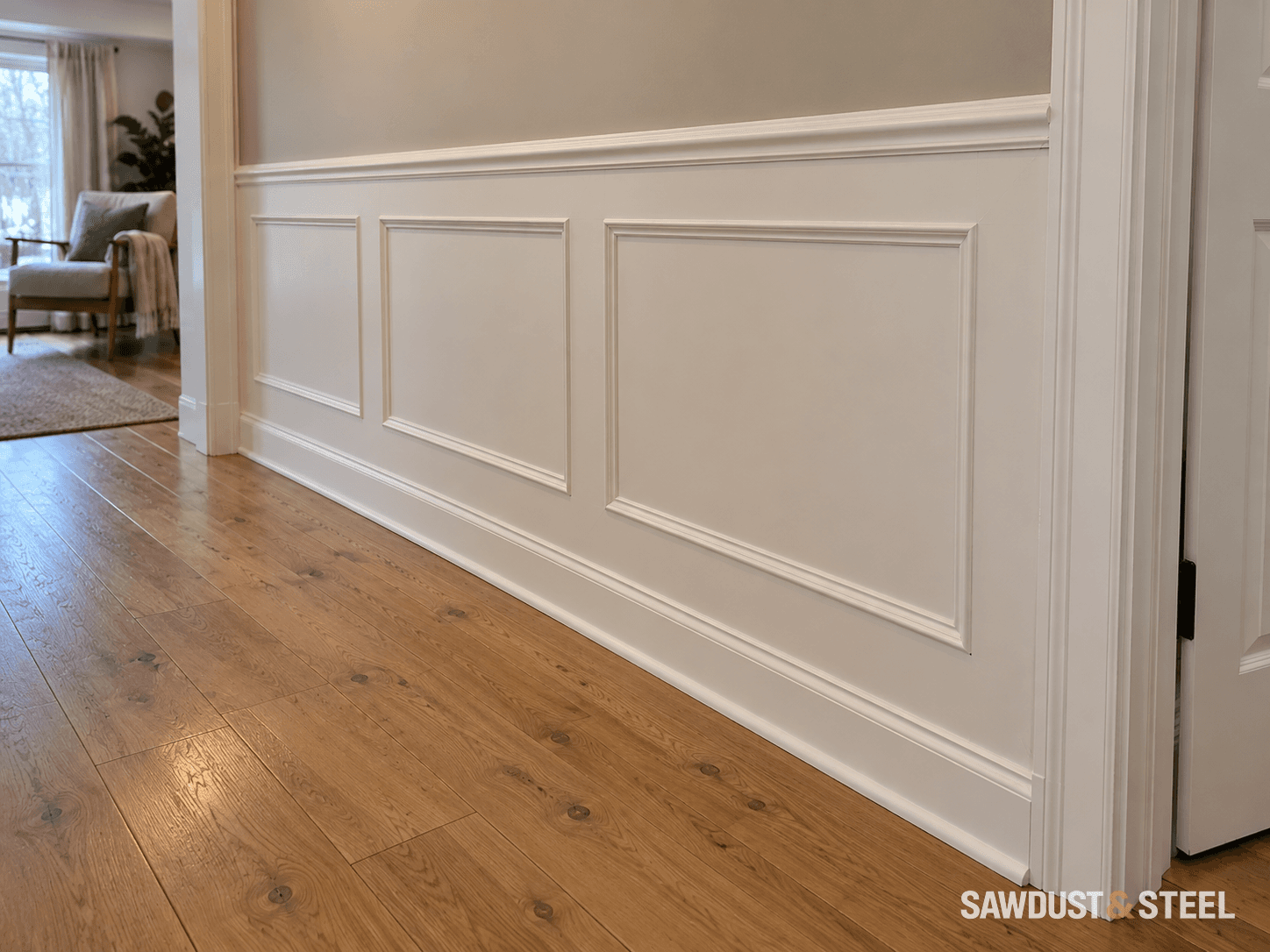
White wainscoting hallway over dark hardwood floors

Every trim consultation we do in the GTA eventually lands on the same material conversation. MDF, poplar, or pine — which should you use, and why are your neighbors' quotes so different? The three materials serve overlapping but not identical use cases, and picking wrong is the difference between trim that looks great on day one and trim that looks great in year ten.

We install all three and we have strong opinions about where each belongs. This post is the honest breakdown — it pairs with our scribing trim in old Ontario houses post if you're working on a pre-1990 build.

One framing note before we get into it. This post is specifically about paint-grade trim — baseboards, door casing, window casing, crown moulding, wainscoting — that's going to be painted white or a color after install. Stain-grade trim (where the wood grain shows through a clear or stained finish) is a completely different conversation involving oak, cherry, walnut, maple, and other hardwoods, and we'll cover that separately. Most GTA renovations are paint-grade, so that's the lens we're using here.

MDF — the default for most GTA paint-grade trim

Medium-density fibreboard is what the builder installed in your suburban home. It's pressed wood fibre glued and compressed into long lengths, milled into a profile, and shipped primed. We buy it from Metrie, Windsor Plywood, or Taiga Building Products in Ontario, and the three grades that matter are standard MDF, moisture-resistant MDF (MR-MDF), and ultra-light MDF. For baseboard, casing, and crown, standard MDF is fine in dry areas and MR-MDF is the right call anywhere within 6 feet of a bathroom, laundry, or exterior door.

What MDF does well: it's cheap, it comes pre-primed so it takes paint beautifully with minimal prep, it cuts cleanly on a mitre saw with the right blade, and it doesn't have grain that telegraphs through paint. A high-quality MDF baseboard with two coats of good semi-gloss latex paint looks legitimately great and is indistinguishable from painted poplar at six feet of distance. That's a real thing — the finish is the thing most people notice, and MDF delivers the same finish as more expensive materials for about half the cost.

What MDF does badly: it dents, chips, and swells if it gets wet. A vacuum cleaner head whacking a baseboard in a high-traffic hallway leaves a visible dent in MDF that wouldn't register on poplar. A mop bucket tipping onto a bathroom MR-MDF baseboard is usually recoverable, but water sitting against standard MDF in a basement for eight hours turns the bottom inch into mush. These are not catastrophic failures — you can repair a dent with wood filler and repaint the spot — but they add up in houses with kids, pets, and basements.

  • Cheapest paint-grade trim option: $3.80 to $6.50 per LF for 5.25" profile in 2026
  • Pre-primed — takes paint beautifully with minimal prep
  • No grain to telegraph through paint; finish reads flat and clean
  • MR-MDF (moisture-resistant) for bathrooms, laundry, basements, and exterior door areas
  • Dents and chips from impacts (vacuum heads, toys, furniture)
  • Swells if exposed to standing water — repair is possible but visible
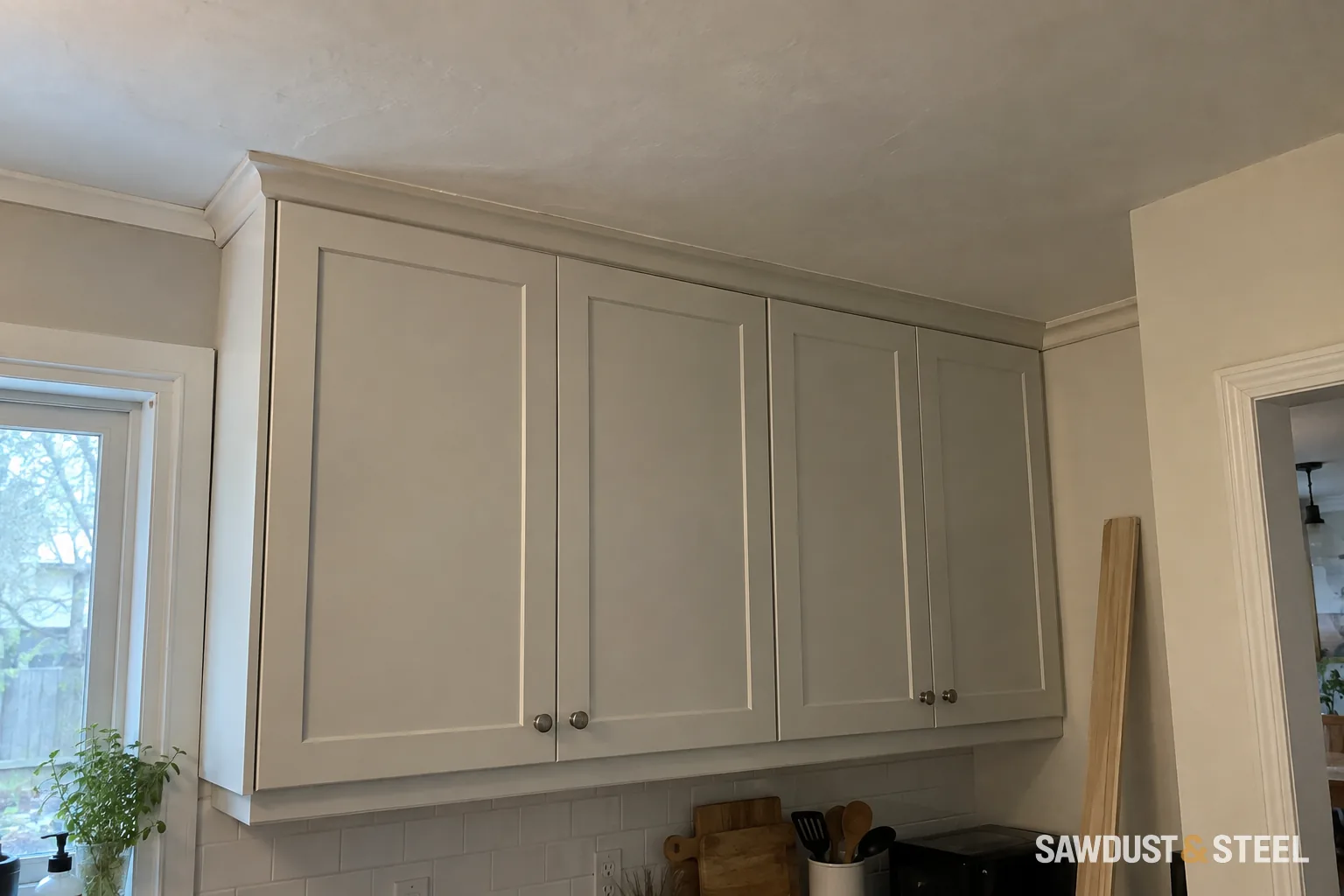
Painted crown molding above a built-in bookshelf
5-inch MDF crown moulding in a Burlington living room. Painted white with two coats of Benjamin Moore Advance, scribed at every inside corner. Total material cost for the crown: $340 on a room this size.

Poplar — the default for premium paint-grade work

Poplar is the middleweight champion of paint-grade trim. It's a North American hardwood (technically a hardwood though it's soft for its category), typically kiln-dried, and comes as rough or S4S (surfaced-four-sides) in dimensional stock. We buy it from a few hardwood dealers in the GTA — Rona has decent stock occasionally, but for volume we go to Exotic Woods in Burlington or Century Mill in Oakville. Poplar mills cleanly, takes paint beautifully, and has enough hardness to handle the dents and dings that MDF struggles with.

What poplar does well: it's hard enough to shrug off the vacuum-cleaner bump that dents MDF, it takes a sanded finish that's smoother than factory-primed MDF after a coat of primer, and it's much more stable in humidity changes. Our poplar baseboards in a 1978 Oakville bungalow have been through eight summers of Ontario humidity with no gap opening, no shrinkage lines, and no telegraphing. MDF in the same house would have a few visible joints by now.

What poplar does badly: it's more expensive (roughly 70% more than MDF for the same profile), it needs a coat of primer before paint (MDF ships pre-primed), and the knots and grain occasionally show through paint if you didn't grain-fill first. On a really premium job, poplar should be grain-filled with a water-based grain filler before primer, which adds another day of labor and about $1.20 per LF in materials and time. It's worth it on a visible wall in a formal room. It's overkill on a basement hallway.

  • Mid-tier paint-grade trim: $6.50 to $11.00 per LF for 5.25" profile in 2026
  • Real hardwood — shrugs off impacts that dent MDF
  • Stable across Ontario humidity swings
  • Takes paint beautifully but needs primer (unlike factory-primed MDF)
  • Grain-fill recommended on formal-room visible walls; optional elsewhere
  • The default for old-house scribing work where trim needs to be planed to fit
White poplar wainscoting in a hallway with dark hardwood floors
Painted poplar wainscoting in a 1970s Burlington hallway. The 1/2-inch difference in floor level across the run required scribing every panel — poplar takes the plane beautifully.

Pine — the budget option with real tradeoffs

Finger-jointed pine baseboard, casing, and crown is the cheapest solid-wood option on the Ontario market. It's pine stock cut into short lengths, finger-jointed end-to-end, milled into profile, and sold as primed or unprimed lengths. The material itself runs about the same as MR-MDF — $4.50 to $7.50 per LF for a 5.25-inch profile — and it's marketed as a step up from MDF because "it's real wood."

We install pine occasionally and we honestly don't love it. The reason is the finger joints. Every 8 to 14 inches there's a joint where two pieces of pine were glued together, and that joint moves slightly across seasonal humidity changes. On a well-primed, well-painted run, the joints show up as faint horizontal lines under certain light. They're not obvious, but they're visible, and they're the thing that makes old finger-jointed pine trim look "off" compared to poplar or MDF. If you're painting with a high-gloss or semi-gloss finish (anything above 20% sheen), plan to see those joints eventually.

Where pine is a fine choice: unpainted or stained clear pine for a specific rustic look (the Scandinavian cabin aesthetic), casing in a closet or utility area where the aesthetic doesn't matter, and baseboard in a basement where budget is genuinely the deciding factor and the walls are low-visibility. Where it's not a fine choice: formal living rooms, bedrooms, hallways, or any high-visibility area where the joints will eventually bug you. We'd rather install MDF in those rooms than pine — it's cheaper and the finish is more consistent.

  • Finger-jointed pine 5.25" profile: $4.50 to $7.50 per LF in 2026
  • Marketed as "real wood" — technically true, with finger joints every 8–14 inches
  • Joints telegraph under high-gloss paint over time
  • Fine for low-visibility areas (closets, utility, basement)
  • Not our first choice for formal rooms — MDF reads cleaner for less money
  • Clear or stained pine (solid, not finger-jointed) is a different product — priced 2–3x higher

What about PVC trim and the newer composites?

The category nobody asks about but should is PVC trimAzek, Versatex, Kleer, and Metrie Fjord are the common brands in Ontario. PVC is cellular plastic milled into standard trim profiles, impervious to water, dimensionally stable in extreme humidity, and paintable with standard latex. Per linear foot it's 2 to 3 times the cost of MDF, which is why most contractors don't spec it by default. But it's the right call in specific situations that MDF and poplar can't handle.

Where PVC earns its premium: baseboards in a basement that sometimes gets 1/2 inch of water in a heavy rain (MDF would swell, poplar would cup), window casings on a sunroom where condensation runs down the frame, trim around a mudroom bench that gets mopped weekly, and any application where the trim is going to be touched by occasional moisture.

We've installed PVC baseboards in a Toronto east-end house that had a basement drainage issue, and four years later it's still flat, still sealed, and still looks exactly like the day we painted it. Standard MDF would have lost by year two.

Where PVC is not the right call: dry rooms where you're paying a premium for waterproofing you'll never need, and formal visible spaces where the subtle plastic-feel of PVC under your fingertips registers compared to wood. PVC is not trying to feel like wood — it's trying to be functional. If the trim is at a finger-touch height (wainscoting, chair rails), we'd lean toward poplar even if MDF is cheaper. If it's baseboard and it's getting hit with water, PVC is the right answer.

White window casing near barn door hardware
Painted window casing in a Markham semi. The casing is poplar; the head detail is MR-MDF because the window wall gets direct morning condensation every winter.

We went with poplar for the main floor and MDF upstairs in the bedrooms. Four years later I can't tell the difference, but the main floor has taken a few hits from the dog that the upstairs hasn't.

Josh T., Markham

The short version: for most GTA paint-grade trim work, MDF is the right call because it delivers 90% of the finish quality for 60% of the cost. Poplar is worth the upgrade in high-visibility rooms or in old houses where heavy scribing is required. Pine we'd skip in favor of MDF in almost every case. PVC is the specialist play for wet-zone applications.

And all four will take paint beautifully if the prep is good, which is the part most DIY and cut-rate contractor jobs get wrong regardless of material choice. Our finish carpentry and trim service covers all four.

questions & answers

Things homeowners ask.

  • For painted finishes in dry rooms, MDF delivers roughly 90% of the finish quality of poplar for about 60% of the cost. The visible difference is negligible once painted. Where real wood wins is impact resistance (poplar shrugs off dents that MDF shows) and moisture resistance (standard MDF fails in wet areas). In a typical GTA home, MDF is fine for formal rooms and MR-MDF is the right call near bathrooms, laundry, and basements.