
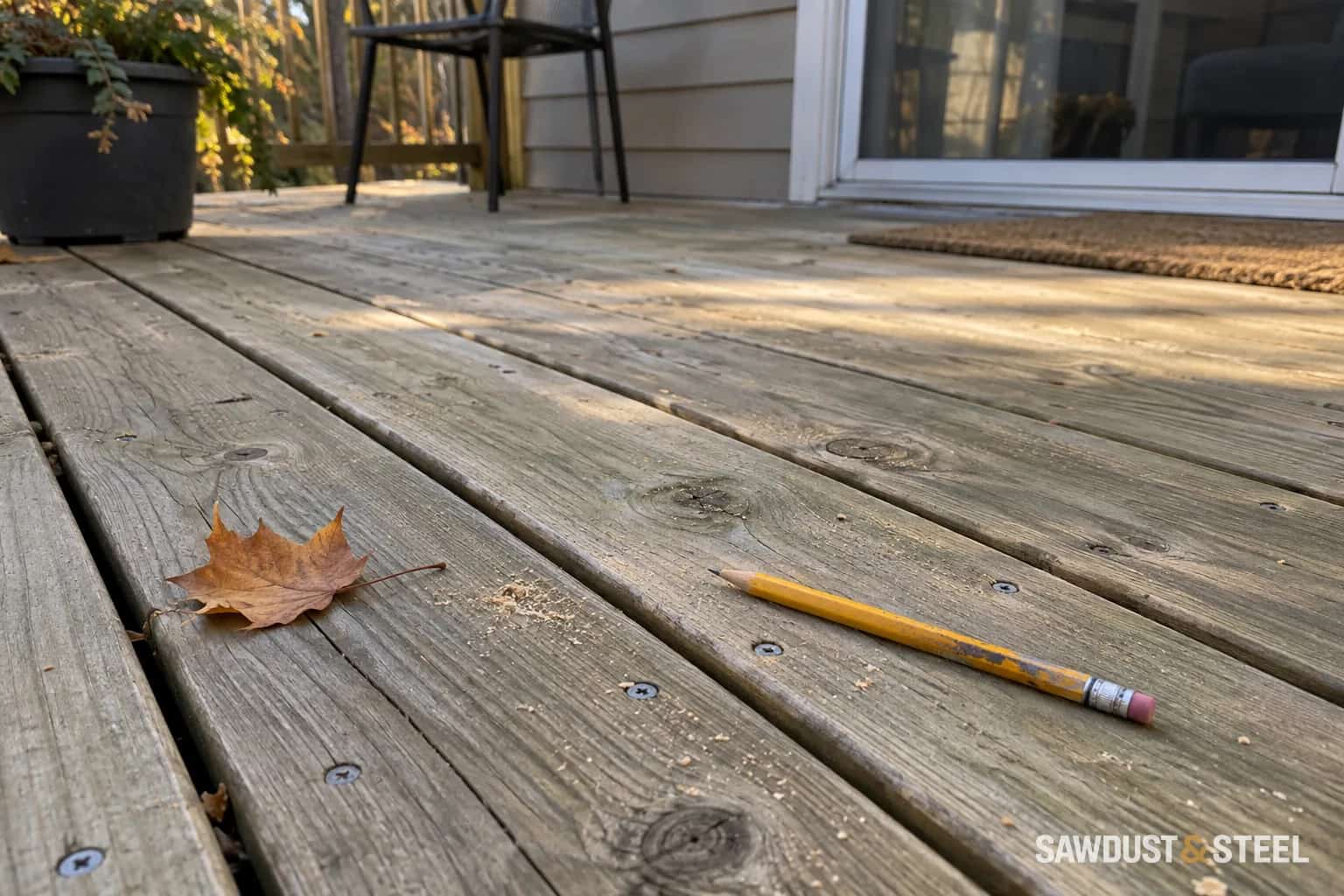
The deck we visited in Vaughan had done nothing dramatic. No sinking corner, no loose railing, no mysterious slope. But the gaps looked wider than the owner's installation photos. He had found his carpenter's pencil underneath it, which was both useful and mildly annoying.
The timber does not stay exactly as it arrived
Pressure treatment protects against specified decay risks; it does not freeze wood at one size. As moisture changes, timber can change dimensions. A board that arrived wet and heavy may become narrower as it dries, while seasonal moisture can change the gaps again.
Wood Preservation Canada's building tips distinguish damp, heavy decking from dry, light boards when discussing installation spacing. The useful lesson is to account for the actual timber, rather than repeat a spacer rule without checking what is being installed.
Look at the pattern before choosing a fix
| What you notice | What deserves checking |
|---|---|
| Similar widening across many boards | The original moisture condition and specified installation spacing. |
| One gap much larger at one end | Board bowing, alignment and the fastenings. |
| A loose or raised board edge | The board, screw hold and framing condition. |
| Gaps packed with wet debris | Cleaning and drainage before judging the spacing. |
Photograph a few fixed locations with a ruler visible, noting the date and weather. Keep the installation photos and the lumber information if you have them. That gives the builder something better than a memory of how close the boards looked in June.
Some changes are ordinary; some deserve repair
A wider gap alone does not prove the deck is unsafe, and it does not prove the installation was correct. The size, consistency, walking surface and product guidance matter. Gaps that trap a chair foot or create an awkward walking surface warrant a practical review even when drying explains how they appeared.
Do not fill them with rigid filler or caulk. Those spaces have a drainage job, and the boards continue moving. Re-spacing or replacing selected boards can be reasonable after the cause is understood, but it can expose old fastener holes and change edge details. Agree what the finished repair will look like.
Check the frame if the boards are moving strangely
At the Vaughan visit, the original photos showed wet boards, and the widening was broadly consistent. We recorded it, checked the loose-looking area the owner had pointed out, and left the sound boards alone. His pencil came back into service. It had acquired a little more personality.
For packed gaps, start with clearing leaves between deck boards. For loose or deteriorated boards, assess whether the existing frame can stay. And keep timber movement separate from composite expansion guidance; the two materials do not share one installation rule.