
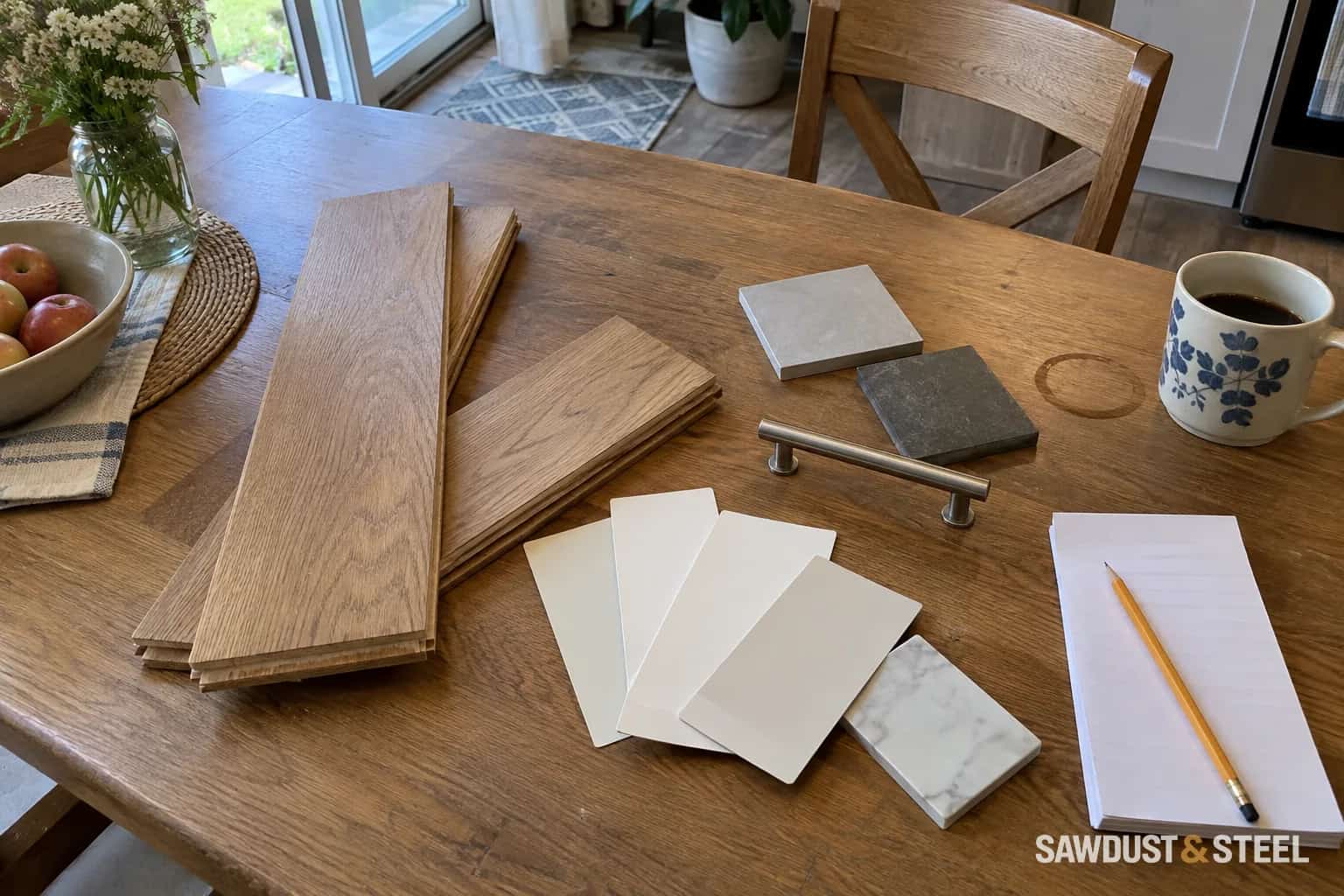
A tile chip looks agreeable in the shop. At home, the full tile is much busier and its edge is thicker than the trim you chose. Samples are most useful when they test a decision that is still reversible.
Make the sample answer a question
For paint, the question might be how the colour looks beside the retained floor. For tile, it might be grout contrast or the edge at a doorway. For cabinetry, it may be how a handle feels on the actual door profile. Choose the sample size and setup around that question.
Benjamin Moore: using paint colour samples recommends movable boards to see paint in different lighting and notes that colour-sample paint is not the final coating system. A useful colour check should not be mistaken for a durability test.
Small chip
Narrow the colour or material family.
Larger movable sample
Check the room's light and neighbouring finishes.
Built detail
Test grout, edge thickness, handle feel or a trim joint.
Labelled approval
Keep a physical reference for delivery and installation.
Put materials in their finished positions
Hold a wall finish upright and lay a floor finish flat. Put the proposed countertop, cabinet and backsplash beside one another. View them during the day and under the intended evening lighting. Your phone can record the arrangement, but its automatic exposure and screen do not make it the final judge of colour.
Bring back retained materials too. A small sample of existing trim or a clear view of the old floor is more helpful than remembering it as 'warm oak'. If the proposed light fittings are not available, record that limitation rather than approving a colour under unrelated lighting.
Mock up the difficult joint
Ask for a representative tile-and-grout board, a finished trim corner or a handle fitted to a spare door when that detail matters. Check thickness, shadow, cleaning access and the feel of edges. These tests often reveal questions that a flat mood board cannot.
Use room measurements to test proportions as well. A paper outline can show cabinet bulk or a mirror's size without ordering it first. Keep the mockup clear of exits and do not attach anything in a way that damages a vulnerable finish.
Record what was approved
Label samples with product, finish and date, and keep the accepted reference through installation. Agree how normal variation will be handled. If the delivered material differs materially, stop and review it before fitting; the delivery inspection is where this reference earns its place on the table.
Do not keep changing every selection because another sample arrived. Once the important comparisons are resolved, document the choice and move on to the next genuine decision.