
Start with the rooms that interrupt each other
A bedroom beside a television room, a home office off the kitchen and a laundry closet beside the living room are useful places to investigate better sound separation. A linen cupboard at the end of the hall has a different job. You do not need the same core throughout the house to keep the same panel design and paint colour.
Hollow-core doors use a lightweight internal structure behind their faces. Solid-core does not necessarily mean solid lumber; manufactured cores are common. Ask for the actual construction, slab weight and available sizes rather than judging by the knock test in a showroom.
JELD-WEN identifies its solid-core options as a means of reducing sound transmission and offers different core choices within its interior-door range JELD-WEN: Interior doors matter.
Listen for where the sound gets through
If voices are clear through a large bottom gap or an unlatched edge, changing the core addresses only part of the problem. Door fit, perimeter details, walls and ventilation all matter. Keep any required airflow route working; sealing a room indiscriminately can create a different comfort problem. Where measurable acoustic performance matters, request information for a tested door assembly and its installation conditions.
Bedroom or office
Compare sound performance, closing feel and a reliable latch.
Closet
Consider handling weight, budget and how often the door is moved.
Existing weak jamb
Repair attachment before increasing the door load.
Rated opening
Choose a compliant complete assembly, not by core name alone.
The old hinge screws have a vote
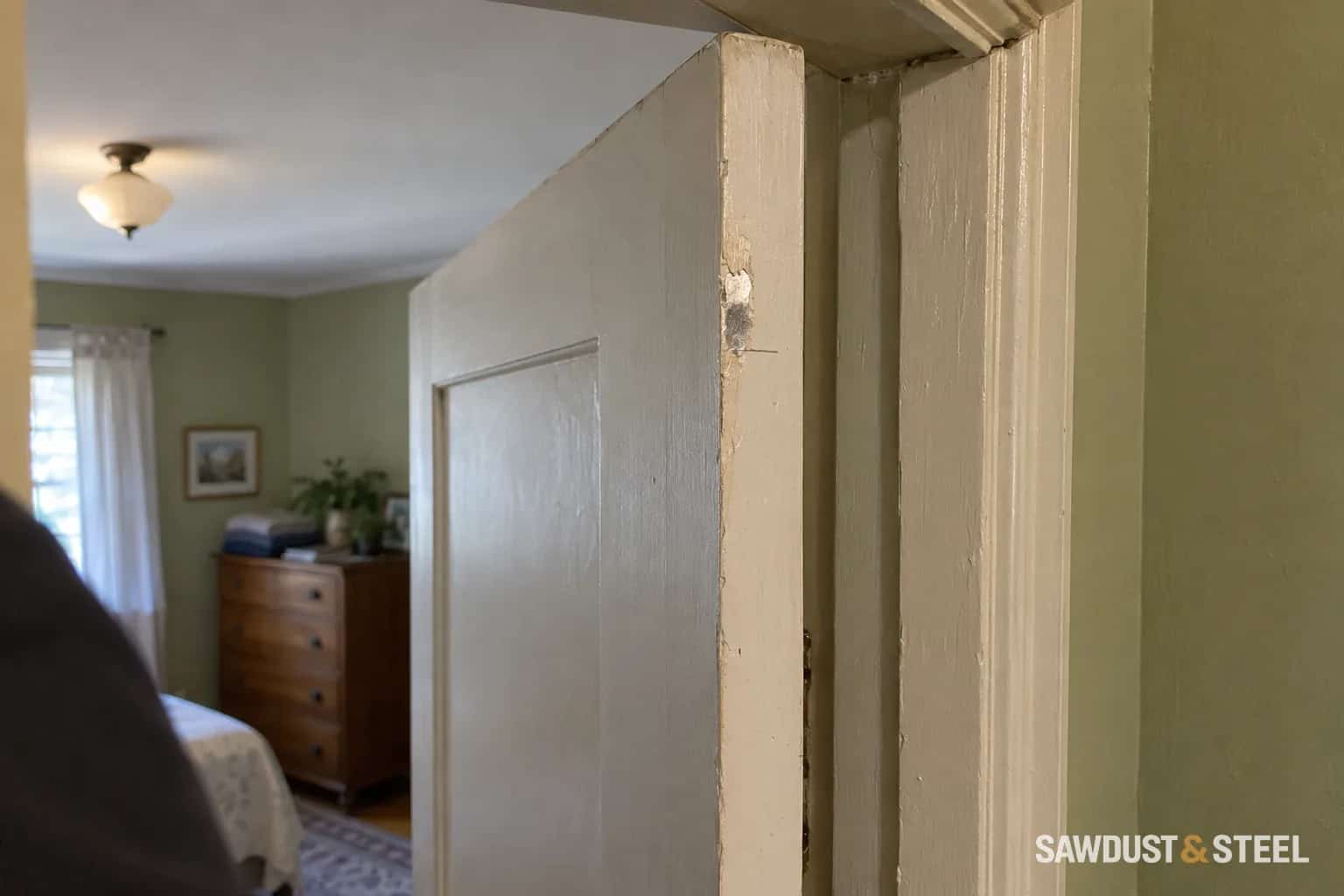
A heavier slab changes handling and the load on the hinges and jamb. Look for loose leaves, enlarged screw holes, a split hinge recess or a frame that moves when the door is lifted gently. Do not order the new slab assuming those faults disappear when the old door comes off. Our hinge-screw repair guide explains the distinction between one worn hole and unsound material.
Confirm hinge size, quantity and fixing requirements with the door supplier. The existing locations may suit a replacement, or they may need alteration. Include delivery, handling, machining and finishing in the comparison: the slab's shelf price is not the completed price. A heavy door that needs lifting at the handle is not an upgrade.
Keep the frame only if it is worth keeping
Measure the existing opening and slab rather than trusting a nominal size. Check the bevel, hinge locations, latch preparation and allowable trimming. A new slab can preserve good original casing, but fitting it to a distorted jamb can consume the apparent savings. Compare that work with a prehung unit using the existing-frame checklist.
For a staged renovation, start with the noisiest room boundary and judge the result before replacing every door. Close the new door during an ordinary evening and listen from the rooms that matter. You are buying a better daily routine, not a satisfying thud for its own sake.