
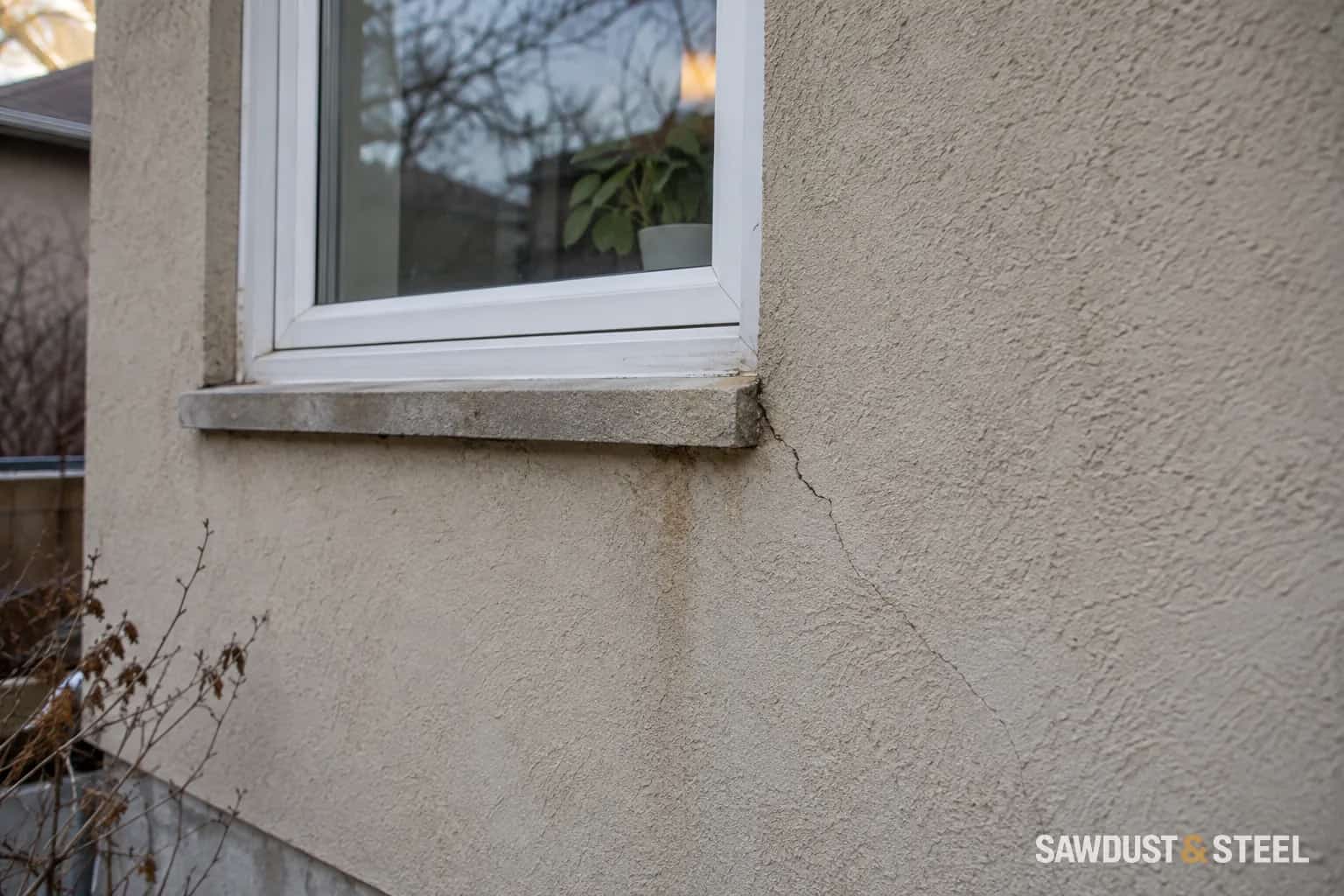
A crack below a window is easy to point at and surprisingly easy to misunderstand. It may be a local finish defect. It may also be the place where movement or water damage finally becomes visible. The size of the patch is not necessarily the size of the problem.
Start by identifying the wall system. Traditional cement-based stucco and exterior insulation and finish systems have different layers and repair requirements. The thin coating over a foundation is another assembly again; flaking foundation parging needs its own diagnosis.
Make a record before someone fills the crack
Take a wide photo showing the whole elevation, then closer photos of each crack with a scale beside it. Record the date, weather and whether indoor staining corresponds to the same area. Mark locations on a simple wall sketch so future photographs can be compared reliably.
Map
Photograph location, staining and change over time.
Identify
Confirm the stucco or exterior finish system.
Investigate
Assess adjoining water details and concealed condition where warranted.
Repair
Match the assembly and correct causes before finishing.
Decision guide; not a construction detail or a substitute for the project specifications.
The older CMHC home maintenance checklist identifies increasing cracks and loose or damaged stucco as reasons to investigate, including possible water behind the cladding. Use it as maintenance guidance, not a current code specification or a recipe for your particular wall system.
Look for patterns: cracks returning after previous repairs, staining beneath penetrations, separation at window corners, bulges or loose material. Do not pull at overhead pieces or climb to tap an unstable surface. Keep people clear of a suspected falling-material area and arrange safe access for assessment.
Ask what the assessment will actually cover
An investigation should identify the finish system, likely water-entry points and whether the underlying material is affected. A finish-only quote and an investigation-and-rebuild quote are different services. Ask the contractor which one is being offered before comparing totals.
Useful questions include whether moisture readings are appropriate, whether targeted openings are needed and who restores those openings. Readings require interpretation for the actual materials; a meter number alone does not establish how far damage extends or whether structural repairs are necessary.
If there is staining indoors, record it too. Moving a bookcase and finding a musty corner changes the scope of the conversation. Health Canada: addressing moisture and mould emphasizes correcting moisture problems when addressing mould. A fresh exterior coating should not be used to bypass an unresolved indoor moisture problem.
Look above the stain
Water can enter at a window head, roof junction or penetration and emerge lower down. Ask the assessor to examine adjoining details rather than treating every stained patch as a local leak. The repair may need flashing or sealant-joint work in addition to restoring the cladding.
A familiar example is staining below a roof that ends against the wall. Repairing the stained finish while leaving the roof runoff detail unchanged can set up the same job again. Our roof-to-wall flashing guide explains what to ask about at that intersection.
Likewise, a moving joint should not automatically be filled rigidly. Ask how the original system accommodates movement and whether the proposed repair preserves that function. The compatible materials and joint detail come from the identified assembly, not whichever patching compound happens to match the colour.
Choose the repair scope after the findings
For an isolated finish defect in a sound, dry assembly, a compatible local repair may be enough. If investigation finds damaged substrate, failed drainage or a recurring movement problem, the repair needs to include those causes. Record the findings before the opening is closed.
Request a sample of the proposed finish where texture or colour matching matters. A technically sound patch can remain visible; discuss whether blending or finishing a larger logical area is included. This is a scope decision, not a reason to conceal a moisture problem under an entire new coat.
Keep the investigation photographs, materials used and any maintenance instructions. Revisit the same photo positions after significant weather and at routine exterior checks. A recurring crack or stain deserves renewed assessment, especially if its pattern changes.
The useful outcome is not simply a wall without a visible line. It is a repair that explains the line, addresses its cause and gives you a sensible way to notice if the problem returns.