
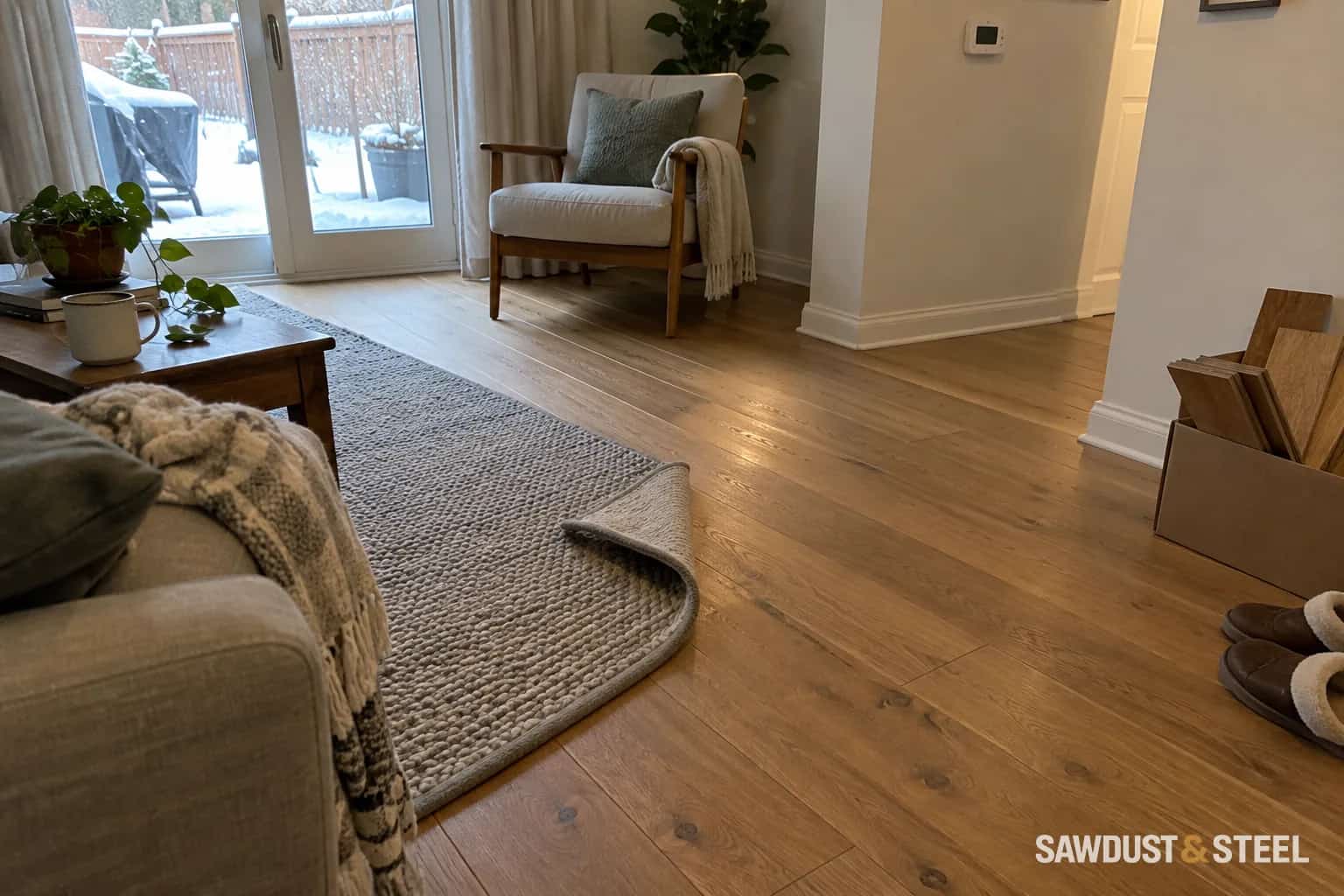
A smaller rug seemed like an easy room update. Now the old rectangle runs through the middle of the new arrangement. If the boards are smooth and sound, this may be a colour difference rather than something sitting on the surface. A stronger cleaner cannot reliably remove a history of unequal light.
First check whether the mark behaves like a rug outline
Compare its edges with the rug's previous position and with furniture that stayed in place. Look in daylight and under the room's usual lamps. An even rectangle crossing several boards suggests exposure differences. Sticky patches, a printed backing pattern, a cloudy ring or raised board edges suggest another problem, possibly alongside the colour difference. Do not diagnose it by shade alone.
Lift the rug and pad without dragging grit across the floor. Check that both are dry and that the backing has not transferred material. Use only the finish maker's approved cleaning method on a small inconspicuous area. Stop if the finish becomes tacky or colour transfers to the cloth. A white water mark follows a different repair path from a dry, smooth rectangle.
The exposed floor can become darker or lighter
Mirage's technical bulletin on colour variation describes both darkening with ordinary ageing and lightening under intense exposure. It also explains why a covered area may gradually approach the surrounding colour without becoming an exact match. That is more useful than the usual promise that leaving the rug off for a few weeks will fix everything.
The species, existing finish, age of the floor and exposure history matter. A maple floor near a large window need not behave like an older stained oak floor in a shaded room. Nor does a visible colour change automatically mean the protective finish has failed. Ask the flooring supplier to identify the actual product before choosing a finish treatment.
Smooth and dry; follows the old rug
Document the exposure difference and discuss realistic blending expectations.
Sticky or patterned residue
Ask the finish maker about compatible cleaning; do not scrub experimentally.
Cloudy, raised or damp area
Investigate moisture and finish damage before treating colour.
If you wait, make it an observation rather than a promise
Take photographs from the same position in similar light, noting the date and rug arrangement. If you leave the area uncovered, compare the boundary over time rather than judging from memory every morning. Do not deliberately expose a vulnerable floor to stronger sunlight to speed things up. Existing shading can limit further uneven exposure even if it does not erase what has already happened.
A future rug layout can distribute coverage differently, but moving rugs is not a guarantee of uniform ageing. Choose a pad approved for the floor and finish, and follow any waiting period after coating work. If you are considering solar film as protection, check glass and film compatibility before applying it. A product that filters light still has to suit the window.
Discuss the whole visible area before agreeing to a repair
Give the contractor the product name, installation age, old rug position and everything used to clean or polish the floor. Ask whether the contrast appears to be in the wood, finish or both, and whether a test can establish a likely outcome. A finish-only recoat does not remove colour differences within the wood. Spot sanding can create a new pale patch and a sheen boundary larger than the original concern.
If refinishing is proposed, first establish whether the floor can be sanded, how much usable wear layer remains and where the work would stop. Recoating and refinishing are different jobs. Ask what contrast may remain after the proposed treatment and see a representative test where practical. A sensible result might be a less noticeable outline, a revised rug arrangement or a full-room finish project; it need not begin with replacing sound flooring.