
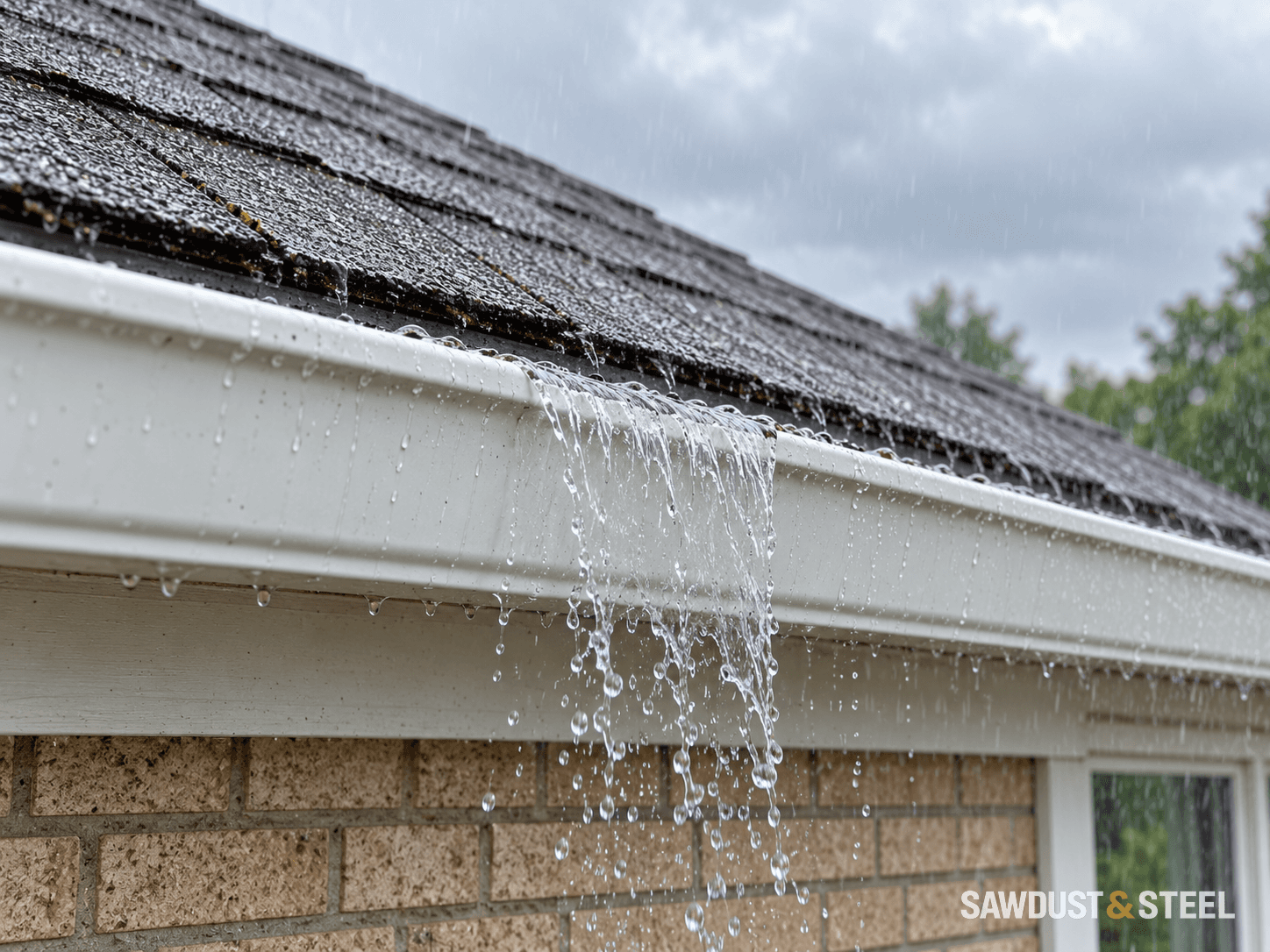
The quote offers a six-inch upgrade. It sounds like a sensible answer to an overflowing five-inch gutter. It might be, but the question is where the extra water goes next.
Buying a bigger trough while leaving the bottleneck untouched is a very polished way to keep the same problem.
Size the route, not just the front edge
Amerimax's drainage sizing guidance links gutter selection with downspout size, roof area, and rainfall. Its product guidance is useful for understanding the system; use a design appropriate to the actual Ontario property and supplied components.
The roof area feeding one run matters more than the overall house footprint. A valley or an upper roof discharging onto a lower section can concentrate flow in a small area.
Sketch the roof area feeding each outlet
A: contributing roof
Mark the slopes and valleys feeding this run, including any upper-roof discharge.
B: gutter run
Mark direction of fall and where water must travel along the trough.
C: outlet and downspout
Name the opening, pipe and elbows as a compatible system.
D: discharge
Show the receiving ground and walking routes, not just the pipe end.
Conceptual detail; product instructions and the actual assembly determine dimensions and attachment.
A useful manufacturer example is the pairing in Amerimax drainage catalogue, appendix A1-A3: its five-inch system can use either a two-by-three-inch or three-by-four-inch downspout, while its listed six-inch system uses the three-by-four-inch arrangement. If an existing five-inch run has the smaller downspout, a six-inch proposal should explain the outlet, elbows and pipe changes as well as the trough. That is a worked component comparison, not a capacity design for your house.
The catalogue is older US product literature. Its rainfall map and generic flow figures are not a substitute for current local design rainfall or the supplied Canadian system's instructions. Ask the installer to identify those inputs and the relevant product table in the actual quote. Do not multiply the nominal widths and call the answer a dependable percentage increase.
For two similar-looking runs, label the roof area feeding each separately. The rear run below a valley may receive concentrated flow while the straight front run behaves normally. Mark that observation on the sketch before comparing larger troughs, an additional outlet or repairs to an existing low spot.
Ask what the upgrade includes
| Quote item | What to clarify |
|---|---|
| Trough size and profile | What capacity is needed for this roof section? |
| Outlets and downspouts | Will their number or size change with the trough? |
| Slope and supports | How will water reach the outlets without persistent pooling? |
| Fascia condition | Is the attachment surface sound, and who repairs it? |
| Discharge | Where does the water go after leaving the downspout? |
Gentek's eavestrough system is another reminder that the visible gutter is one part of a product system. Compare compatible parts and an installation scope, not nominal width alone.
Separate sizing from maintenance and defects
A clogged outlet, sagging run, or poor connection can overflow even when the trough is large enough. On one rear run, water spilled at the middle while the downspout carried very little. The assessment found a low section holding water away from the outlet. Simply fitting a wider trough to the same line would have carried the defect into the new work. Have the levels, outlet and fascia checked together.
Avoid a universal percentage claim about how much more water "six-inch gutters" handle. Profile, slope, outlet arrangement, and rainfall conditions affect the result. Ask the installer to explain the selection for your roof instead.
Keep the discharge off the wrong place
An improved collection system should not deliver more water onto a walkway, neighbouring property, or back towards the basement. Walk the proposed discharge route with the installer and show them the gate, winter walking route, window wells, and any spot that already stays wet. Include the final route in the proposal and check local discharge requirements. The downspout extension still has to work when the gate is open.
Ask the installer to show you the outlet and discharge changes beside the proposed gutter upgrade. You want to know where the water will leave the roof and where it will land. If the explanation stops at 'six-inch is better,' the quote still needs another conversation.
If the water crosses a path after leaving the downspout, compare walkway-safe discharge layouts before signing off on the gutter upgrade.
Use the clean-gutter overflow checks to establish whether the current fault is capacity, fall or an obstruction before ordering a larger profile.