
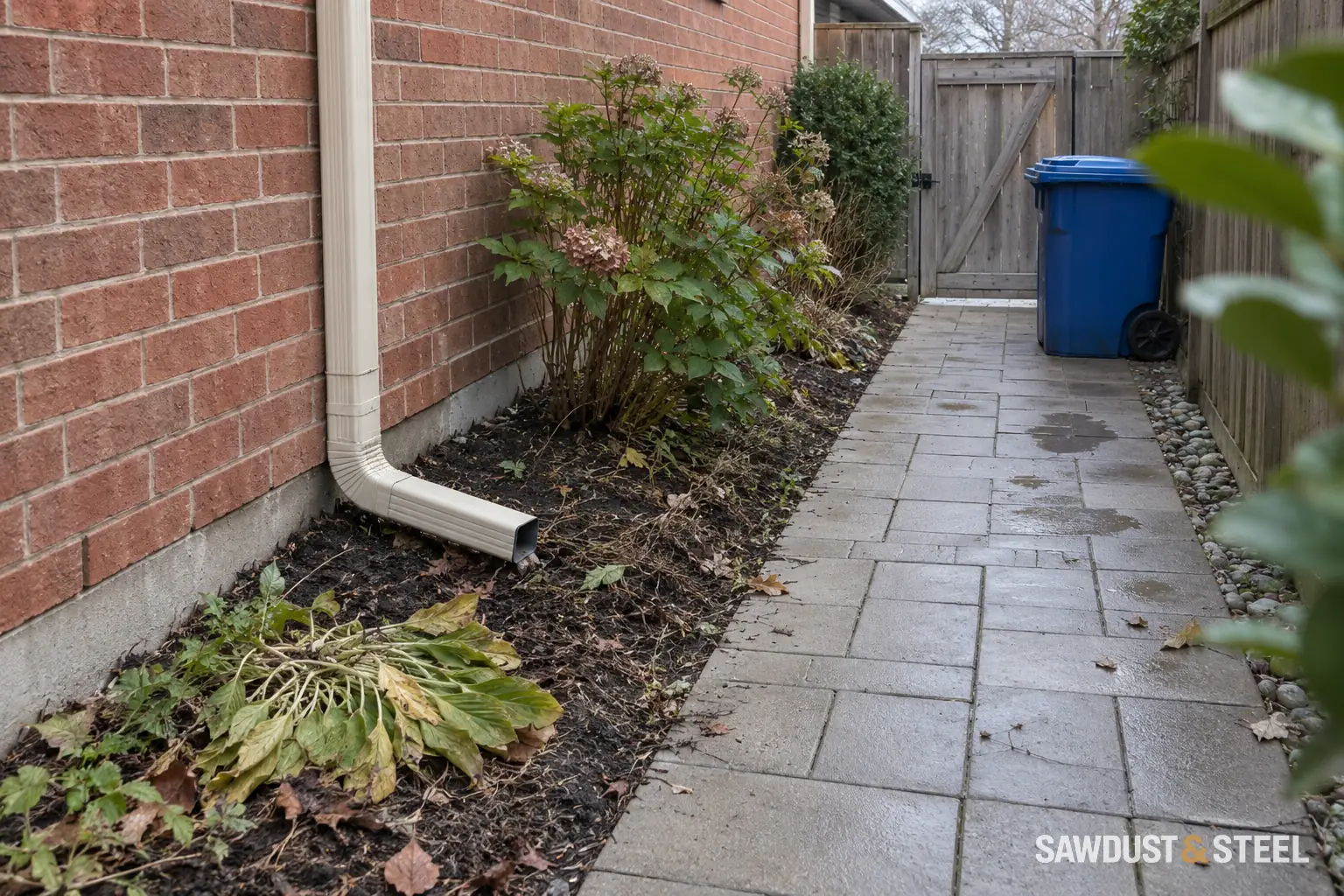
The extension solved the puddle beside the wall. It also sits exactly where everyone carries the recycling bins. A drainage fix should not require a daily obstacle course.
Follow the water beyond the pipe end
Observe the discharge in ordinary rain and consider where meltwater will go in winter. The outlet needs a suitable receiving area, not merely a location farther from the downspout.
Health Canada's moisture guidance recommends directing roof runoff away from the building and avoiding impacts on neighbouring foundations. That objective needs to work with the actual path, grade, and property boundaries.
Toronto's downspout-disconnection guidance explicitly advises against extensions across walkways or in front of gates and doors. It also flags winter icing and discharge onto sidewalks. A flatter pipe still crosses the route; it does not settle where the water goes.
Draw the outlet and the destination
- Sketch the downspout, house wall, path, gate, steps and property boundary. Mark any low spots, window wells, drains and shallow drainage channels.
- Watch from a safe spot during ordinary rain. Mark both the first wet area and where water collects after the shower. If the gutter is spilling above you, start with overflowing-gutter diagnosis.
- Try the route with a bin or the mobility aid actually used at home. Include the open gate and the place snow is usually piled.
- Identify the intended receiving area before choosing pipe. A planting bed sloping back toward the house is not a useful outlet simply because it is green.
Compare routes before digging
A relocated downspout, a different surface discharge, or a properly designed drainage route may each deserve consideration. Buried piping needs an approved destination and maintenance plan; it is not automatically better because nobody can see it.
| Route to consider | When it may fit | Question to resolve |
|---|---|---|
| Extension beside the path | There is a clear strip leading toward suitable receiving ground. | Will the outlet drain away from foundations without entering the walking route or blocking a swale? |
| Move the downspout outlet | The current corner forces every extension across the gate. | Can the gutter and outlet arrangement deliver water to a better location? Have the gutter installer assess the change. |
| Pipe beneath the walkway | The destination is suitable but the path lies between it and the downspout. | What are the outlet, slope, cleanout access and winter drainage details? Check local approvals and utilities before digging. |
| Rain garden or other designed landscape route | The lot has an appropriate receiving area. | Will soil, grades and overflow routing suit this roof-water volume and the nearby structures? |
| Rain barrel with overflow | Stored water would be useful and overflow has a safe destination. | Where does water go when the barrel is full or removed for winter? The barrel cannot be the only plan. |
A buried pipe needs a known outlet. Do not connect it to an unidentified pipe beside the foundation or assume a stone-filled hole can absorb every storm. Ask for a sketch showing the full route, accessible clearing points and what happens if the outlet blocks.
Apply the rules for your property
Oakville's drainage guidance says not to extend downspouts to the property line or onto a neighbour's property, and not to fill swales or change sheet-drainage direction. It also cautions against changes that impair existing drainage. Preserve those routes when adding a bed or altering a path.
Toronto's mandatory disconnection program addresses sewer-connected downspouts and has an exemption process where disconnection is not technically feasible or would create a hazard. Do not transfer a rule, setback or sewer-connection assumption from one municipality to another. Confirm the proposed outlet and any grading or connection approvals with the authority responsible for your property.
Move the pipe, or change how much it stands out?
A conspicuous white downspout beside new dark siding is an appearance problem only if its drainage already works. Compare the proposed outlet before changing the elevation. The quieter side wall may put the pipe directly beside the gate, where water and winter ice would cross the only useful route to the bins.
If the existing route is sound, a compatible factory-finished replacement or manufacturer-approved finish can reduce the contrast without moving the discharge. Take the colour sample outside against the siding. Check both the upper pipe and the lower extension; hiding one and leaving the other across the path has not improved the arrangement.
If relocation is worthwhile, ask the gutter installer how the fall, outlet, elbows and downspout capacity change. Draw the complete route and maintain access for clearing it. More bends and a longer concealed run are maintenance decisions as well as visual ones. The final selection should show where the water lands when the gate is open and when the snow pile occupies its usual corner.
Keep the revised route accessible
Record which joints can be opened, where a blockage can be cleared and who reinstates the assembly after service. Keep photographs of any buried route before it is covered. Recheck after landscaping changes: a newly raised bed can make yesterday’s sensible outlet send water back toward the foundation.
Test the whole route in daily use
- Gate and door swings remain clear.
- People, mobility aids, and bins can pass without stepping over piping.
- Discharge does not repeatedly wet or ice the walking surface.
- Water stays within an appropriate, locally permitted drainage arrangement.
Use the utility-locate checklist before excavation. Have the installer explain how the arrangement can be inspected and cleared later, then photograph its route before a buried section is covered.
After installation, check it in rain and again during thaw. Photograph the receiving area, path and foundation side. If water collects beneath a nearby deck, our under-deck pooling guide helps separate concentrated roof discharge from a low spot in the ground.
A temporary extension can be a useful clue about where water ought to go. It should not become permanent simply because the household has learned to step over it.