
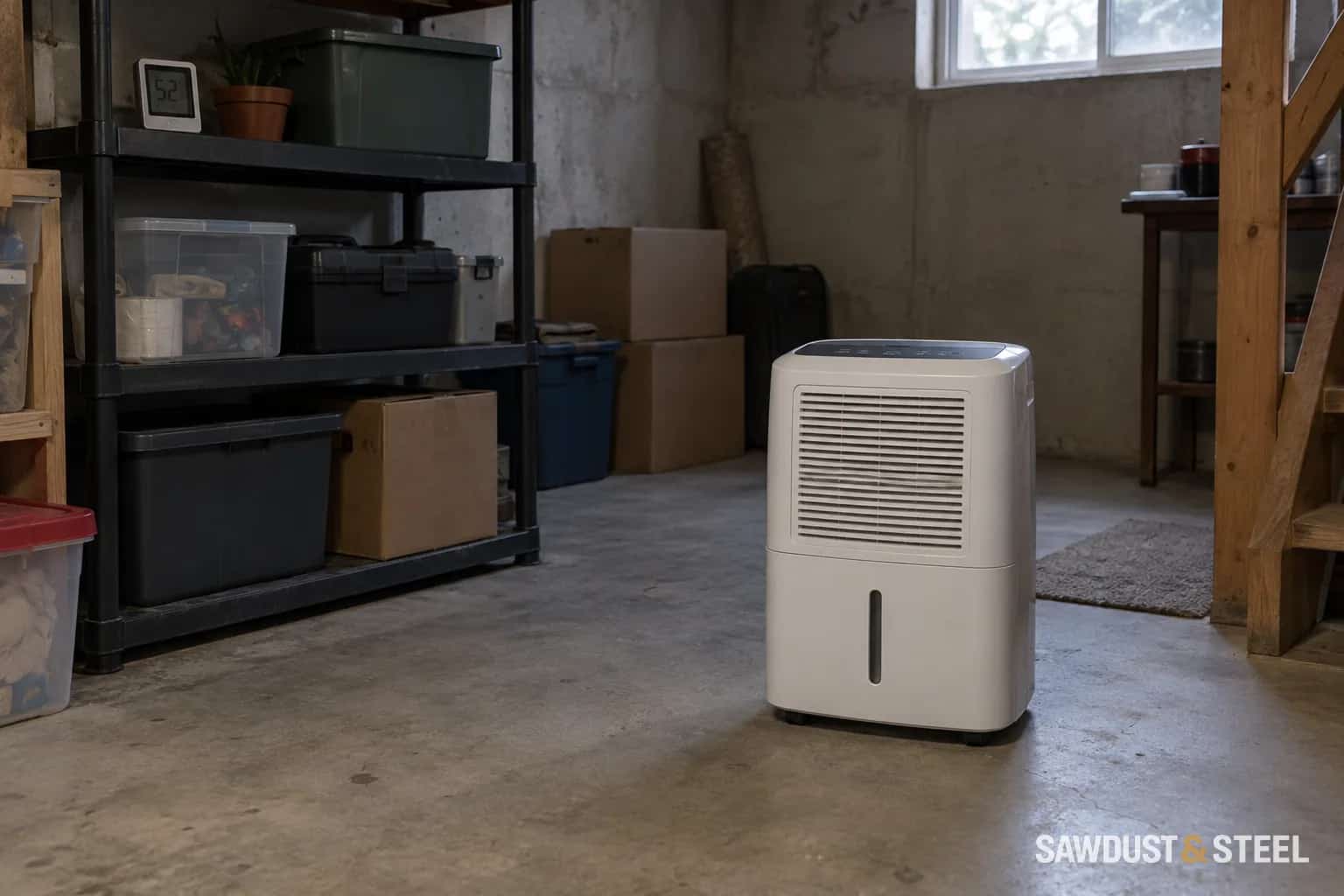
The box says it handles thousands of square feet. Your basement is considerably smaller, yet the machine never seems to finish. Before buying the next size up, separate three questions: how much water can it remove, how much can its bucket hold, and can damp air from the problem area reach it?
Start a shopping sheet before opening another product tab
Measure the floor area you want to control, then draw the rooms and doors. Include the laundry area and any room that stays shut. Record temperature and relative humidity in the main space and the dampest occupied room over several days. Note rain, laundry and open windows. A reading beside the unit's dry-air outlet is a poor description of the whole basement.
| Write down | Why the seller needs it |
|---|---|
| Area and room divisions | One open 800-square-foot room differs from four closed rooms of the same total area. |
| Typical basement temperature | A unit must be rated for the actual operating conditions, including cooler shoulder seasons. |
| Humidity before and during use | A persistent problem differs from a short spike after laundry. |
| Visible water or rain-related wetting | Water entry needs investigation; a bigger appliance does not repair it. |
| Drain location or emptying routine | A full bucket can stop drying while you are away. |
Read the capacity unit carefully
ENERGY STAR's buying guide describes capacity as water removal in pints per 24 hours under test conditions. The required capacity depends on both area and dampness. A bucket rating describes storage, not extraction. Integrated energy factor, expressed in litres per kilowatt-hour, is an efficiency measure rather than a bigger-is-better tank size.
For example, a machine advertised as removing 50 US pints per day does not necessarily hold 50 pints. That extraction rating is about 24 litres per day, but its actual daily collection will vary with temperature and moisture conditions. Keep units consistent when comparing a Canadian litre rating with a US pint rating. Do not compare a bucket number on one listing with a daily capacity number on another.
Use the current manufacturer's sizing guidance for a shortlist, then check its assumptions. GE's sizing advice also ties selection to the space and its conditions. A retailer's largest headline area should not override the manual's temperature range or your divided-room plan.
Use a published range as the starting point
For an open basement under 2,000 square feet that feels slightly to moderately damp, ENERGY STAR's current portable-unit chart gives a 20-30 US pint-per-day starting range. Its very damp category gives 25-40 pints per day for that same area band. These are broad shopping ranges under the US program's guidance, not a Canadian code rule or a promise for every basement.
Consider an 800-square-foot open basement with a moderate humidity problem, no visible water entry and conditions inside the appliance's operating range. A current 25-pint model is a reasonable candidate from that chart. If a 35-pint option also fits, compare drainage, temperature performance, noise and efficiency before deciding whether the extra capacity is useful. Now change the example to divided rooms, a cool shoulder-season temperature or daily rack drying: the floor area alone no longer settles the purchase. Supply those observations to the manufacturer or installer rather than blindly choosing the next carton up.
Compare two machines on the details you will live with
- Daily extraction capacity, using the same units and rating basis.
- Minimum operating temperature and how defrost is handled.
- Bucket size, full-bucket shutoff and how easily the full bucket lifts out.
- Gravity drain versus a built-in pump, including the manual's permitted hose route.
- Air inlet and outlet clearance, filter access, noise and available replacement parts.
A pump can make an otherwise awkward drain route possible, but it is a separate feature from dehumidifying capacity. Check the drain-hose plan before paying for it. For a cool basement, confirm low-temperature performance instead of assuming that every unit with automatic defrost will be equally useful.
Decide whether capacity is really the missing piece
If the main room reaches the selected humidity and a closed bedroom does not, first consider the air route. Increasing extraction capacity in the main room does not make it reach through a shut door. Do not hold open a required separation door to make the purchase work. Review dehumidifier placement and whether a separated area needs its own solution.
If the unit fills repeatedly during indoor laundry drying, record that activity as an added load. If the wall becomes wet after rain, keep that as a different item on the repair list. These two observations can happen in the same basement without having the same remedy.
Check the result after installation
Keep the shopping sheet and repeat the room readings after the new unit has had time to work under its manual's instructions. Confirm that water is being collected or drained, the bucket is not stopping operation unnoticed, and the remote room improves too. A successful purchase is one that controls the intended space through ordinary use. An impressive number on the carton is only the beginning.