
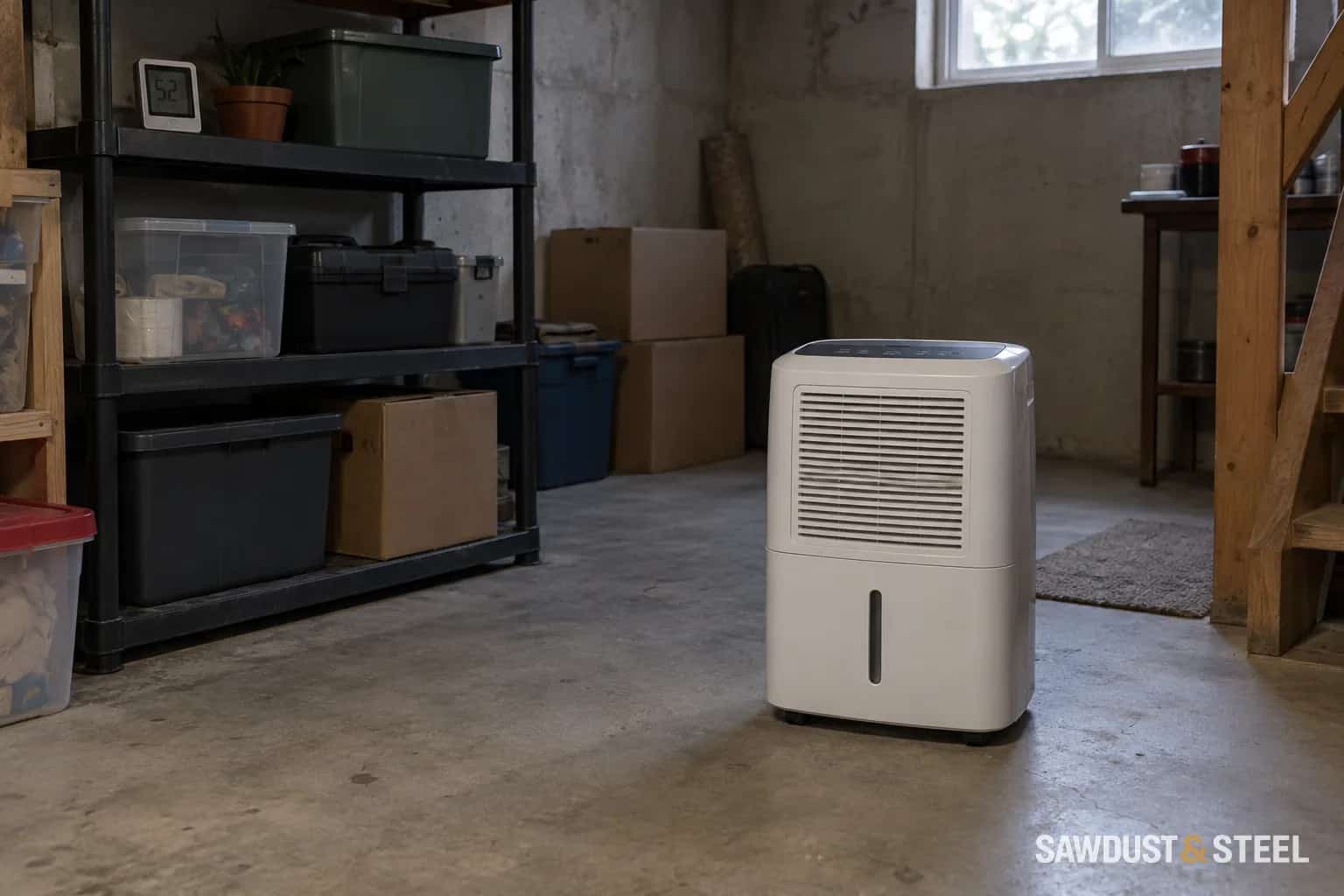
The dehumidifier in a Richmond Hill basement lived between a filing cabinet and Christmas. More precisely, six boxes of Christmas. Its display looked reassuring. The far corner beside the sofa felt less convinced. Before discussing a larger machine, we moved the boxes.
Start with the air openings
Find the intake and discharge on your model. They are not in the same place on every appliance. Follow its clearance instructions rather than copying a distance from another machine. Leave room to remove the filter and bucket as well as space for air.
GE's troubleshooting guidance calls for unobstructed airflow, appropriate sizing and a clean filter when a dehumidifier is not reaching the expected humidity. It also notes that moisture stored in the room and its contents takes time to remove after initial setup.
Do not build a snug cabinet around the unit to make it disappear. A shelf niche can recirculate recently dried air while the rest of the space receives little attention. If the machine is unpleasant to see, first consider a less prominent open position that still meets its instructions.
Measure beyond the display
- Place a separate humidity meter in the area you want to understand, away from the immediate discharge stream.
- Compare readings in the main room and any separated rooms over several days under similar conditions.
- Keep notes about laundry, weather, open windows and doors.
- Check whether the operating temperature is within the appliance's intended range.
A single display reports conditions near its sensor. It does not certify every corner of a divided basement. Doors and partitions affect air movement. Do not prop open a required fire-separation door just to help a portable appliance; a separated area may need its own plan.
The drain can decide the practical location
For bucket operation, make removal and carrying straightforward. For a gravity drain, the hose route needs a continuous suitable fall and an approved destination. A built-in pump changes the possibilities, but still has limits in its manual.
Avoid a hose across the walkway or an improvised raised perch. Use the required electrical connection; do not solve a poor location with an unsuitable extension cord. Keep the appliance away from places where water can spill onto electrical equipment.
Do not ask it to fix water entry
In Richmond Hill, clearing the space improved the arrangement, and a second meter helped the owner see the difference between rooms. We also found that the basement window was routinely left open on humid days. That belonged in the summer humidity conversation, not on a shopping list for a bigger unit.
If water enters through the wall or floor, investigate that source. If the appliance repeatedly freezes, check the icing-up guide. Placement is worth getting right, but it is only one part of a dry basement.
The Christmas boxes ended up on a higher shelf. They took the relocation reasonably well.