
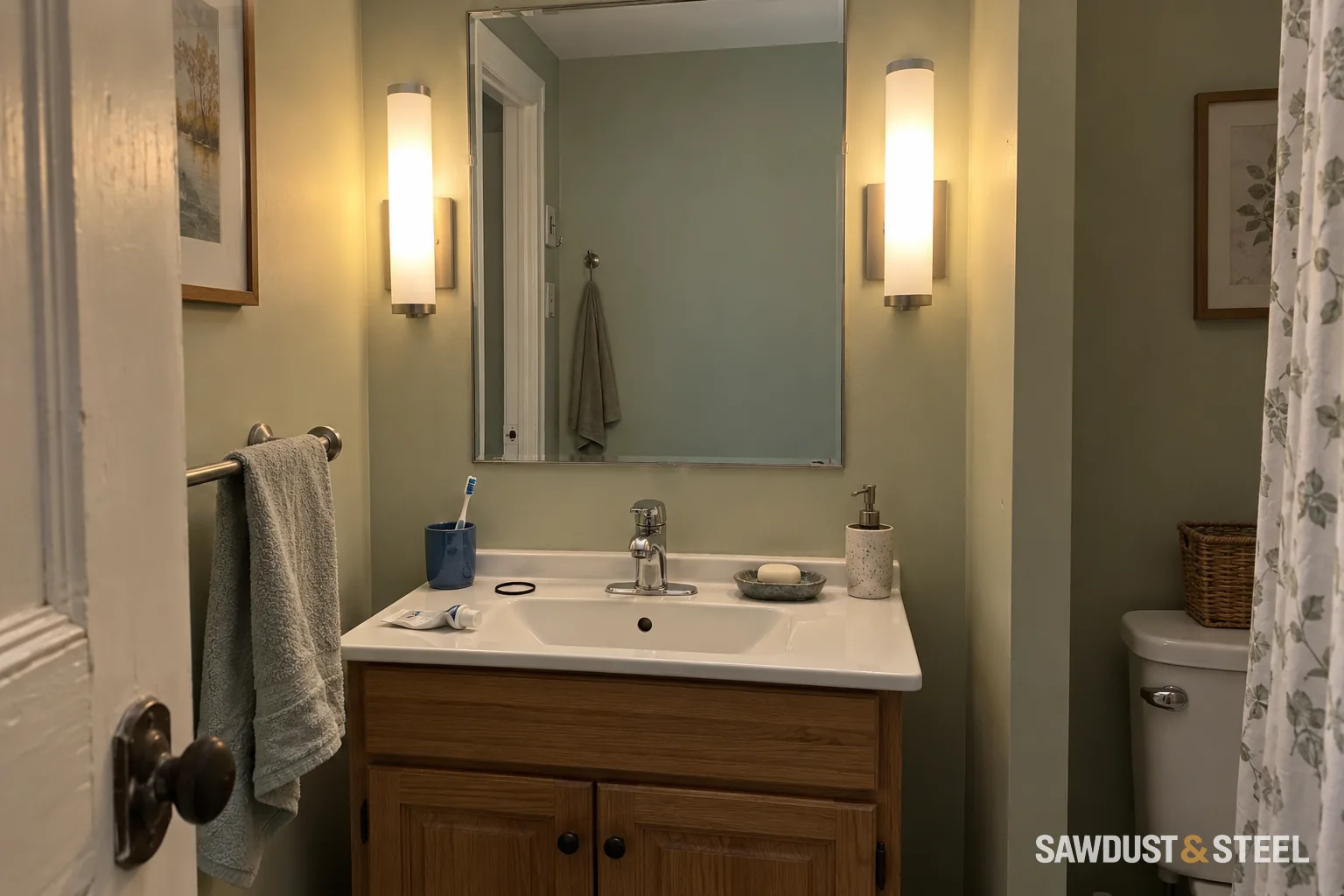
The bathroom is bright enough to find a dropped contact lens. Somehow, shaving still happens in a small cave under your eyebrows. More ceiling light may not solve that particular problem.
Put light where the task happens
Kichler's bathroom-lighting guidance considers mirror size, room size, and fixture placement together. Mock up the proposed locations with the mirror size and actual users in mind. Decorative symmetry should not be the only placement test.
Compare where the light reaches your face
Above
Light coming steeply down can leave shadows beneath brows, nose and chin.
Beside
Diffused light from both sides can illuminate the face more evenly; check glare at the actual standing position.
Behind mirror
A halo lights the wall; it may contribute little useful light to the front of the face.
Across the room
General light helps movement and cleaning but does not settle the grooming task.
Conceptual light paths; actual distribution depends on the fixture, diffuser, mirror and room.
| Option | Useful when | Test before fixing boxes |
|---|---|---|
| Side fixtures | Wall space allows light beside the mirror | Both users' face positions, glare and medicine-cabinet clearance |
| Over-mirror bar | Side space is limited | Diffusion, projection and shadows at normal standing distance |
| Front-lit mirror | Its forward light suits the grooming task | Brightness, dimming and access to replace drivers or components |
| Backlit mirror | Wall glow is wanted as part of a layered arrangement | Whether separate face lighting is still needed |
At the sample test, stand at the distance the vanity will actually keep you from the mirror. Try both the tallest and shortest regular user. Put a hand at eyebrow level and look for a strong shadow across the eyes; then look beneath the chin and beside the nose. You are comparing the direction and softness of illumination, not deciding whether the room feels generally bright.
Use the intended mirror size on the wall, even if it is only a paper outline. A broad mirror may leave little space for sconces, while a cabinet door can swing into a fixture that looked well placed in elevation. Add the cabinet in its open position, the towel location and the route of any wall-mounted faucet. Coordinate these before the electrical boxes are set.
Check colour appearance with familiar objects and the actual finishes. A lamp that flatters a tile sample can make faces look odd beside a different light source. Ask for compatible lamps, drivers and dimmers as one combination, then test for flicker, buzzing and low-level behaviour. A dimmer on the wall is not evidence that every fitting on the circuit will dim well.
Keep a separate comfortable setting for late-night use if the layout permits. It should help you find the room without forcing the grooming light to do every job. Have the electrician confirm the relevant fixture location and suitability requirements; an attractive bathroom label on a box does not authorize every position near a bath or shower.
Coordinate the faucet and bowl mock-up with the mirror test so the real standing position is used. If someone sits at the vanity, include the seated-use layout rather than testing only standing eye height.
Check the quiet evening setting too
Before the next step
- Test lighting at face height for the people using the room.
- Check full brightness and a comfortable evening setting.
- Coordinate mirror, boxes, controls, and fixture suitability before finishing.
A mirror light earns its place by helping you see yourself comfortably. That is a better audition than looking attractive while switched off.