
A bench lid is easy to underestimate while it is an unfinished piece of plywood. Add a timber edge, upholstery and a cushion, and the opening force changes. The moment someone reaches inside is a poor time to discover that the stay was selected for the bare panel.
Holding, lifting and damping are different jobs
A hinge lets the lid rotate. A lift-assist mechanism reduces the effort to open it. A damper controls closing speed. A stay or torque hinge may hold it at particular positions or through a defined range. One product can combine functions, but the word soft-close does not establish all of them.
Sugatsune's HG-TLAJ25 guidance illustrates selection using lid size, weight and application details. It is an industrial hinge example, not a bench-hardware recommendation. Give the hardware supplier the complete finished lid specification and intended opening angle. Include handles and attached upholstery; do not choose only by the bench width or by how strong a gas spring feels in your hand.
Finished lid
Account for the panel, edging, handle and attached upholstery.
Hinge geometry
Identify the pivot position and available opening space.
Required behaviour
Specify opening effort, hold-open range and controlled closing.
Installed checks
Verify the correct mounting positions, clearances and operation without placing anyone beneath the lid.
Check fingers, cushions and the wall behind
The front edge is not the only pinch point. Look along the hinge line, beside the support arms and where the open lid approaches the wall. A cushion can obstruct the intended motion or hide a closing gap. Keep handles positioned so normal use does not require fingers under a heavy edge.
Use the supplied mounting geometry and suitable attachment material. A strong stay attached to a thin, crumbling side panel is still a weak installation. Do not relocate its screw holes casually to avoid a shelf. If the specified arrangement cannot fit, choose a different system or a different opening method.
Treat child-accessible storage as a separate design check
The US Consumer Product Safety Commission's chest warning describes falling-lid and entrapment hazards, including automatic latches and blocked ventilation. It is useful hazard guidance, not an Ontario code specification. For storage children can enter or use as a toy chest, select a purpose-designed compliant product or have the complete design assessed; adding a generic stay is not a certification.
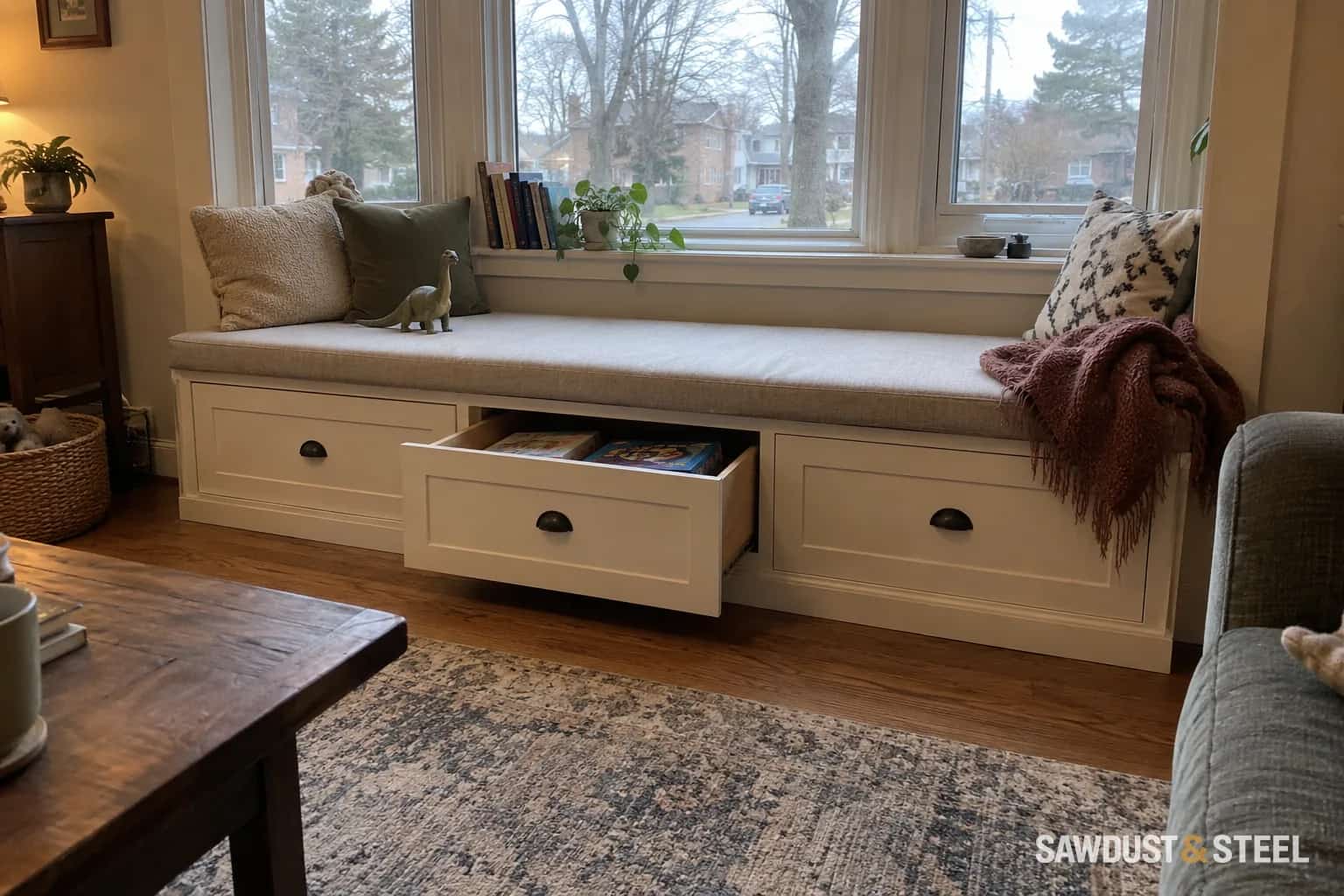
Keep an unsafe chest out of use until the lid and entrapment issues are resolved. A stick used as a prop is not a dependable everyday solution. If the storage will be accessed frequently by children, drawers or open bins may avoid the overhead-lid problem altogether, provided the rest of the furniture is appropriately designed and secured.
Test access with the finished seat
Check that the lid opens without removing half the room and that the intended user can close it comfortably using the handle. Repeat the inspection after upholstery is fitted. If the bench sits beneath a window, keep the airflow around the glass and window operation in the design too.