
A storage seat sounds like two jobs solved at once. Sometimes it is two jobs politely waiting for each other: the person must stop sitting before the storage can start storing.
Choose by how often you open it
A lift-up compartment suits bulky items retrieved occasionally, provided the opening is manageable. Drawers can make everyday throws, games, or shoes easier to reach while leaving the cushion in place. Neither is ideal if access means moving a heavy table first.
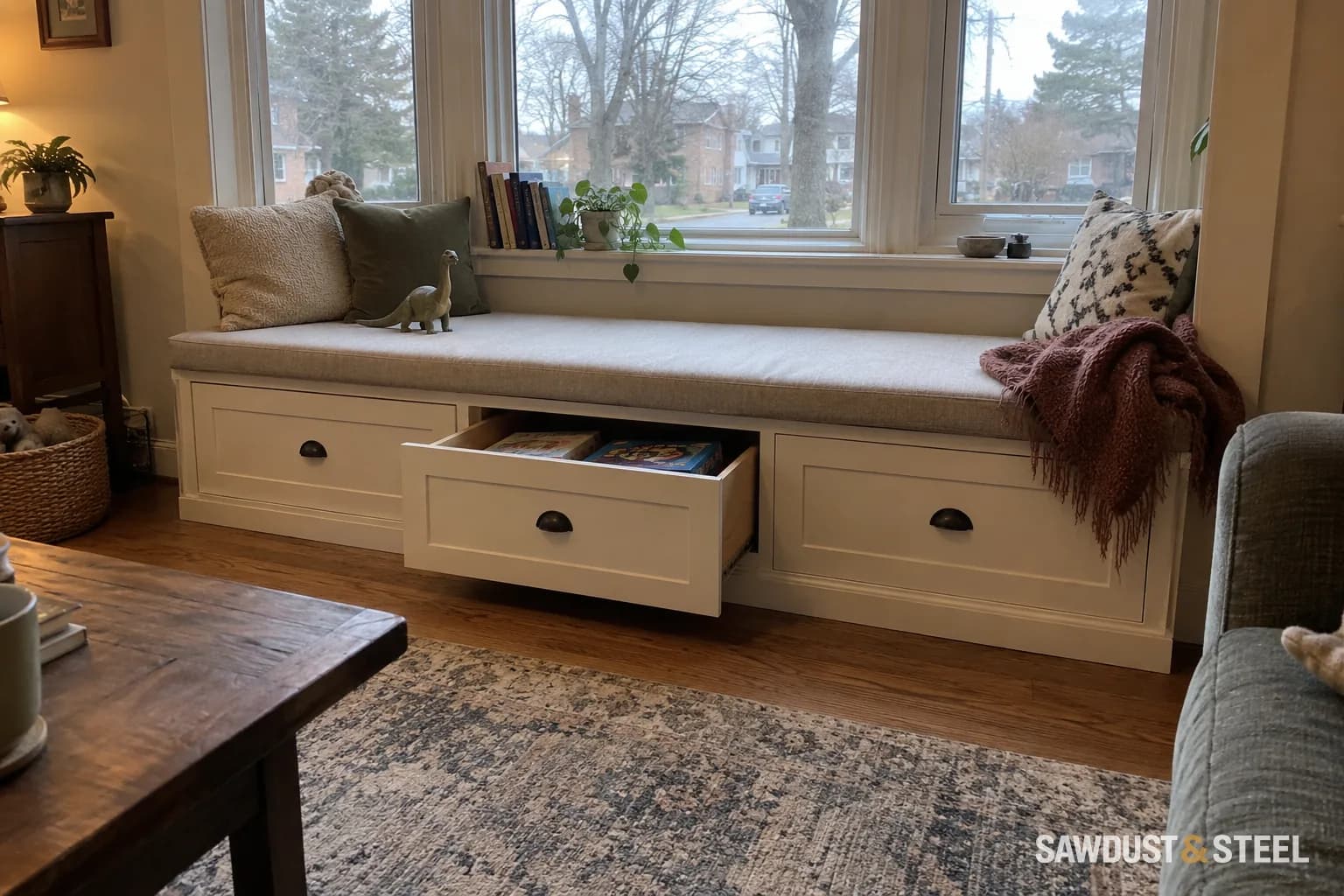
Try the movement with the room furnished. At a bay-window seat, the proposed lid hit the window handle before it opened far enough to reach the back. Splitting the lid would have solved only part of it: the long cushion still needed somewhere to go. The owners wanted games out most evenings, so we changed to drawers and checked their travel against the rug and coffee table.
The lid is a hardware decision
Sugatsune’s top-opening lid supports are selected for particular applications and loads. Have the complete lid and support arrangement specified, including pinch and closing risks for the intended users. A standard hinge alone does not make a heavy lid safe to operate.
For drawers, verify the hardware rating, extension, and usable internal dimensions. We sized those drawers around the board-game boxes rather than dividing the front into equal panels. That left a little unused space behind, which was acceptable because the boxes came out easily. For an occasional-use lift-up seat, ask the maker to demonstrate the finished lid and support together, including any attached cushion. The moving weight and dimensions decide the hardware.
Measure the storage opening and the space outside it
| Dimension | Lift-up lid | Front drawers |
|---|---|---|
| Usable interior | Clear opening after hinge and support hardware | Inside drawer width, depth and height after runners and boxes |
| Room clearance | Full lid swing plus somewhere to put the cushion | Full extension plus space to stand and retrieve items |
| Obstructions | Window handle, blind, sill and wall | Coffee table, rug edge, radiator and door swing |
| Frequent use | Seat must be cleared | Seat can remain occupied if the drawer route stays clear |
Try the largest intended item, not just a tape measure. A blanket bends; a board-game box does not. For a 450 mm-deep drawer that extends 450 mm, mark that travel from the closed front and then stand beyond it with the item in your hands. Those are sample dimensions, not a minimum clearance rule. Check the chosen runner's actual travel.
For a lid, hold a full-size cardboard outline at the hinge line and check its complete sweep, including cushion thickness. Then have the maker select the support for the finished moving weight and geometry. Toy-box lid and entrapment checks matter where children can enter the compartment or reach the lid. A soft-close label alone does not establish a safe hold-open arrangement.
Load
Bring the actual games, throws or luggage.
Open
Mark the full lid swing or drawer travel.
Retrieve
Reach the back without kneeling on a drawer or propping a lid.
Reset
Return the cushion and furniture without blocking required access.
Check what the seat covers
For an arrival-area seat, compare open cubbies with closed cabinets around the same retrieval routine. Keep access to heat emitters, vents, electrical equipment, and required window operation or escape routes. An existing radiator is not an invitation to build a sealed cupboard around it. Choose a lid for occasional bulk storage, drawers for frequent retrieval, and a plain seat if the proposed storage is making the room harder to use.