
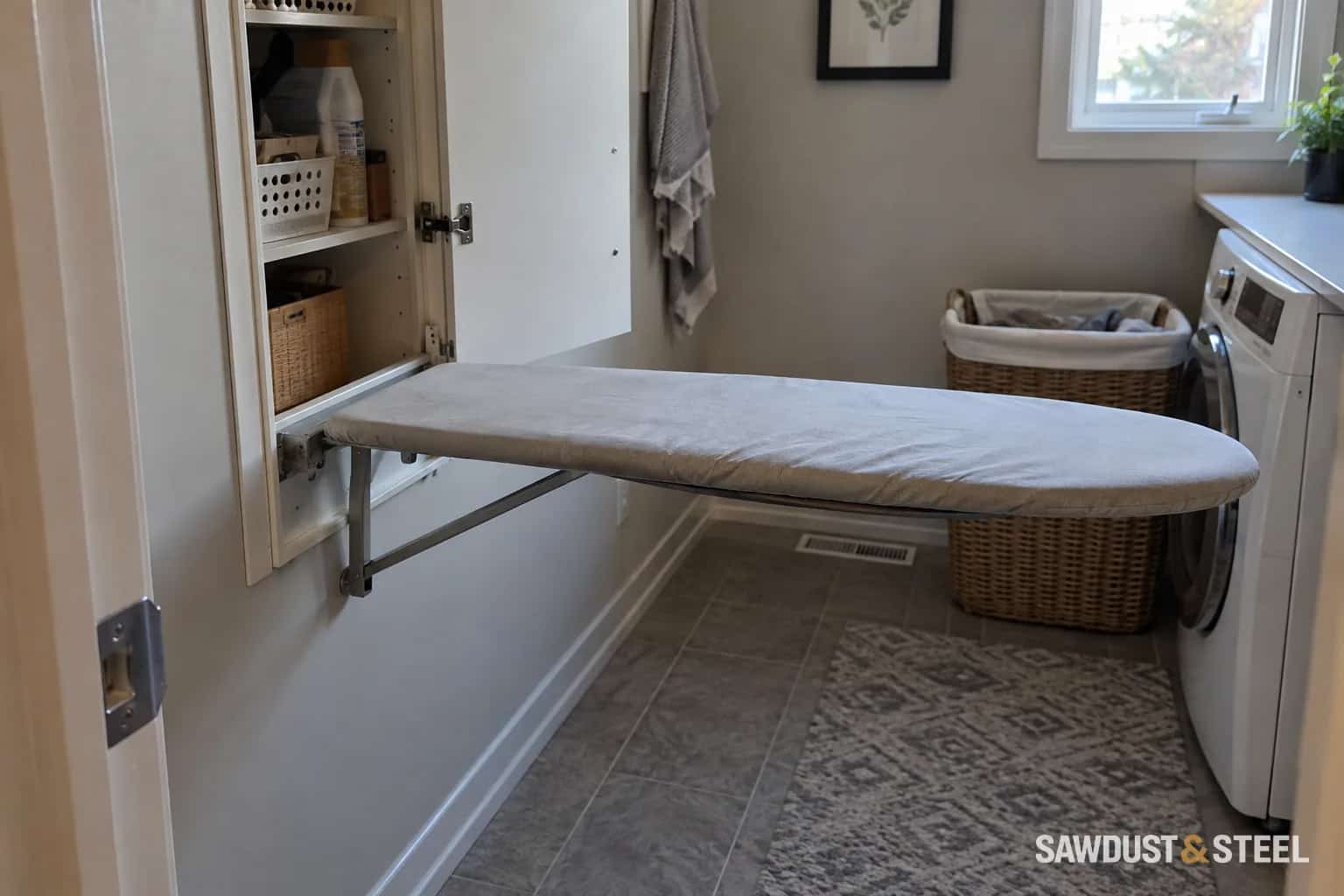
A built-in ironing board looks like a good way to reclaim the cupboard. It can also turn a laundry doorway into an obstacle course if the open board occupies the route through the room. Start with the deployed shape, not the tidy closed cabinet.
The useful layout includes the board, the person using it, the garment hanging over it and the cabinet door. A board that technically unfolds may still leave you ironing with one shoulder against a wall.
Pick a model before measuring the recess
Recessed and surface-mounted units have different wall projections and installation requirements. Some boards swivel; some do not. Cabinet doors and internal iron-storage arrangements also vary. Get the complete dimensions and installation instructions for the actual model before deciding where its opening belongs.
The Iron-A-Way installation manual includes pre-installation clearance checks and distinguishes mounting and board arrangements. Use the relevant model's drawing for the opening size, mounting height and deployed projection. A dimension copied from a different unit can put the board at the wrong working height or leave its nose against the opposite cabinet.
Check the physical wall construction before promising a recessed installation. A shallow cabinet can still conflict with a stud, pipe, cable or other wall component. Do not cut framing or remove concealed material to make a product fit without an appropriate plan.
Draw the working position on the floor
Mark the cabinet face and the board's complete open outline using the manufacturer's dimensions. If it swivels, mark the full permitted sweep as well. Put a lightweight temporary surface at the proposed height where it can be supported safely, or use a floor outline to test position without loading a mockup.
Stand where you normally iron. Try the movement of a shirt sleeve, a long trouser leg and a basket placed nearby. Check whether a cabinet handle catches a garment and whether the laundry door can open without striking the board. Keep the route out of the room usable while the equipment is in operation.
Closed cabinet
Include the cabinet projection, door swing and nearby handles.
Open board
Use the selected model's full wall-to-tip dimension.
Swivel movement
Check the whole permitted arc, not just the favourite parked angle.
Person and laundry
Allow comfortable standing, garment handling and a basket without blocking the route.
For example, a narrow laundry room may accommodate the board pointed toward an open doorway on paper. In use, that same position can prevent anyone from passing and put the basket in the door swing. Turning the layout or selecting another location may be better than buying the smallest board and hoping.
Set the height for the person who uses it
Follow the product's relationship between mounting height and final board height. A cabinet mounted at a convenient visual height may produce an uncomfortable ironing surface. If the unit offers height adjustment, check the usable range and how the adjustment operates when the board is deployed.
Have the main user try the working position before the wall opening is made. Reach matters as much as height. A deep cabinet, a counter beside it or a fixed shelf can push the person away from the useful part of the board.
The same room may need a counter over front-loading machines. Draw both surfaces together, including appliance controls and service access. A fold-down item should not depend on moving a permanent worktop every time it opens.
Resolve power and hot storage before installation
Some units include an electrical arrangement; others simply provide storage. Follow the selected product and iron instructions. Have any required fixed electrical work planned and completed by the appropriate qualified electrical contractor. Do not solve an inconvenient supply by routing an extension cord through a wall or across the walking path.
Check where the cord travels during ironing and folding. It must stay away from hinges and pinch points. Follow the iron and cabinet instructions for cooling and storage; an ordinary wooden shelf should not be assumed suitable for a hot iron just because it fits.
Keep chemicals and wet cleaning tools in a separately planned cleaning cupboard. When the installation is complete, demonstrate the opening, locking, swivel and closing sequence to the people using it. Compare fold-down desk planning if another moving surface shares the room. The payoff is a board that opens easily and goes away just as easily, without rearranging the house first.