
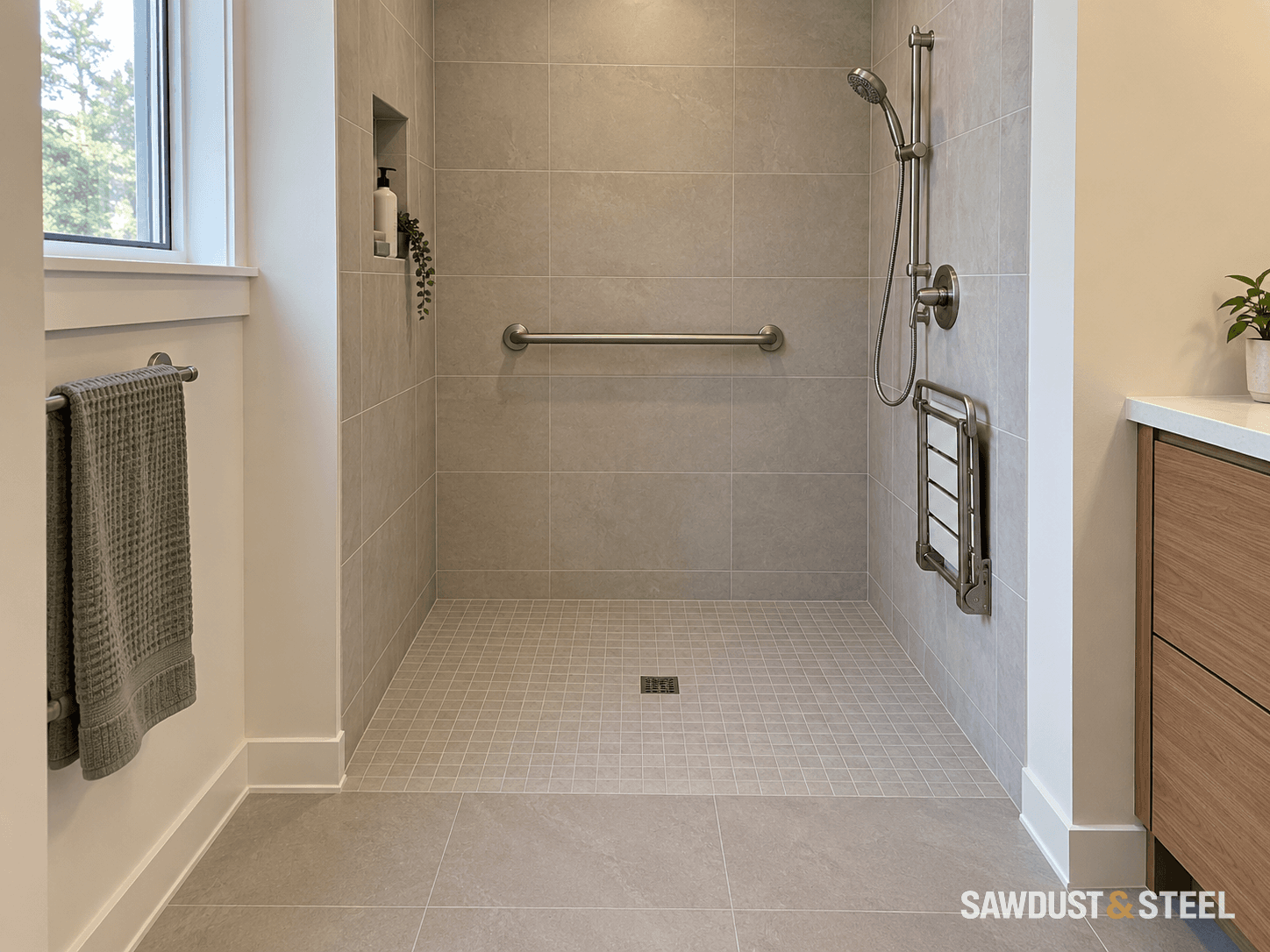
The chair fitted into the proposed shower. Its helper ended up in the door swing. We caught that in a Mississauga bathroom by taping the shower opening and vanity onto the floor and trying the layout with the homeowner's actual chair. Moving the vanity edge on paper was easy. Moving it after tile would have been another conversation. A useful curbless shower starts with that whole morning routine: getting in, reaching the controls, sitting, turning and getting out.
Is a curbless shower automatically accessible?
No. A level entry removes one obstacle, but the full room still has to work. Someone using a cane may need different support than someone using a walker, wheelchair, shower chair, or caregiver. Controls should be reachable, the floor should be suitable for wet use, and there must be enough clear space to enter, turn, dry off, and reach storage without blocking one another.
CMHC's accessible bathroom guidance recommends planning around the resident's mobility, balance, reach, manoeuvring space, controls, seating, and grab bars. Those are design inputs, not one universal bathroom recipe.
| Decision | What the plan must answer |
|---|---|
| Access | Who uses the room, with which mobility aid or assistance, and how much clear space is needed? |
| Floor and drain | Can the structure and waste route create the required slope without an awkward hump or unsafe framing change? |
| Water control | How will the membrane, drain, glass, spray direction, and bathroom floor work as one system? |
| Support | Where are the grab bars, seat, handheld shower, and controls, and what solid backing do they require? |
| Approvals | Which drawings, building or plumbing permits, electrical notification, and inspections apply to this address and scope? |
What has to be designed before demolition?
Start with measured existing conditions. The designer needs to know the joist direction and depth, drain location, finished floor build-up, doorway, ventilation, and what sits below the bathroom. Lowering or altering framing is structural work. Moving a drain is plumbing work. Neither should be improvised after the old tub is on the truck.
Ontario's building permit guide explains that municipalities administer permits and decide which drawings and approvals apply. Ask the local building department about the exact plan before demolition, especially when framing, plumbing, electrical work, or a new exterior opening is involved.
Which details make the shower useful every day?
Consider a handheld shower on an adjustable slide bar, controls reachable before entering the spray, a stable seat when needed, solid backing for present and future grab bars, good lighting, slip-conscious flooring, simple storage, and a door route that does not block the person using the room. CMHC also recommends planning adaptable features before the walls close, when support can be added cleanly and its location can be recorded for later.
If accessibility is important for a specific medical or mobility need, include that person and an occupational therapist or other qualified accessibility professional in the design. A contractor can build the room. The user is the expert on how their body moves through it.
Choose the seat around the person and the remaining floor
Before choosing a permanent bench, decide whether someone will sit on it. Many large tiled rectangles spend their lives holding shampoo. If sitting matters, use a stable dry mock-up with the intended user and, where needed, an occupational therapist. Check approach, transfer, feet, knees, controls and the hand shower together. Do not ask the person to balance on improvised supports to test a drawing.
| Example | Published footprint or projection | What the design must resolve |
|---|---|---|
| Schluter KERDI-BOARD-SB rectangular 48-inch bench | 48 in wide x 16 in deep x 20 in high before tile | Permanent floor occupation, finished seat height, full support and waterproofed connections |
| Moen DN7110 folding seat | 20-15/32 in overall top width; 15-3/32 in open projection; 2-27/32 in closed depth | Open knee and transfer space, folded brackets, specified structural mounting and waterproofing |
The sizes above come from Schluter's bench page and Moen's DN7110 drawing. Neither is a prescription for the user's seat height or an endorsement of this model for every need. Add tile thickness to the bench dimensions and use the exact mounting drawing for the folding seat. Check the current item number before ordering; superficially similar seats can have different fixings and projections.
Schluter specifies full support for its prefabricated bench and sealed seams and corners within its shower system. Moen identifies six mounting locations and supplied wood screws for the DN7110. Have the support and fastener engagement established for the actual wall; tile alone is not structural backing. Coordinate every wet-area fixing with the waterproofing system before closure. A weight statement on a seat does not establish the capacity of an improvised wall attachment.
| Choice | Benefit | Tradeoff to test |
|---|---|---|
| Built-in bench | Ready to use without operating a mechanism | Always occupies floor area; finish changes its usable height and edges |
| Folding seat | Recovers some space when stowed | Still projects when folded; user must be able to operate it |
| Separate bottle storage | Keeps the sitting surface available | Must remain reachable without twisting or blocking a transfer |
Test the clear entrance, handle and cleaning route
Draw the glass, its handle and the actual person opening it. For a hinged or pivot door, the movement envelope includes the handle, towel rail and the place the user stands. A panel can clear the vanity while its handle hits the towel ring. For a slider, overlapping panels reduce the entrance and can change how someone reaches the controls. The enclosure width is not the clear entry width.
Measure the finished walls at top and bottom and record height before ordering glass. Give those measurements to the installer with the model's adjustment range and support requirements. Check the stated clear opening with the user's equipment and assistance needs. A wide-looking display panel is not enough evidence that a chair or helper can use the entrance.
In the showroom, ask to reach the bottom guide, overlap and seals with a cleaning cloth. Confirm which access movements the maker permits; do not assume a fixed panel can swing out or be unclipped. Keep the wet floor outside the shower in the conversation too: a door arrangement that sends water into the approach area undermines the benefit of a level entry.
If the seat only solves bottle storage, use a separately planned shelf and preserve standing space. If it supports daily washing or transfers, settle that routine before choosing the tile pattern. Keep the future grab-bar backing map with the seat and glass details so later fittings do not become unplanned holes.
How does a shower hold water without a curb?
The shower needs a complete, compatible drainage and waterproofing assembly. That includes the sloped surface, drain connection, wall-to-floor transitions, penetrations, glass layout, and the wet area beyond the obvious shower footprint. Schluter, for example, publishes a curbless shower ramp and system with its own installation handbook and warranty conditions. Other approved systems have their own details. Use components whose compatibility is confirmed by the system manufacturer.
Choose the complete assembly first, then follow its current instructions and the approved design. Our KERDI, RedGard, and hot-mop comparison explains the practical differences without pretending the membrane can rescue poor framing or drainage.
When is a curbless conversion worth doing?
It is worth serious consideration when a tub or curb is already difficult, when the household expects changing mobility needs, or when the bathroom is being rebuilt deeply enough to coordinate the structure and plumbing properly. It may be the wrong answer when the room cannot provide useful circulation, the structural work is disproportionate, or a simpler adaptation solves the real problem better.
Price the defined plan, not the phrase curbless shower. The GTA bathroom cost guide shows which scope decisions move the budget. Ask for framing and drain changes to be priced separately so you can see what the level entry adds. Compare the whole routine with a walk-in tub, including getting in, washing and getting out. Before choosing either, check the bathroom doorway and approach space.