
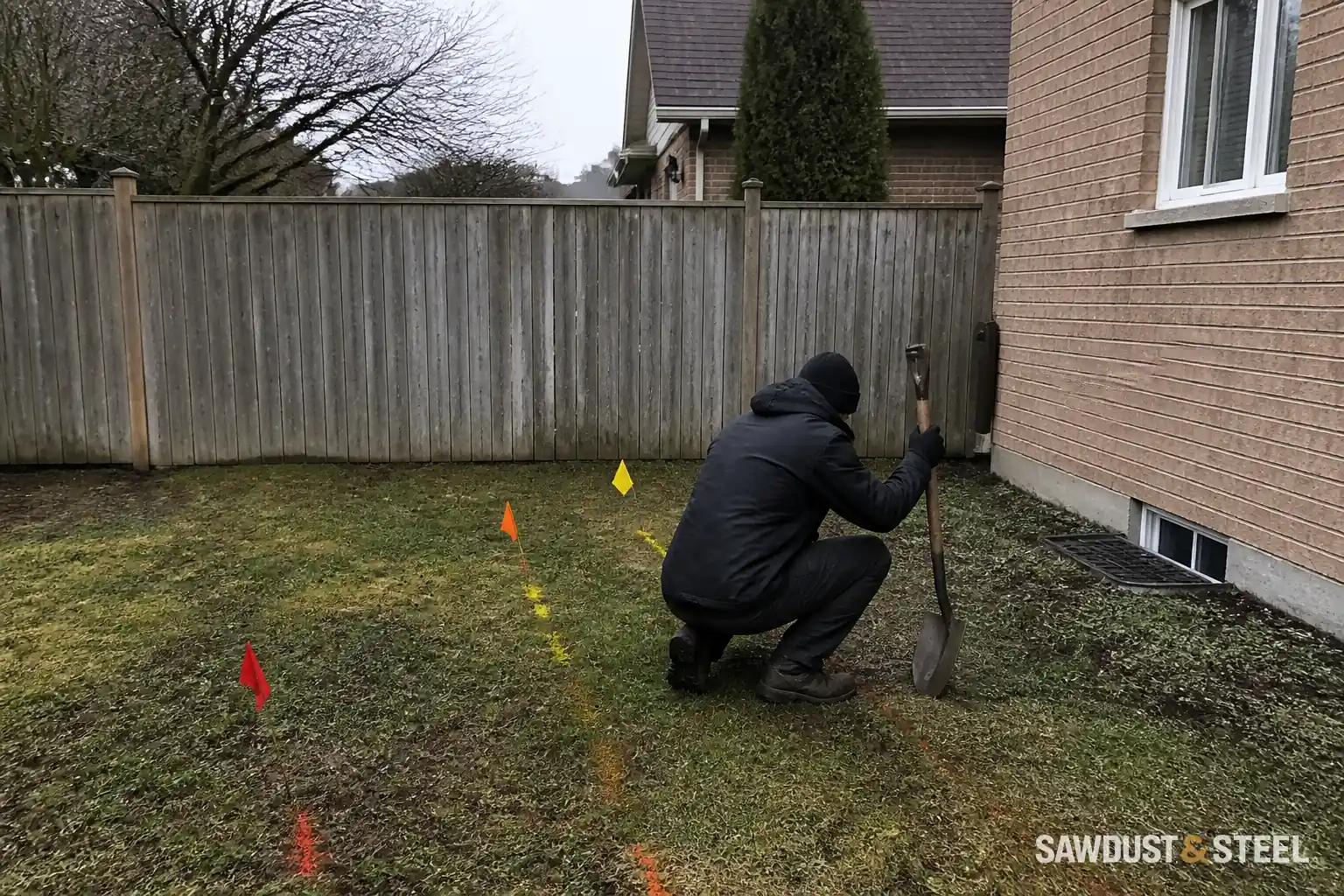
The patio door opens toward the nicest part of the yard. Unfortunately, the septic system may already have a claim on that space. A tank lid is only one visible clue; the treatment area and pipes extend beyond it, often beneath perfectly ordinary grass.
Do the septic homework before choosing the deck footprint. Moving a line on the drawing is cheap. Moving footings after excavation, or discovering that the pump-out route has vanished under new stairs, is considerably less cheerful.
Collect the records, then verify the site
Find the sewage-system permit, installation drawing, inspection records and recent service information. Ask the previous owner or service provider about changes, but treat recollections as leads rather than a final surveyed layout. Record the tank, distribution components, bed area and pipes serving them.
| Feature | Why it matters |
|---|---|
| Tank and lids | Inspection, pumping and replacement access |
| Bed limits | Protected treatment area |
| Pipes and controls | Excavation and private service locating |
| Deck works | Posts, stairs, drainage and delivery route |
Ontario's SepticSmart guide explains the components and the importance of suitable separation. Confirm the current requirements for your proposed deck with the authority responsible for on-site sewage systems in your municipality. Do not transfer a distance for one component to every part of the system.
Arrange appropriate locating of private services as well as the usual Ontario One Call process. A utility clearance does not, by itself, prove where a privately installed septic pipe or bed lies. Nobody should start an exploratory hole beside a guessed line because the surface looks clear.
The leaching bed needs more than an access hatch
A leaching bed treats and disperses wastewater through the ground. It is not simply a buried pipe that can be bridged with decking. Indigenous Services Canada's septic safety guidance says not to build a deck, shed or parking area over the bed.
Protect it during construction too. Delivery vehicles, soil stockpiles and repeated equipment traffic can be a problem even where no permanent structure is planned. Mark a protected area on the contractor's access drawing and show where materials will actually be placed. 'We will be careful' is less useful than a route everyone can see.
Do not direct new roof or deck drainage toward the bed. Planters, grading and paving can change water movement across the same area. The finished deck drawing should therefore show the surrounding ground and discharge routes, not stop neatly at the edge of the boards.
Maintenance access is a real working space
Ask the service provider what access is needed for inspection, pumping and future repairs. A small removable panel may expose a lid while still making the actual work awkward or impossible. Consider the route from the driveway, the position of stairs and skirting, and the equipment that would be needed if a component had to be replaced.
Keep records of the agreed access dimensions and route. If skirting is planned, read deck skirting and service access before deciding that a discreet little door will cover every future need. Access that requires dismantling the deck should be understood and accepted explicitly, not discovered during a service call.
Compare another footprint before redesigning the system
A smaller landing with stairs to a patio elsewhere may give you useful outdoor space without crowding the septic area. A shifted deck can sometimes preserve the best seating position while leaving a clear service corridor. Test those options on the same site drawing before assuming the entire sewage system must move.
Where a proposed footing or support is close to existing equipment, obtain a coordinated structural and sewage-system review. Excavation can matter as much as the finished post location. Keep the approved layout, locating records and construction photographs together, and make sure any site changes are reviewed before work continues. The aim is a deck you enjoy without making the system beneath the yard harder to maintain.