
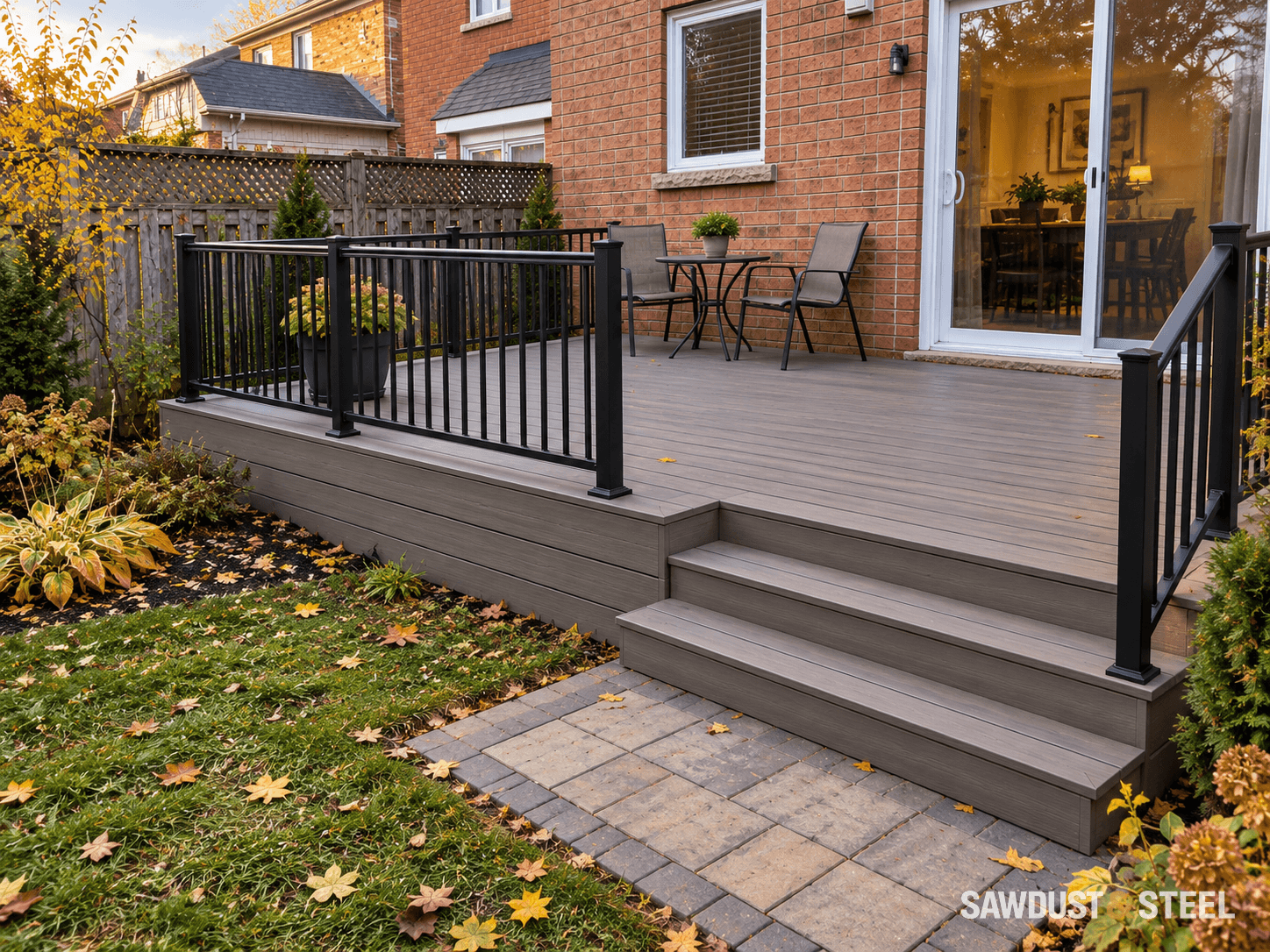
If the landing has moved enough to make the bottom step uncertain, stop using that route until it is assessed. A wobbly paver and a moving stair support are different repairs, but either can change where your foot lands when you are carrying something.
Compare the stair with the walking surface
Original landing position
Record the rise from the finished landing to the first tread, then compare the other rises. Measure at the actual walking line.
Landing has risen
The stairs may stay fixed while the landing moves upward. The bottom rise becomes shorter even though the treads have not changed.
Side-view comparison, not a stair design or a tolerance chart. Measure the actual rises and have the cause of movement assessed before changing a tread or landing. Oakville sample deck and stair details.
Keep the distinction clear in photographs: the stringer is the sloping structural member under the treads; the landing is the surface you step onto. A landing can heave while the stair remains in place, reducing the last rise. It can settle and make the last rise larger. If the stair itself bears on the moving assembly, the whole flight or its top connection may move too.
| Observation | What to establish |
|---|---|
| Landing high beside an unchanged bottom tread | Did the paving/base heave while the stair support stayed put? |
| Landing low with a larger last step | Has bedding or base settled or washed away? |
| Stair pulls at its upper connection | Has the structural support moved as well as the walking surface? |
| One paver rocks but surrounding levels are stable | Is the defect local bearing or part of wider base movement? |
The deck connection guide treats the stair attachment as part of the structure. A paver repair should therefore establish where the stringers are supported before anyone lifts the pieces beneath them. Do not remove a bearing paver, pack a loose shim under a stringer or excavate beside a footing as a trial fix.
Specify the finished level and the support separately
Ask for a section showing the unchanged or repaired stair support, finished paving elevation, drainage direction and the full run of steps. Photograph the original condition with a fixed reference before work starts. The repair should explain what caused movement and how the rebuilt surface relates to every riser, not merely make the bottom pavers look level for the afternoon.
Where the patio also ponds, include the discharge route in the scope. Raising the landing can improve one step while sending water toward the house or burying a nearby post base. Check the route from the door through the stair and beyond the landing before reopening it.
For surrounding paving movement, see spreading paver edges. If the stair layout changes, coordinate the guard and handrail details with the rebuilt landing.
Record which part changed
Compare dated photographs of the landing, stringers, and nearby grade. Note rocking pavers, visible gaps, and whether the change reverses seasonally. Photograph from the same position so the bottom tread and landing appear together, rather than sending only a close-up of one low stone. Don't adjust the stair to match one temporary position. The repair needs to explain which part moved and how that changes the complete flight.
Simpson Strong-Tie's deck guide treats stair connections as part of the structure. The local design and applicable Ontario requirements determine the actual stair and landing details; a US illustration does not establish them.
Ask two different questions
First, what supports the stair? Second, what provides the walking surface at its base? A patio can be attractive and reasonably level while being the wrong assumption for structural support. Conversely, a supported stair can still meet an uneven, slippery landing.
Put the finished levels on the drawing
- Show the intended landing elevation relative to the bottom tread.
- Establish the stair support and any foundation work.
- Show drainage away from the landing without creating an awkward walking slope.
- Check the complete run of risers after the proposed changes.
If the stair or landing is unstable, restrict access until it has been assessed. A handrail is not a cure for unpredictable footing.
Ask the contractor to explain what moved, what will support the repaired stair, and where the landing will finish. Keep the before photos with that answer. A freshly level paver looks convincing in October; you want a repair that accounts for the winter that shifted it.
When replacing the treads as well, check composite stair-stringer spacing separately from the landing repair.