
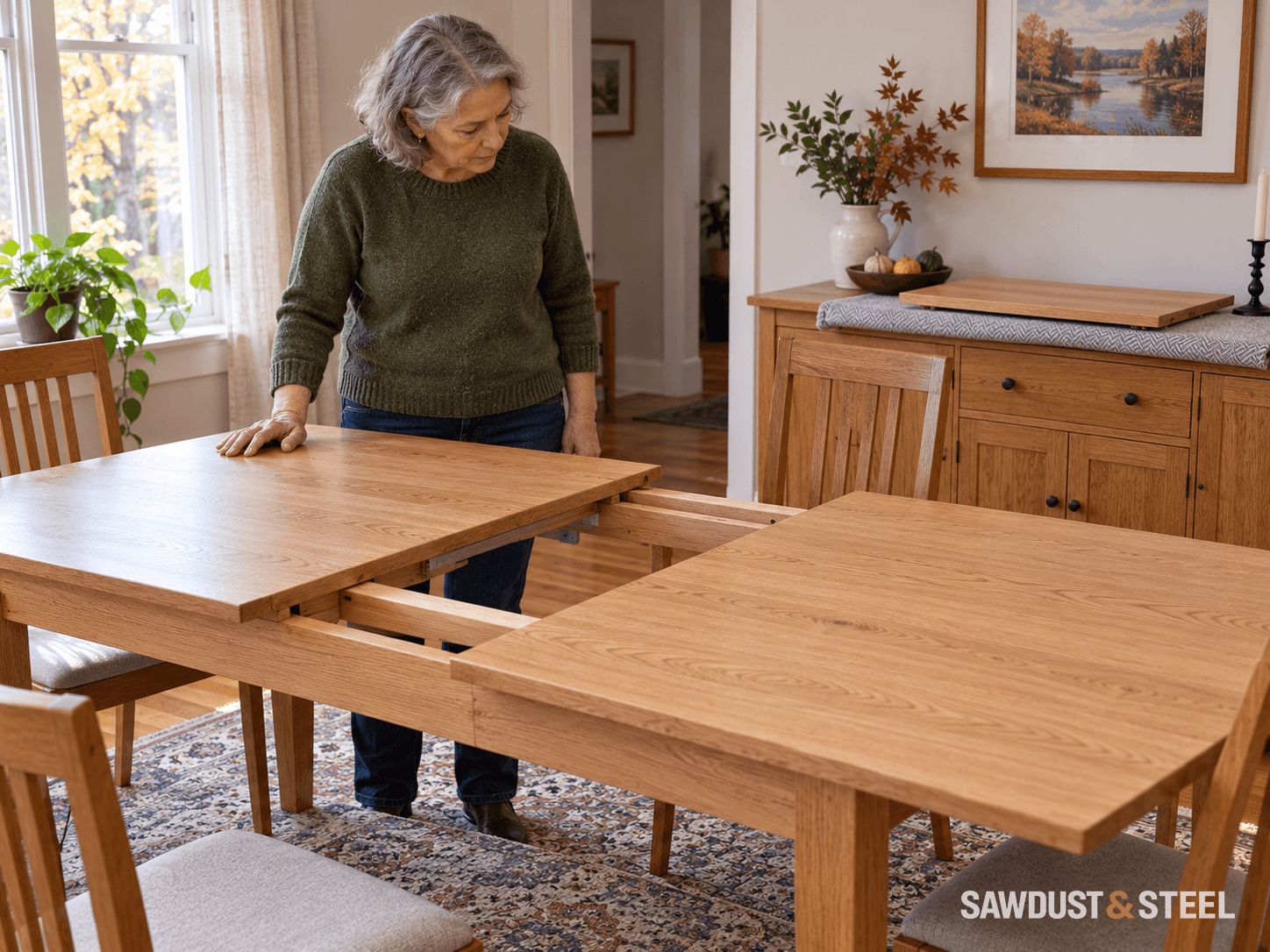
The table seated six perfectly well until the invitation list became eight. You retrieve the leaf, pull the two halves apart and discover that the furniture has declined to participate. Before someone suggests leaning on it, clear the tabletop and find out which part has stopped moving.
Identify the extension system before pulling
Look for the maker's label, model and instructions. Some tables use loose centre leaves, others have folding butterfly leaves, end extensions or synchronized mechanisms. A latch underneath may need releasing before the top moves. Keep fingers clear of pinch points and use the assistance specified for the table.
Canadel's guide to extending tables describes several different leaf arrangements, including removable and self-storing designs. The existence of a seam in the top does not tell you the opening sequence. A folding leaf that seems stuck may still be restrained by part of its intended storage arrangement.
For one concrete example, Gat Creek's Governor table uses wooden extension glides operated by two people, with pins and reference numbers for fitting its leaves. That is useful evidence that assistance and matching order can be part of the design, rather than signs that a table is defective. Follow your own model's arrangement.
Separate slide resistance from leaf fit
| When it stops | What to inspect |
|---|---|
| Before the halves begin to separate | Locks, catches and the correct opening sequence |
| Partway through opening | Uneven travel, an obstruction, loose attachment or damaged slides |
| Only when a leaf is offered up | Leaf identity, orientation, pins, sockets and support position |
| Only when closing the last gap | A misplaced fitting, apron interference or misaligned mating parts |
Look underneath with a light while the table is stationary. Check for a trapped object, a screw head standing proud, a loose rail or a visibly bent component. Do not reach into a moving slide while someone pulls the other end. If the table rocks, a leg joint opens or a runner comes away from its attachment, stop using the extension until it is repaired.
Where two halves must move together, pulling one corner can rack the assembly. Follow the intended grip points and direction with the required helper. Do not drag the table across the floor by an extended top or use the extension mechanism to haul a leg off a rug edge.
Match the leaf before changing it
Check any numbers or orientation marks underneath. Compare the apron profile, pins and sockets before lowering the leaf into position. Several leaves can look interchangeable from above while their fittings or skirts differ. Keep the leaf supported and avoid dropping it onto projecting pins.
A pin should meet its corresponding socket without using the table's closing action as a press. A visibly bent pin, blocked socket or proud fitting needs attention first. Do not hammer the leaf flat, enlarge every socket or plane an edge simply because the table closed last Christmas. Those changes can make the fit worse when the original cause is corrected.
Check where the leaf has been stored
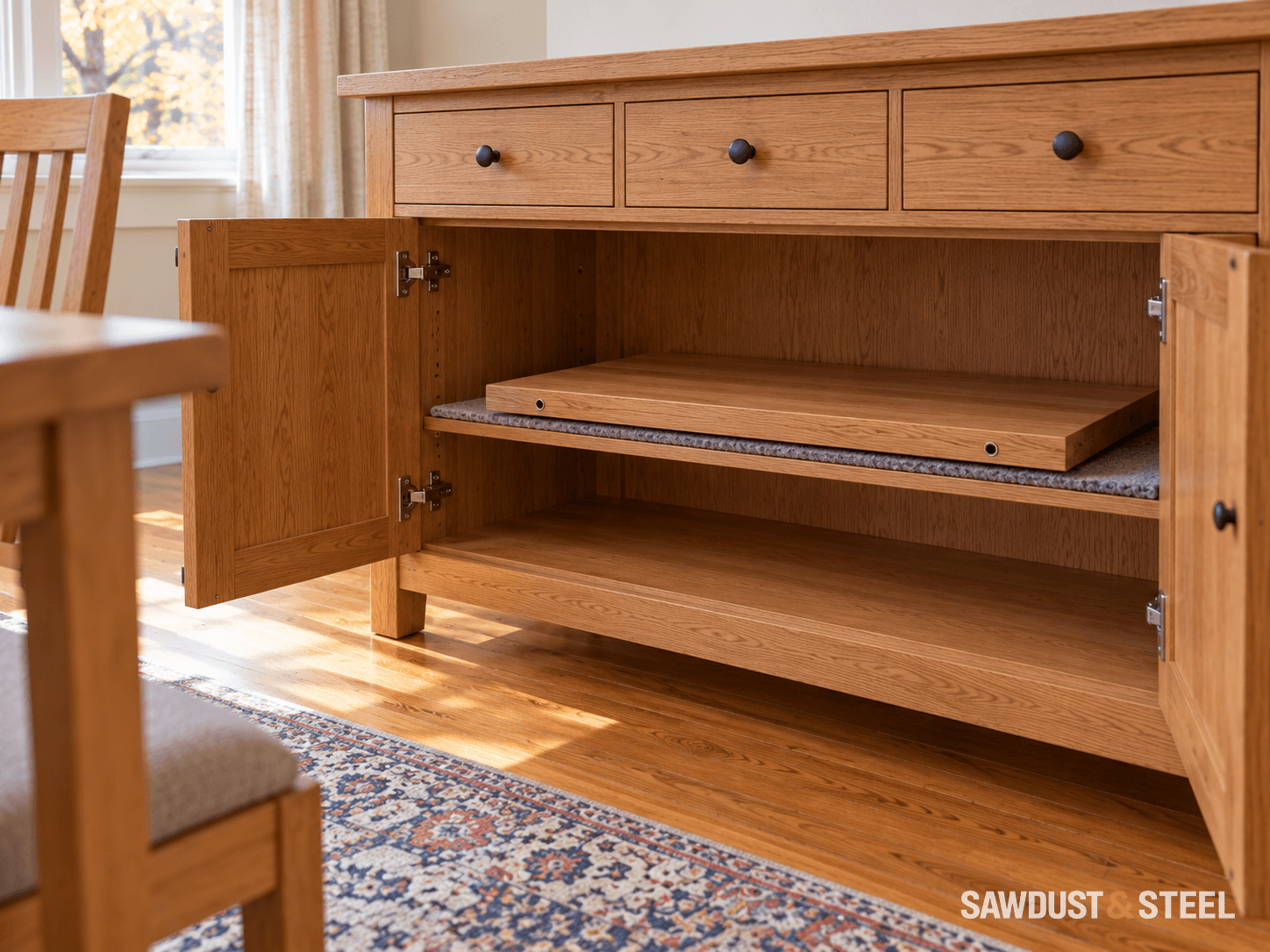
A leaf kept in a damp basement may experience different conditions from the table in a heated dining room. Canadel's care guidance recommends storing its leaves horizontally and near the table so they share similar humidity. Follow the maker's support and storage instructions; a protected surface still needs proper support.
Record any change in storage or room conditions for the repairer. Bringing a leaf into the room is useful information, not a promise that it will become flat by dinner. Persistent bowing, a split or a changed fit needs assessment before material is removed.
Use the maintenance method for the actual slides
Wooden runners, metal slides and geared mechanisms may have different maintenance requirements. Ask the table maker which parts should be cleaned or lubricated, with what product and how much. Do not spray an unknown lubricant across the mechanism and nearby finish. Keep the leaf edges and finished top out of the experiment.
Canadel also warns that an added leaf can exceed the capacity of a mechanism designed for fewer leaves. A replacement panel of the right colour is therefore not the whole specification. Give the supplier the model, photographs, original leaf count and the point where movement stops. Repair may involve the slide pair, attachment or matching leaf rather than the top itself.
Once the intended setup works, check that every leaf is fully supported, the mating surfaces meet and the locks or catches engage as instructed. Keep the useful identification marks and storage notes. If repair cannot be completed before the meal, use a separate sound table; guests can cope with two surfaces more easily than a centre leaf that becomes a lap tray.