
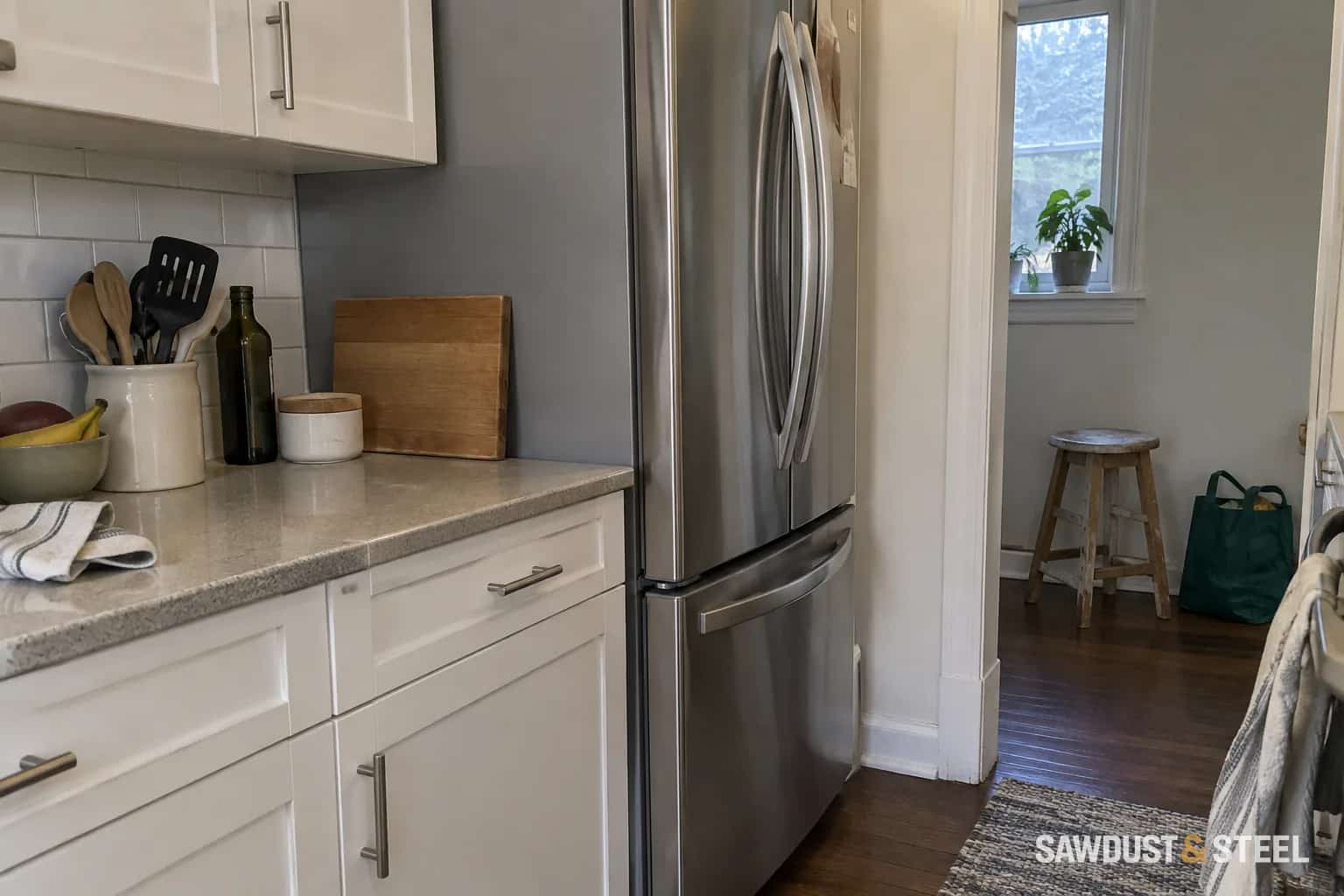
We met Arun's new refrigerator in the hallway because it had arrived before the cabinet panels. He was delighted with it until he held a straightedge against the kitchen cupboards. The doors came forward. The handles came forward a bit more. "Counter-depth," he said, with the tone usually reserved for a parking ticket.
Read the depth label carefully
A specification sheet may give depth without doors, depth without handles and overall depth. Those are useful different numbers, not interchangeable descriptions of the same thing. KitchenAid's counter-depth comparison describes the shallower format; the individual product drawing is what you need for a fitted opening.
As an example of the distinction, KitchenAid's refrigerator dimension tables separately label depth without doors and handles and depth with doors open. That older catalogue illustrates how to read a drawing; do not use its numbers for a current model.
Mark the front of the handle, too
- Measure from the finished rear wall, allowing the exact rear space and services required by the manufacturer.
- Mark the front of the cabinet, the closed fridge door and the handle as separate lines.
- Open the doors through their required travel and check internal drawer removal.
- Check the passing route, nearby island, adjacent drawers and the person using the refrigerator.
Painter's tape on the floor makes the projection obvious before the delivery team arrives. A cardboard door outline can help with swing. Include skirting, wall unevenness and a water connection if those occupy the recess. Do not assume the available depth is the dimension written on the old kitchen plan.
Deeper panels can create a new problem
Extending the side panels may hide more of the refrigerator body, but they can also obstruct door movement or ventilation. Recessing the appliance into a wall is a building alteration, not a free pocket of space. That wall may contain structure, services or insulation.
Our separate fridge-beside-a-wall guide covers the side clearance problem. Also keep the water shutoff accessible. A beautifully framed appliance should still be usable and serviceable.
Decide how flush you really need it
Arun kept the fridge. We adjusted the panel detail within the manufacturer's requirements and checked the island passage before anything was fixed. Once the shopping went in, the handles bothered him rather less than they had in an empty room.
If a truly integrated appearance is essential, choose an appliance designed for that installation and price the cabinetry around it. If generous storage matters more, a visible projection may be a perfectly sensible choice. Make that tradeoff while choosing the appliances, when it is still a pencil decision.