
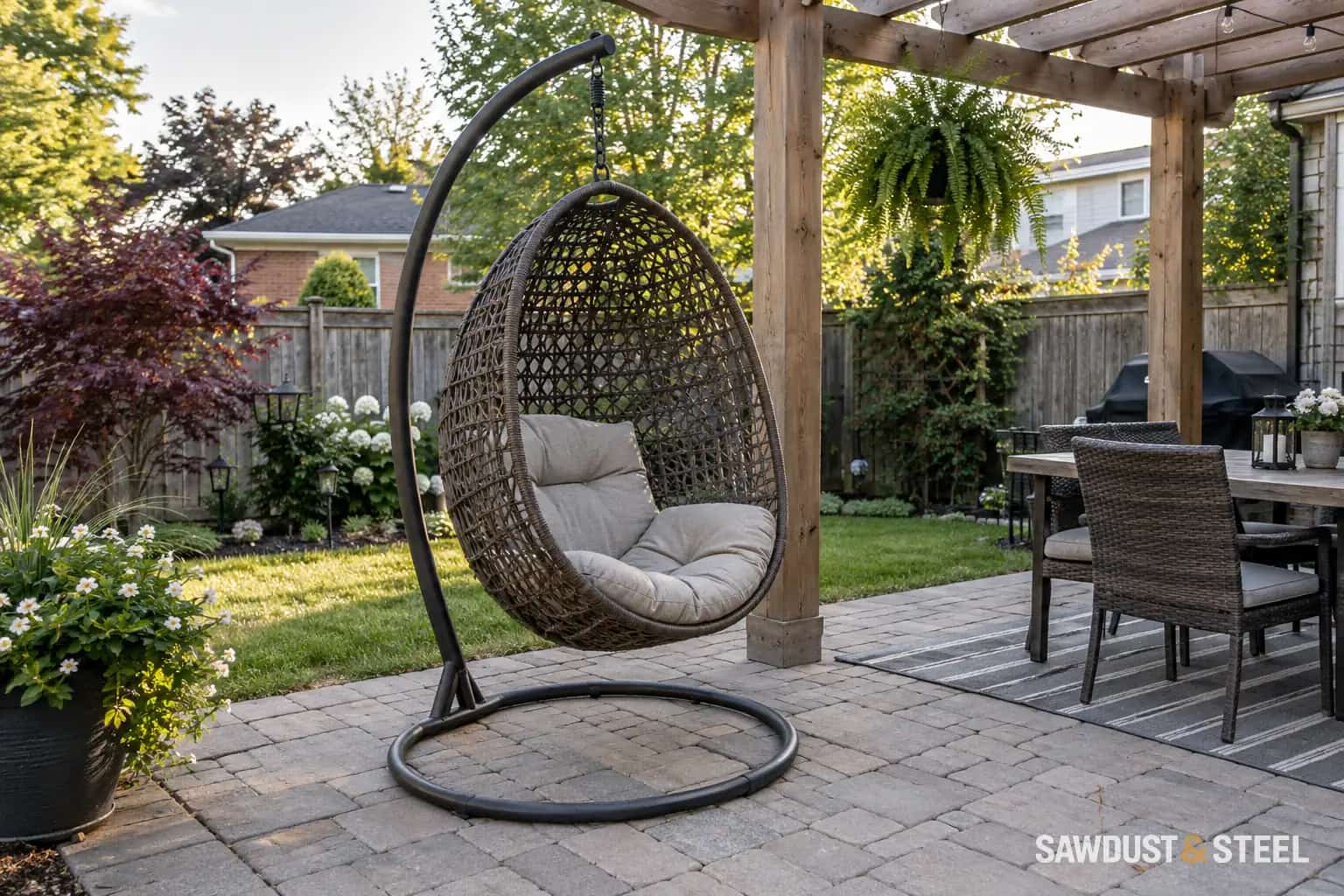
The beam looks substantial, the chair box gives a weight limit, and there is a convenient spot out of the sun. None of those details answers the important question: can this particular structure safely carry a person who sits down, shifts sideways and gets out again?
The chair rating does not rate the pergola
A hanging chair transfers forces through a chain of components. The seat connects to its suspension, the suspension to a hanger, the hanger to the beam, and the beam to posts and foundations through joints. A high rating printed on one hook cannot establish the capacity of everything beyond it.
The Two Trees single-chair kit manual makes this distinction explicit: its specified kit capacity is conditional on correct installation, and it directs users to obtain suitable advice about the supporting beam. It also distinguishes a beam from a ceiling or roof covering. Its product-specific limit does not become a capacity for an unknown pergola.
Gather the information before choosing a hook
- The pergola drawings or kit model, age and any alterations.
- The chair model, suspension arrangement and its installation manual.
- Clear photographs of the proposed beam, its ends, post joints and supports.
- Any decay, splitting, corrosion, loose connections or movement already noticed.
- The intended chair position and whether the maker permits swinging or only gentle seated use.
A carpenter or engineer may need measurements and access to concealed connections before deciding what works. A photograph of the beam's broad face cannot reveal its species, grade, internal condition or connection capacity. Decorative battens above the beam are especially easy to mistake for useful suspension points.
Avoid the reassuring test that proves very little
Do not hang from the beam, bounce on the chair or ask the heaviest person to "try it first." A one-time load does not establish capacity under repeated motion or reveal every weak connection. Keep the chair unused until the support and installation have been verified.
Nor is a strap around an arbitrary beam automatically safer than drilling it. A strap still applies forces to the same structure and needs an approved arrangement that controls movement and wear. Drilled hangers need a suitable location, material and fixing detail; there is no universal screw length that makes an unknown pergola acceptable.
Adhesive also has no place in an improvised suspension repair. The limitations of ordinary exterior wood glue are particularly relevant when a joint looks tidy but must carry someone's weight.
Compare the practical options
| Option | What it solves and what remains |
|---|---|
| Verified existing support | Uses the pergola, but needs an approved suspension point and all required clearances. |
| Designed structural alteration | Can create a suitable load path; may affect posts, foundations and local permit requirements. |
| Compatible freestanding stand | Avoids relying on the pergola; still needs the correct chair pairing, stable location and operating clearance. |
| Ordinary chair or bench | Provides seating without suspended-person loads. |
A stand should be a manufacturer-approved match, not merely wide enough to contain the chair. Check its assembly instructions, permitted surface, load limit and stability requirements. Leave enough space for the allowed movement and for someone to get in without striking a post, wall or planter.
Keep checking after installation
Follow the suspension maker's inspection intervals and inspect after unusual movement or weather exposure. Look for wear at contact points, corrosion, looseness and changes in the timber. Stop use when something changes rather than tightening whatever is visible and carrying on.
The useful question for an installer is, "Can you verify this chair and suspension at this location, including the structure beneath it?" That is much clearer than asking whether the pergola is strong. If the answer requires a substantial rebuild, a suitable stand may buy more relaxing afternoons with much less carpentry.