
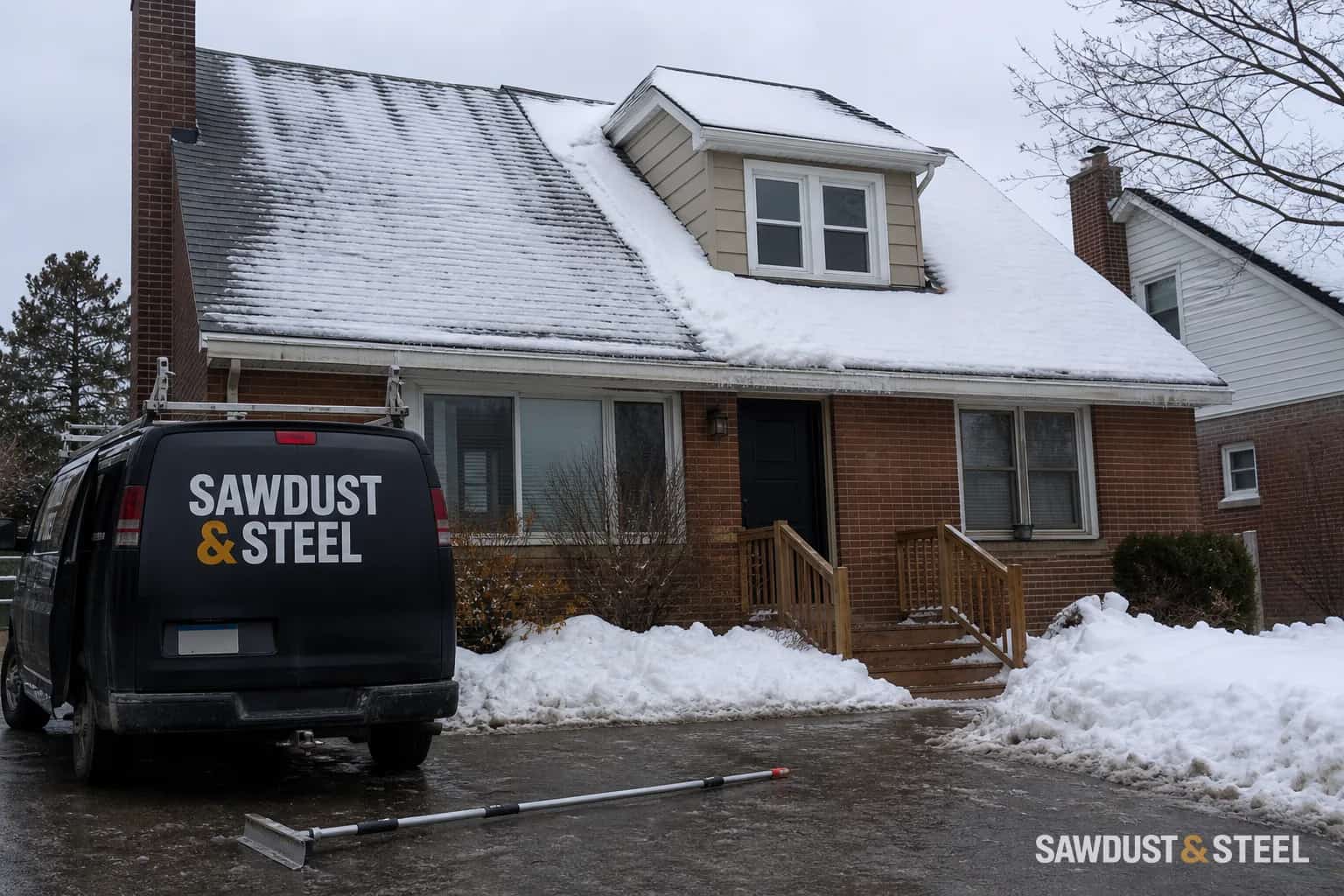
Your neighbour has hired someone to clear the roof. Now you're looking at your own snow and wondering whether you missed a rule. There isn't one safe depth for every house: wet snow, ice, and drifts can load a roof very differently from fresh powder. From the ground, compare the whole roof, including the lower addition you cannot see from the front walk. Wind can leave the main ridge almost bare while piling snow against the taller wall behind it. A neighbour's cleared roof tells you very little about the load on that hidden lower section.
Why is depth alone a bad answer?
| What is on the roof | Why it matters | What to notice |
|---|---|---|
| Fresh, fluffy snow | Usually lighter per centimetre, but it can deepen or drift quickly | Total accumulation and sheltered drift zones |
| Wet or compacted snow | The same depth can hold much more water and weight | Thawing, settling, and a heavy layer that no longer looks fluffy |
| Rain on existing snow | Rain adds weight and can saturate the snowpack | Forecast rain, blocked drainage, and rapidly changing conditions |
| Ice or repeated melt-freeze layers | Dense bonded layers are difficult and hazardous to remove | Ice at valleys, eaves, drains, and low-slope areas |
| Wind drift | It concentrates load in one area instead of spreading it evenly | Piles beside dormers, walls, roof steps, and other obstructions |
Ontario's snow-loading alert gives the useful comparison: a cubic foot of snow can range from about seven pounds when new and dry to 30 pounds when old and compacted; rain adds more weight, and drifting can concentrate it. Those figures explain why a depth-only rule is shaky. They do not calculate the capacity of a particular house.
The Township of Oro-Medonte reaches the same practical conclusion in its 2025 snow-accumulation bulletin: depth, outdoor temperature, home age, roof structure, slope, drift loading, and roofing system all affect the answer, so building staff cannot name one amount every roof can withstand.
What warning signs change the urgency?
- A roofline, ceiling, or structural member that appears newly sagged, twisted, or bent.
- Fresh cracking that appears suddenly or grows while snow and ice accumulate.
- Unusual movement or distress around a roof step, dormer, addition, or heavily drifted area.
- Active leaking after a thaw or rain-on-snow event. A leak does not prove overload, but it still needs prompt investigation.
- A roof with known damage, altered framing, deterioration, or an uncertain load path.
Can you remove snow safely from the ground?
The current Canada.ca snow-and-ice guidance recommends working in pairs or hiring a professional, using a roof rake slowly from a safe position, and taking small amounts at a time. It suggests limiting buildup beyond roughly 15 to 30 cm. Treat that range as general maintenance guidance, not a Building Code load limit or proof that every roof is safe below it.
- Stay on the ground and follow the roof-rake manufacturer's directions; keep the fall zone clear of people, pets, windows, vehicles, and overhead wires.
- Do not climb onto a snowy or icy roof, work from an unsecured ladder, or stand below the section you are pulling down.
- Do not beat, chop, or pry bonded ice from shingles.
- Do not create a sharply uneven pile by clearing one convenient patch while leaving a heavy drift beside it. Professional removal planning matters when loads may already be significant.
Who should look at the problem?
A roofing professional can investigate leaks, damaged roofing, ice dams, and safe access or removal. A structural engineer is the better call when the question is capacity, visible movement, altered framing, a heavily concentrated drift, or whether removal itself could worsen the load pattern. If the moisture is at the eaves without structural distress, start with the Ontario ice-dam guide; if the house is moving, use the structural warning-sign checklist.