
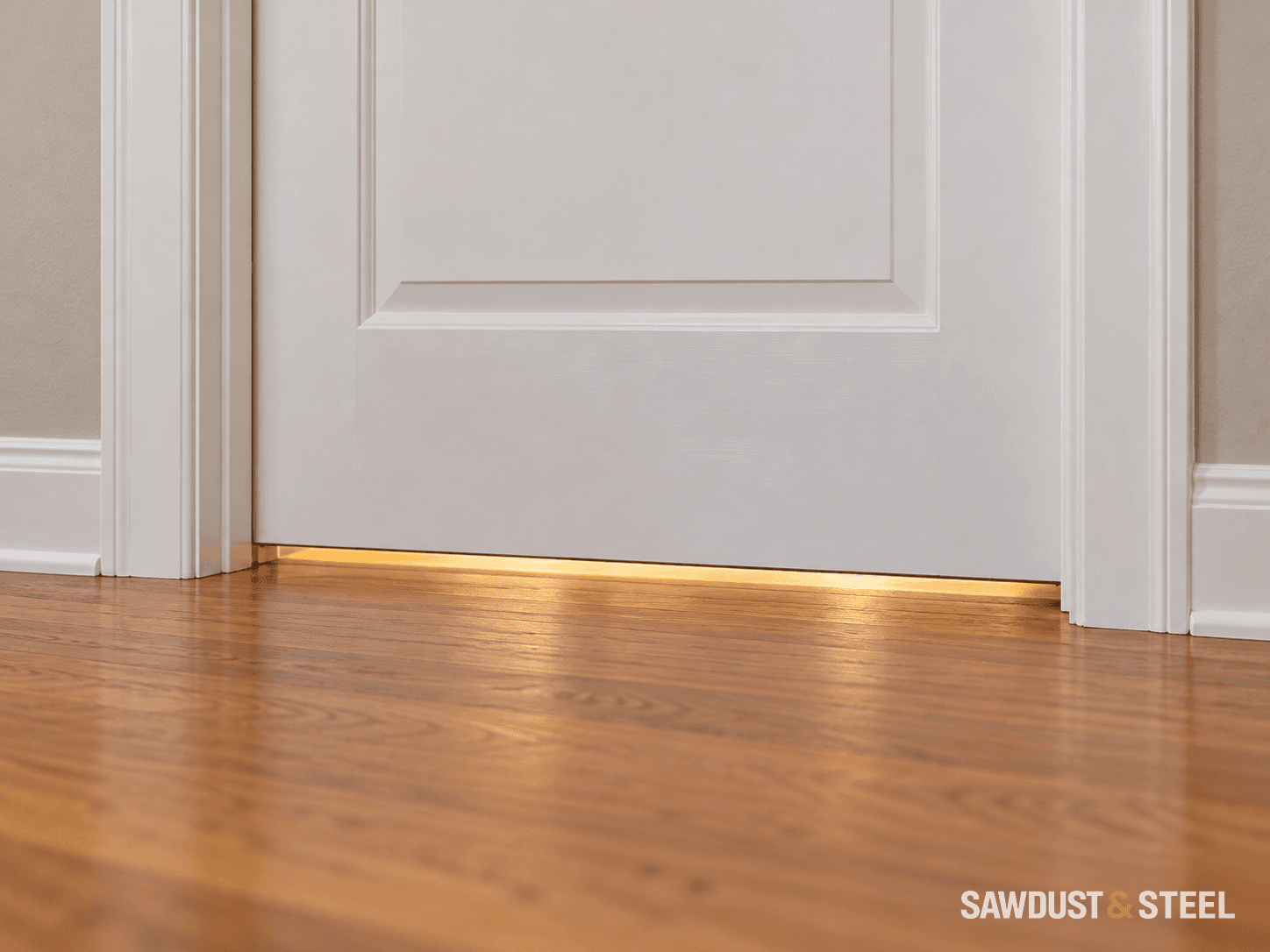
The office door is shut, but everyone in the hall can follow the meeting. Before ordering a heavier slab, listen near the latch edge and the floor. A sound path around a door remains a sound path around a more expensive door. The useful repair starts by locating it.
Check the closed opening before adding anything
With the room in ordinary use, compare what you hear beside the door, beside the adjoining wall and near any transfer grille. Look for a visibly uneven perimeter gap, a latch that does not hold the slab consistently against its stops, and a bottom edge that sits well above the finished floor. This is a practical comparison, not an acoustic rating test.
Correct loose hinges and a door that will not latch first. A gasket has a working compression range; it cannot straighten a distorted frame. Seals that require a hard shove to close the door may be the wrong profile or fitted in the wrong position. Everyone who uses the room still needs to operate the latch comfortably.
Give each edge the right detail
| Part of the opening | What to confirm |
|---|---|
| Head and jambs | A continuous compatible seal with even contact when latched |
| Bottom edge | A seal suited to the gap, door construction and floor surface |
| Bottom corners | How the bottom and side details meet without an open bypass |
| Latch and hinges | Free operation after the seals are fitted |
A fixed sweep stays near the floor throughout the swing. An automatic drop seal retracts for opening and lowers when its actuator meets the jamb. Pemko's STC411 range is one example of that mechanism, with a mortised installation. Other products mount differently. Match the actual slab and preparation instead of assuming every door can accept a deep routed groove.
Check the full swing across rugs, transitions and uneven flooring. A bottom seal needs a suitable contact surface at the closed position; dragging across a high spot elsewhere is a separate fit problem. Confirm permitted trimming and hardware preparation with the door supplier, especially for hollow-core or labelled doors.
Find the room's return-air route
In a forced-air house, supply air entering a closed bedroom or office needs a route back toward the return system. That route may be a dedicated return, a designed transfer path or, in some houses, an inadequate door gap. Closing the gap changes the route even if the new seal looks like a small improvement.
Pacific Northwest National Laboratory's undercut guidance explains that undercuts alone often cannot provide enough return airflow. Its jump-duct guidance describes other return-path arrangements. Ask an HVAC contractor to assess the room with the door closed and the system operating before selecting a sealing plan. A grille's presence does not prove it has enough capacity.
Explain the sound goal at the same time. A simple opening through the wall can restore an air path while creating another sound path. The designer can coordinate airflow and sound attenuation rather than solving them on separate visits. Do not cut a transfer opening through a fire separation or into a garage. A bathroom exhaust problem has its own replacement-air check.
Ask what an acoustic number includes
If a supplier gives a sound-transmission rating, ask for the tested assembly and installation conditions: slab, frame, seals, bottom detail and hardware. A rating for a complete tested opening is not a promised improvement from sticking a gasket onto your existing door. Sound can also travel through the surrounding wall, ceiling or ductwork.
For ordinary household privacy, try one suitable opening and compare the same everyday sound from the same positions. For a room where speech privacy or measured performance matters, include an acoustic specialist in the scope. The solid-core versus hollow-core guide helps with the slab decision once the rest of the opening is understood.
Check comfort and closing after installation
Operate the door slowly and normally from both sides. Check the latch, perimeter contact and bottom seal through its whole travel. Have the planned airflow checks completed with the door closed. Keep the product details and adjustment instructions, and investigate new room-temperature differences or closing resistance instead of trimming away a random part of the seal. The meeting may remain dull; it should at least become less communal.