
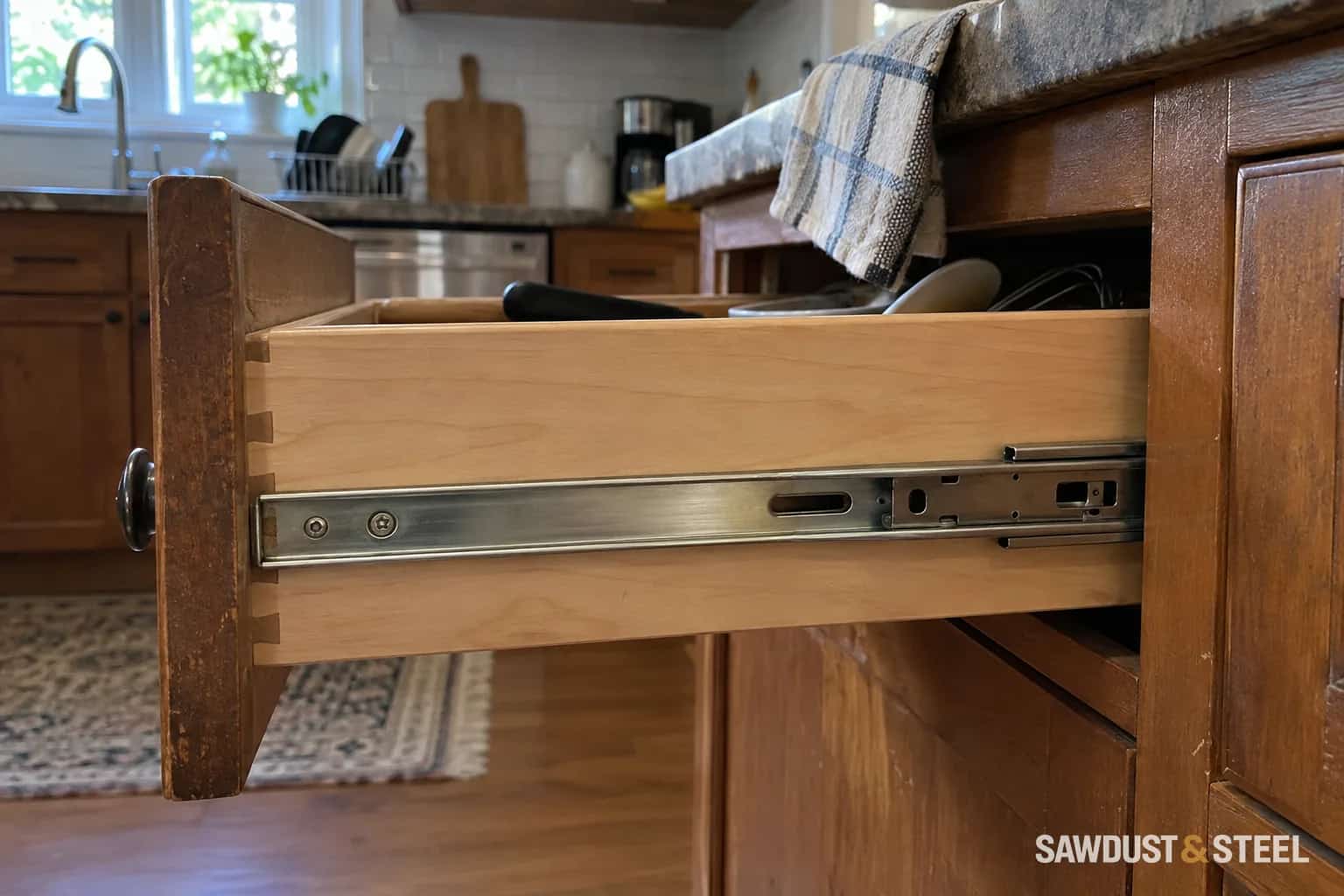
Cast iron accumulates quietly. One pan becomes three, the casserole joins them, and the drawer still closes, so the arrangement seems fine. Smooth movement is useful, but it is not a measurement of the load the installed assembly can carry.
Find the rating that belongs to this drawer
Start with the cabinet order or hardware markings. Record the runner manufacturer, model, length and mounting arrangement. A brand name alone is not enough: product families can contain different capacities, and an older runner may differ from the current version advertised online.
Ask the cabinet supplier for the finished drawer's limit as well as the hardware rating. The box, bottom, front attachment and cabinet fixing points must all suit the use. If the supplier specifies a lower limit for the assembled drawer, a larger number on the runner does not override it.
Blum's TANDEM overview describes capacity up to 100 lb for its system. That is a product-family claim, not a default allowance for an unidentified kitchen drawer. Treat words such as heavy duty and soft close as descriptions, then find the actual specification.
Check whether the rating means contents or total weight
Accuride explains its load ratings as gross weight: the drawer construction plus the contents, carried by a pair of slides mounted as instructed. Do not double a pair rating because there is a runner on each side. Other product documents need to be read on their own terms.
Here is a calculation example, not a capacity recommendation: suppose the confirmed limit is 40 kg including the drawer, the empty drawer weighs 8 kg, and its organizer weighs 2 kg. That leaves at most 30 kg for contents under that rating, before considering any lower cabinet or drawer limit. If the documentation instead rates contents separately, use that definition rather than subtracting the box twice.
| Figure or label | What to establish |
|---|---|
| Runner capacity | Exact model, pair or single unit, and whether drawer weight is included. |
| Drawer or cabinet limit | Whether the completed assembly has a lower allowed load. |
| Length and width | Whether this drawer falls within the product's tested application. |
| Mounting orientation | Whether the rails are installed in the position for which they are rated. |
| Static test load | A test condition, not extra everyday storage capacity. |
The way the runner is installed matters
The Accuride cabinet-hardware catalogue explains that drawer dimensions and mounting affect slide performance. A side-mounted slide placed flat underneath may have a substantially different rating, or may not be suitable at all. Do not rotate a familiar runner and keep its original number.
Support also matters where screws meet the cabinet. A sound runner fixed into loose blocks or damaged board is not a sound installation. If the front drops, a fixing moves or the bottom bows, unload the drawer and investigate rather than searching for a higher-rated slide to fit around the problem.
For an existing fault, the sagging-bottom guide distinguishes a failed panel from opened box joints. This article is about establishing the loading limit before that repair is needed.
Weigh the contents and arrange them for use
Weigh groups of pans, lids or dishes on a suitable scale instead of estimating by how full the drawer looks. Dense items can use very little volume. Count removable organizers when the rating requires it, and keep a little practical space for future additions rather than filling to a number on day one.
Spread heavy items sensibly across the drawer rather than making one tall stack in a corner, and avoid dropping heavy cookware onto the bottom. Store the items where the regular user can lift them without an awkward reach. Dividing a collection between two suitable drawers may be easier than upgrading one very wide unit.
If the routine involves lifting a heavy mixer out of a low drawer, a mixer lift is a different option to evaluate. Its rating and cabinet support need their own checks; it is not simply a drawer with stronger springs.
If the model cannot be identified
Do not assign a capacity from appearance. Send clear photographs and dimensions to the cabinet maker or hardware supplier, keep heavy items elsewhere, and arrange an assessment if fixings or construction are uncertain. For new work, ask the quotation to name the runner and finished drawer capacity so the decision survives beyond the showroom conversation.