
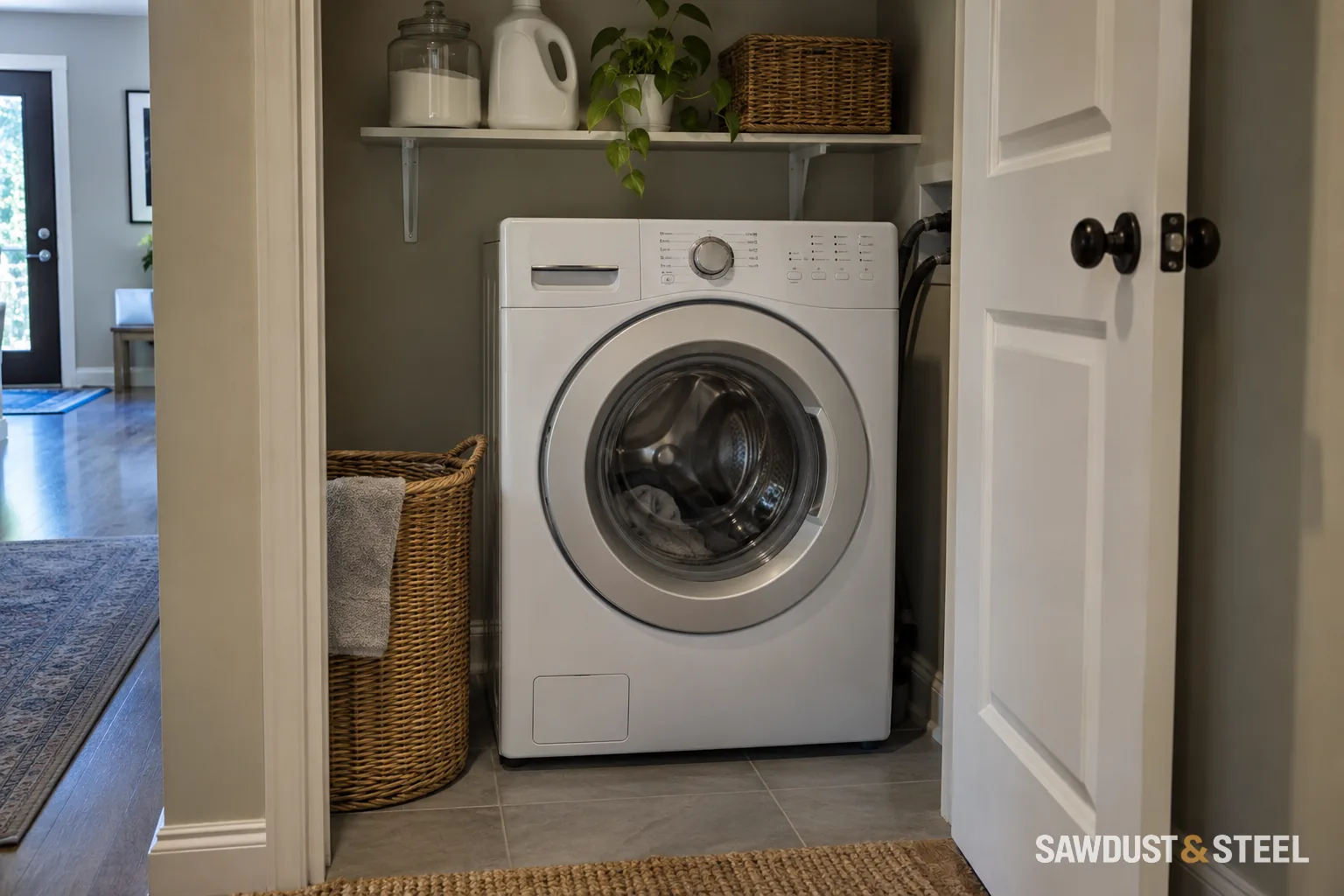
A solid door is excellent at hiding laundry. Whether it is suitable for hiding the machines depends on the machines. Pick the appliance models before the door style, and keep their installation diagrams beside the cabinet drawing.
Read both installation manuals
Find the instructions for recessed or closet installation, the arrangement you intend and any stacking kit. Separate minimum clearances from recommended service space. A vented dryer, heat-pump dryer and combined laundry unit may have different requirements; a photograph of another laundry closet is not a specification.
Whirlpool laundry room sizes includes top and bottom door openings in its closet-planning guidance. Use the exact appliance manual for the required arrangement and opening area rather than copying a general sizing example.
Exact models
Confirm the washer, dryer and any kit identifiers.
Closet requirements
Record required clearances and ventilation opening locations.
Door specification
Check the effective free opening of the chosen grille or louvres.
Installed check
Confirm shelving, baskets and trim do not obstruct the planned openings.
The grille size is not necessarily its open area
A grille includes blades and a frame. Ask the supplier for its published free area, then have the installer compare it with the appliance requirement. Two doors that look equally ventilated can leave different actual openings. Do not count a gap behind a solid panel as an opening to the room.
For example, suppose the appliance manual requires 48 square inches of free opening at the upper location. An 8 by 12 inch grille has 96 square inches of overall face area; at a published 50% free area it provides 48 square inches, if that rating applies to the full stated face. Ask for the manufacturer's actual free-area figure rather than estimating from the slots. A separate lower-opening requirement must still be met at its specified position. The 48-square-inch figure here is an arithmetic example, not a requirement for every dryer.
Door trim and baseboards also reduce the finished space. Check the machine doors with the closet doors fully open, including handles and hinges. Make sure a basket can pass without someone having to hold a door in an awkward half-open position.
Keep maintenance possible with the enclosure complete
Plan filter access, appliance removal and reachable shutoffs before adding shelves. Required ventilation cannot become a storage cubby. If the dryer is gas-fired, its installation and combustion-air questions belong with a qualified gas technician; do not adapt a generic electric-dryer closet detail.
A heat-pump model may remove the exhaust-duct route, but its own room and installation conditions still apply. Have the final enclosure checked as installed, including the doors you will actually close during laundry.