
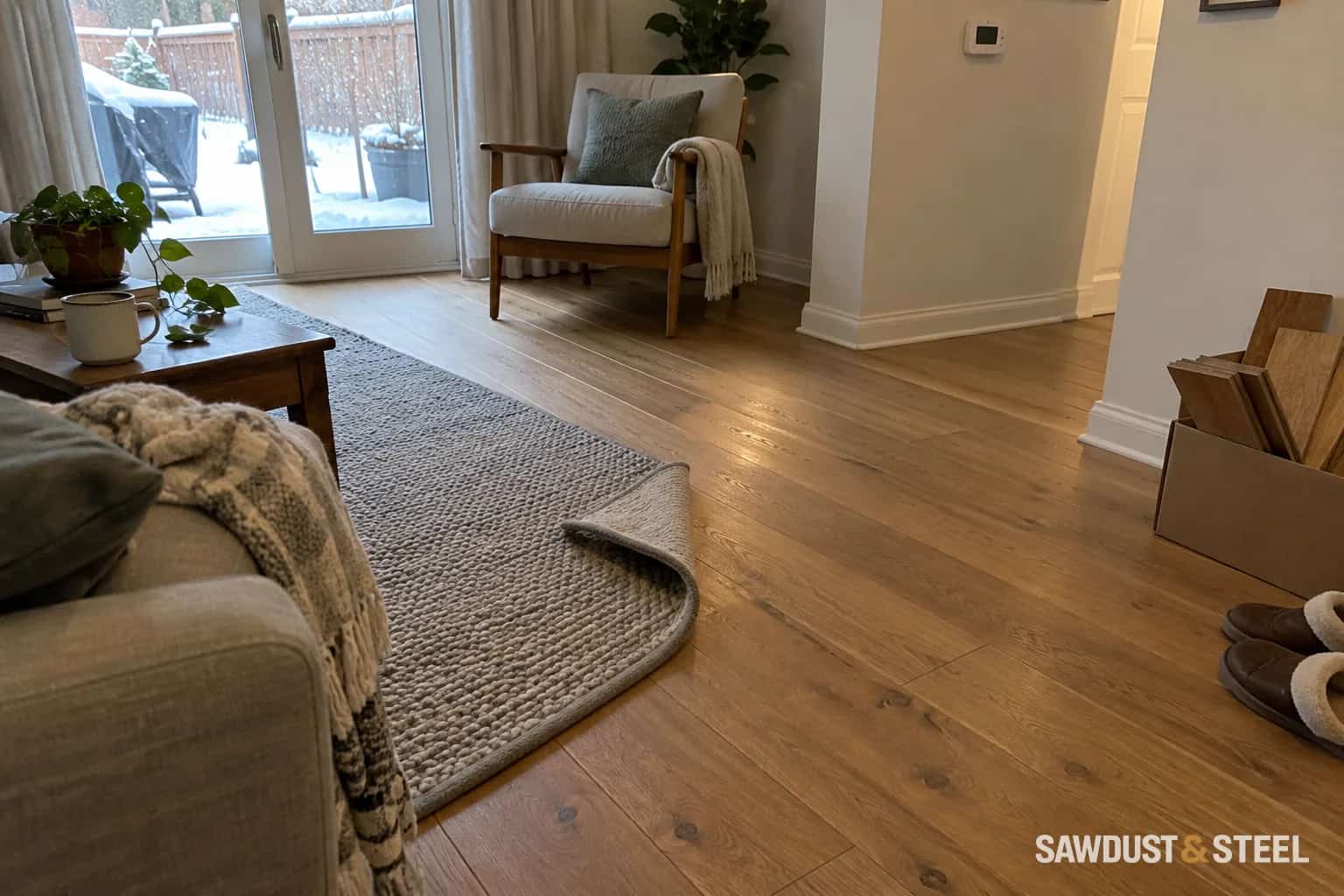
A photograph can find a promising colour. It cannot tell you whether a replacement board will lock into the floor. Start with the old product information and a real sample, then decide how much floor needs to change. The goal is a repair that works in the room, not a carton with an encouraging name.
Find the identity before searching the colour
Look for leftover cartons, invoices, builder selections and labels on spare boards. Record the brand, collection, product code, dimensions and production information. Ask the original retailer whether the collection was renamed, replaced or made for a particular store. Two products called natural oak can be completely different floors.
If there is no spare piece, ask the installer how to obtain a sample without creating unnecessary damage. A removable threshold may reveal the edge profile. Do not pry up a good floating plank in the middle of the room just to inspect it. Photograph the face, underside and edges with a measurement reference.
Check fit before accepting a colour match
Compare total thickness, face width, edge bevel, tongue-and-groove or locking profile, and the way the board connects at both ends and sides. Similar dimensions do not prove that two locking systems are compatible. A piece that seems to click together loosely on a bench may still fail in the installed floor.
Installation method matters too. Karndean's separate installation guides distinguish gluedown, rigid-core and loose-lay systems. Do not mix them because the surface print resembles the old floor. For wood, the NWFA installation guidelines likewise distinguish installation and repair methods.
| Match to check | A photo cannot establish |
|---|---|
| Product code and batch | Current stock or physical compatibility |
| Thickness and edge profile | Whether both end and side joints fit |
| Colour and sheen in the room | How a new board compares with aged flooring |
| Installation method | Whether the proposed local repair is feasible |
Judge the appearance in the actual room
Bring samples home and place them beside the damaged area in daylight and evening light. Compare sheen, texture, grain scale, bevel and colour. A near-match with a different gloss can stand out more than expected when the light runs across it.
The existing floor has aged. A spare board from the original batch may still look different if it spent years in a dark cupboard. Read about rug outlines and sunlight on wood before deciding a colour difference proves the wrong product. Do not promise that two visibly different materials will eventually age to the same colour.
Choose the repair boundary
For an isolated damaged board, exact spare stock may make a local repair practical. If the profile cannot be matched, consider recovering suitable boards from an inconspicuous area and replacing that whole area with another finish. This takes careful planning: dismantling can damage locks, and a glued or nailed floor changes the work involved.
A closet can be a donor, but count the usable pieces and lengths before relying on it. If there is too little material, price a deliberate replacement through to a doorway. Our single-plank replacement guide explains why access and attachment method affect the repair.
Make the search finite
Give suppliers the complete identification and the actual quantity required, including expected cutting and repair losses. Confirm stock physically exists and request a sample before paying for a remote leftover batch. Check returns, condition and whether cartons have been stored dry and intact.
If the search keeps producing almost-right boards, compare the total cost with replacing to a natural room boundary. A clearly chosen transition is often calmer to look at than a patchwork of close colours. Keep any new leftovers labelled and stored appropriately; the next small repair should not require the same detective work.