
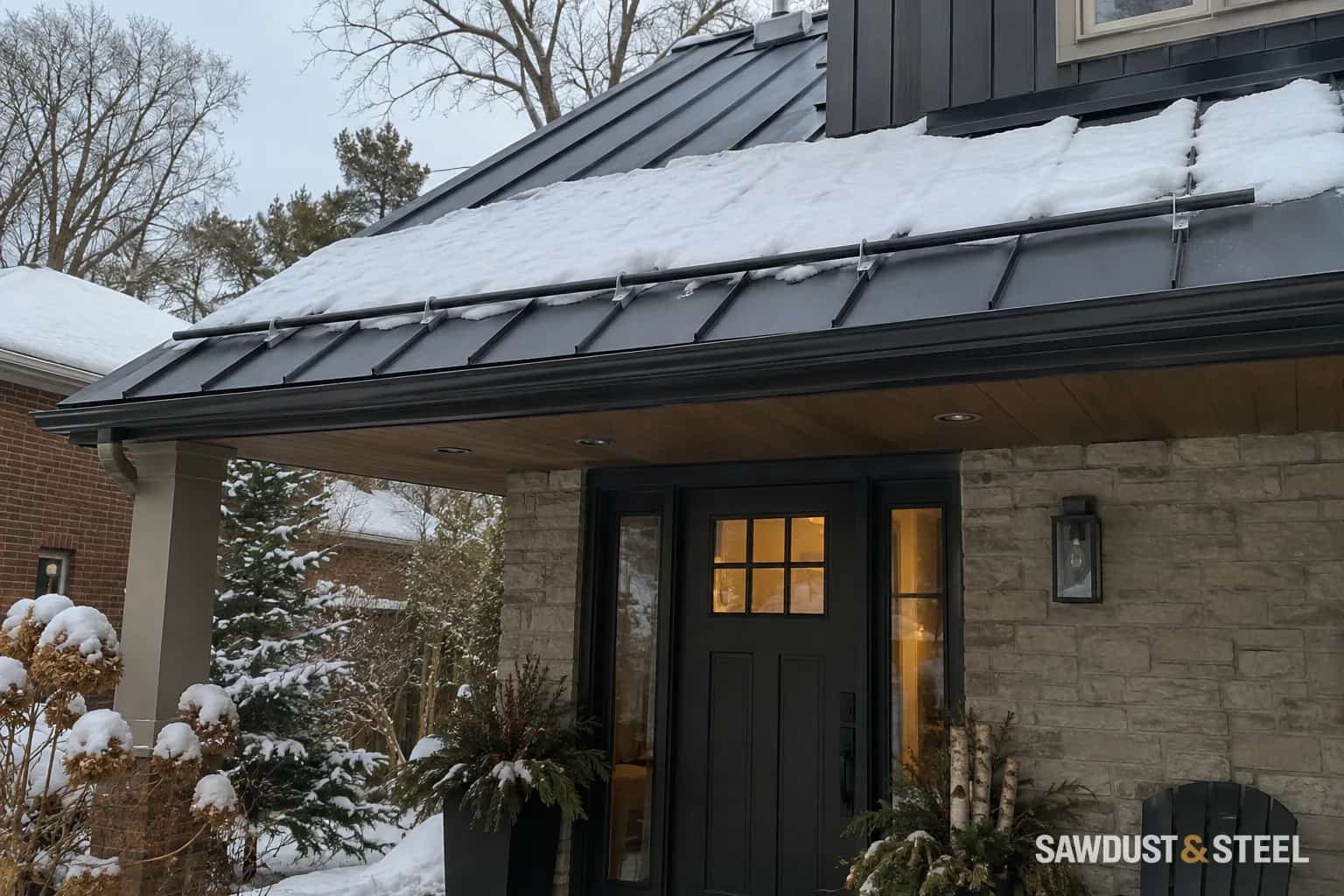
The metal roof sheds its snow efficiently. Unfortunately, the side entrance is where the snow wants to go. Before adding a handful of attractive little guards, map the entire slope and the places people use beneath it.
Keep people out of a known shedding area
If snow or ice is currently threatening an entrance or path, keep people away and arrange appropriate professional assessment. Do not stand below the eave to watch for movement, climb onto an icy roof or knock down a slab yourself. Any temporary alternate route must remain safe and usable; blocking the household's only exit is not a complete plan.
The Metal Roofing Alliance discusses controlled snow release to protect people and property. Its general product overview does not establish a layout for your house. A roof covering also does not prove that the underlying structure can carry any particular snow load.
Map what is below every slope
Mark doors, paths, driveways, lower roofs, skylights, equipment and neighbouring property on a simple plan. Add the route used for bins and winter deliveries. A formal front entrance may be used once a week while the narrow side passage receives every school bag and grocery trip.
Photograph the whole roof from the ground and retain any panel and installer records. Note where snow has released previously without approaching the hazard to obtain a better image. Include new solar panels or other roof-mounted equipment in the assessment; they can change the arrangement the retention designer is considering.
| Record | Why it matters |
|---|---|
| Roof profile and material | Establishes compatible attachment and tested capacity |
| Slope, length and panel spacing | Defines the roof area contributing load |
| Site snow conditions | Sets the design load rather than a visual guess |
| Paths and lower features | Identifies what needs protection from release |
Match the system to the actual roof
S-5's design guidance identifies site-specific snow load, slope, roof length, panel width, profile and material as design inputs. Ask the designer or supplier to document the values used and the tested attachment capacity for the selected roof profile. Similar-looking seams are not proof that a clamp is compatible.
A standing-seam clamp and a fastener through another roof type are different connections. Have the roof manufacturer and installer confirm compatibility, waterproofing implications and warranty conditions. Do not drill through a panel or glue accessories to it because an online kit says metal roof.
A short row above the door may carry more than expected
S-5 explains why partial snow-retention layouts can receive unpredictable loads from a larger snow bank. The snow above a short protected strip does not necessarily separate into a neat rectangle matching the doorway. Have the full roof geometry considered rather than purchasing guards by the width of the path.
The approved layout should identify locations, rows, attachments and installation requirements. Where engineering review is required or appropriate, arrange it before ordering. A manufacturer's calculator is only as useful as its inputs and applicability; ask who is responsible for confirming them.
Keep ice dams and snow retention separate
Retention controls snow movement. It is not a repair for indoor air leakage, poor insulation or an ice-dam problem. The ice-dam guide addresses those causes. Holding snow on a roof while ignoring an existing water-entry problem can leave the household with two unresolved concerns.
Similarly, roof-load questions need their own assessment. Use the roof-snow guide to identify information and warning signs, not to calculate a safe load from a ruler in the garden. Snow depth, water content, drifting and structure are not interchangeable measurements.
Price installation and future inspection
Request a written scope naming the roof areas covered, system components, installation records and inspection requirements. Ask how the installer will reach the roof safely and how future service can occur without damaging panels. Keep product details and photographs of completed connections with the roof warranty.
Inspect from the ground after significant weather and arrange service for visible movement, damaged components or unexpected shedding. Follow the supplier's maintenance guidance rather than retightening clamps by guesswork. If you are still selecting the roof, the roofing-material comparison puts snow management into the purchase before the first winter makes the decision urgent.