
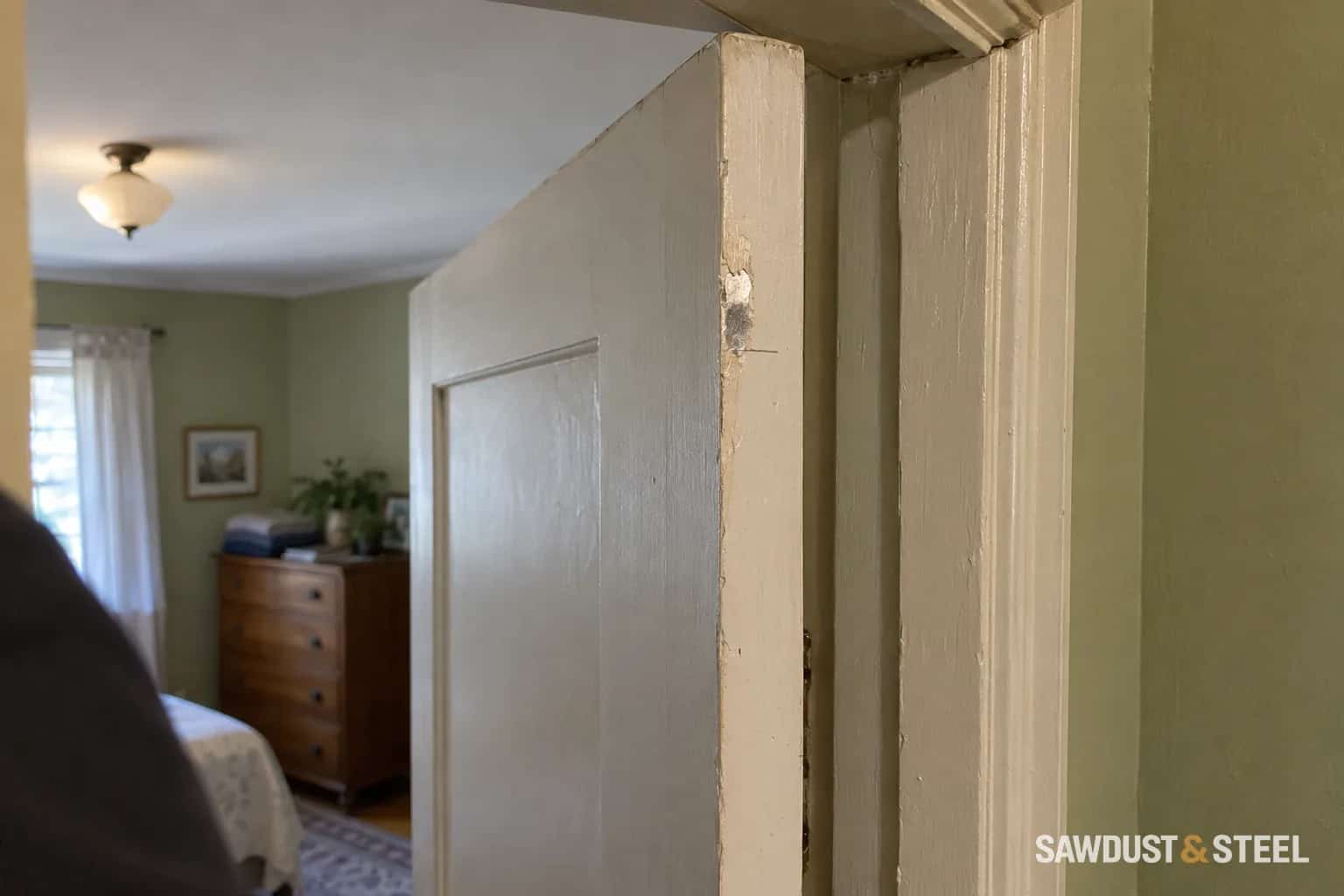
The bedroom door opens with a sharp crack just when somebody has finally fallen asleep. Yet once it is open, it swings normally. That pattern deserves a different investigation from a door that scrapes its frame throughout the last part of its travel.
Watch when it sticks and where the paint transfers
Open gently rather than yanking against a resistant latch. With the door open, check that the latch and handle operate normally. Look along the stop, the narrow strip the closed door rests against, and the matching face of the door. Small bare patches with corresponding paint stuck to the opposite surface are useful clues. Weatherstrip can also adhere to a coating without an obvious wood-to-wood rub.
| Observation | Next question |
|---|---|
| Free swing; sticky after sitting closed | Are the contact surfaces adhering? Check the coating and its return-to-service instructions. |
| Scrapes while moving through the opening | Has clearance changed through paint buildup, hinges or seasonal movement? |
| Handle does not release the latch freely | Check the hardware with the door open before blaming the paint. |
| Both rubbing and torn paint | Resolve the mechanical contact as well as the coating condition. |
Do not repeatedly close it hard to reproduce the noise. Each separation can lift more paint. If the door binds as it moves, use the sticking-door checks. If the lever itself rocks or slips, check which handle component is loose.
Dry to the touch is not the only condition that matters
Sherwin-Williams describes blocking as unwanted adhesion between painted surfaces or between paint and weatherstripping. Its guidance identifies insufficient drying before closure and low block resistance as possible causes. A coating can feel dry to your finger yet behave differently when two surfaces stay pressed together overnight.
Find the exact primer and topcoat, not just the colour or brand. Record when each coat went on, when the door was closed and whether the room was cool or humid. Ask about drying, recoating and return-to-service requirements for that product. Adding more coats because the previous layer feels soft can complicate the repair instead of helping it harden.
There is no single waiting period for every door enamel and set of conditions. If it was painted recently with an appropriate system, the coating maker may recommend more time under suitable conditions. Persistent sticking, poor adhesion or a visibly damaged film deserves a repair assessment rather than an indefinite promise that another week will fix it.
A temporary release treatment is not the same as a sound finish
Wax, soap and powders sometimes appear in blocking advice, including the manufacturer's discussion of temporary relief. They do not establish why the coating failed, and anything left on the surface must be considered before recoating. Do not spray a general lubricant over the frame or improvise a mixture of household products. Ask the coating and weatherstrip suppliers about compatibility first.
Where the finish must be redone, the plan should address loose material, surface preparation, any mechanical rubbing, suitable primer where needed and a block-resistant topcoat. Follow the selected system. Unknown older paint needs assessment before disturbance; Health Canada's renovation guidance warns against sanding or scraping leaded coatings.
Arrange the drying period before painting again
An interior bedroom and an exterior entrance present different practical constraints. Plan how the door can remain usable, secure and appropriately separated from contact surfaces while the coating reaches the required stage. Do not disable a required self-closing door or remove a rated seal to solve a paint problem. A painter should include the return-to-service arrangement in the job, not leave it for the homeowner to discover at bedtime.
Once the maker's conditions are met, check gentle operation and inspect the contact surfaces again. The finished repair should release normally without new transfer or scraping. The cabinet curing guide explains the different coating stages; the extra task here is managing sustained contact at the door stop.